October 15, 2026 · Indumor
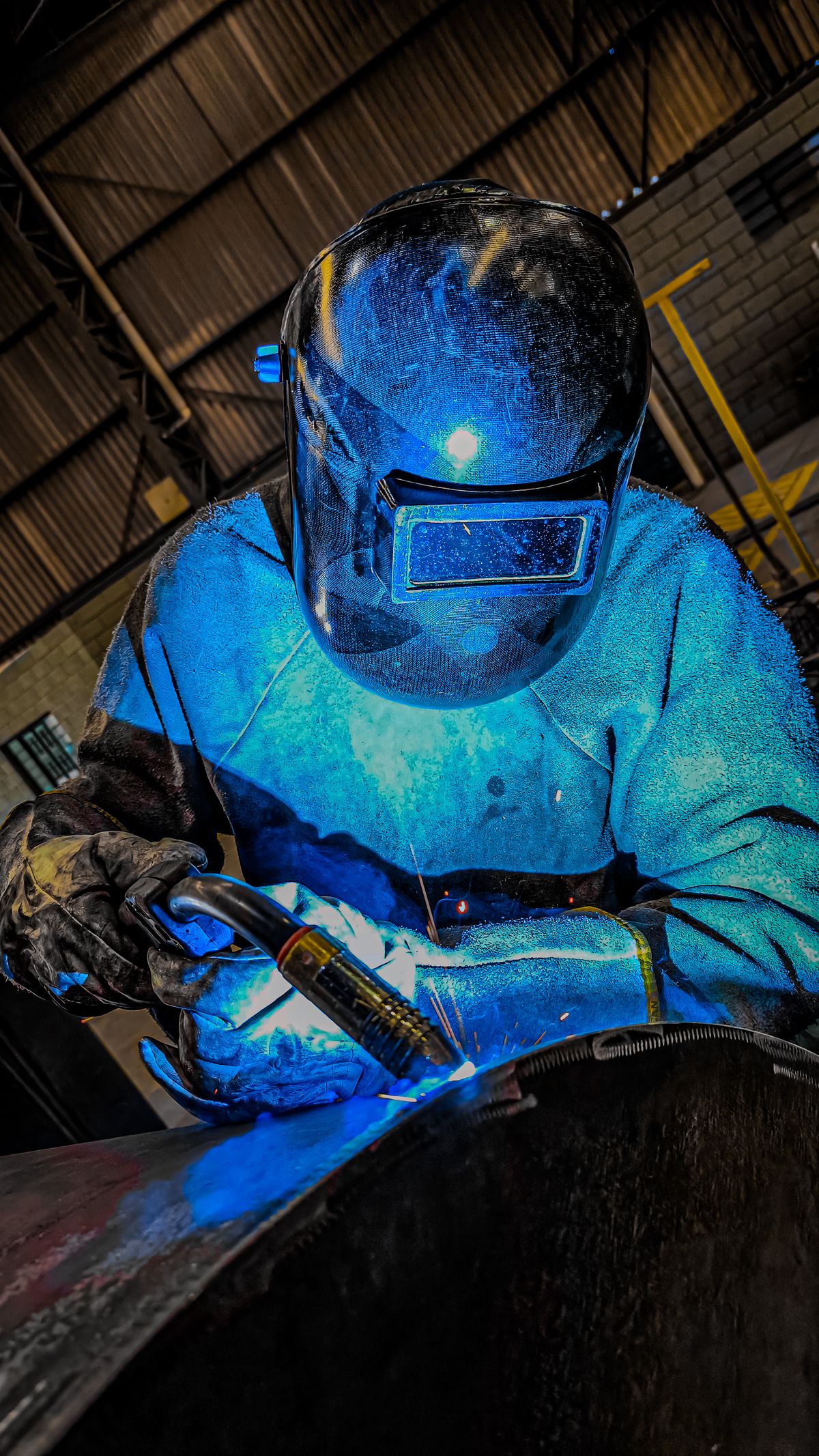
X-raying a tank is like X-raying a leg: the film does not lie. The cracked bone shows up even when the leg looks fine from outside, and the pore hidden mid-weld shows up even when the bead looks flawless. That is the whole point of non-destructive testing (NDT): seeing inside without breaking anything.
On a fuel tank, NDT is not an inspector’s whim: it is the difference between "I trust the welder" and "I have the proof". Here are the four tests we run at Indumor, with what theory says and what the shop floor shows.
Theory: an X-ray or gamma source on one side of the weld, film on the other; internal discontinuities — porosity, slag, lack of fusion — absorb differently and print on the film. API 650 defines how many shots, where, and the acceptance criteria. Shop floor: a certified technician shoots the film, at night or in a cleared area because of radiation, and every film is numbered against the weld map. When a film fails, the joint is repaired and shot again: the standard does not accept "more or less".
Theory: a red liquid of extreme capillarity wets the weld and creeps into any surface-breaking crack; excess is cleaned, a white developer is applied, and the crack "sweats" the dye back out: a red line on white background pointing at the defect. Shop floor: it is the test for nozzles, manways and reinforcements — exactly where geometry defeats radiography — and it is visually undeniable: the developed photo goes in the protocol and anyone understands it, engineer or not.
Theory: a transparent box with a rubber rim sits over each floor seam, vacuum is drawn, and if there is a leak the soapy water underneath bubbles. Shop floor: it is the only practical way to verify an API 650 bottom, because those seams sit on the foundation and cannot be radiographed. Methodical and slow — seam by seam — but the floor is precisely where a leak takes longest to be discovered.
Theory: the tank is filled with water — denser than fuel — and observed: tightness, foundation settlement, overall behavior. Shop floor: it is the moment of truth for the whole project, and the proof that the civil foundation was done right. Only after passing does the tank meet its first liter of diesel.
The framework these tests live in: what API 650 is and what UL 142 is. The concrete application: our fuel storage tank line, where every unit ships with its test protocol. And how to read drawings helps you follow the weld map.
A tank without testing is a promise. With testing, it is a fact.
Ours ship with RT, PT and tightness testing documented.
© Indumor 2010–2026 — Industrial steel fabrication, Córdoba, Argentina
