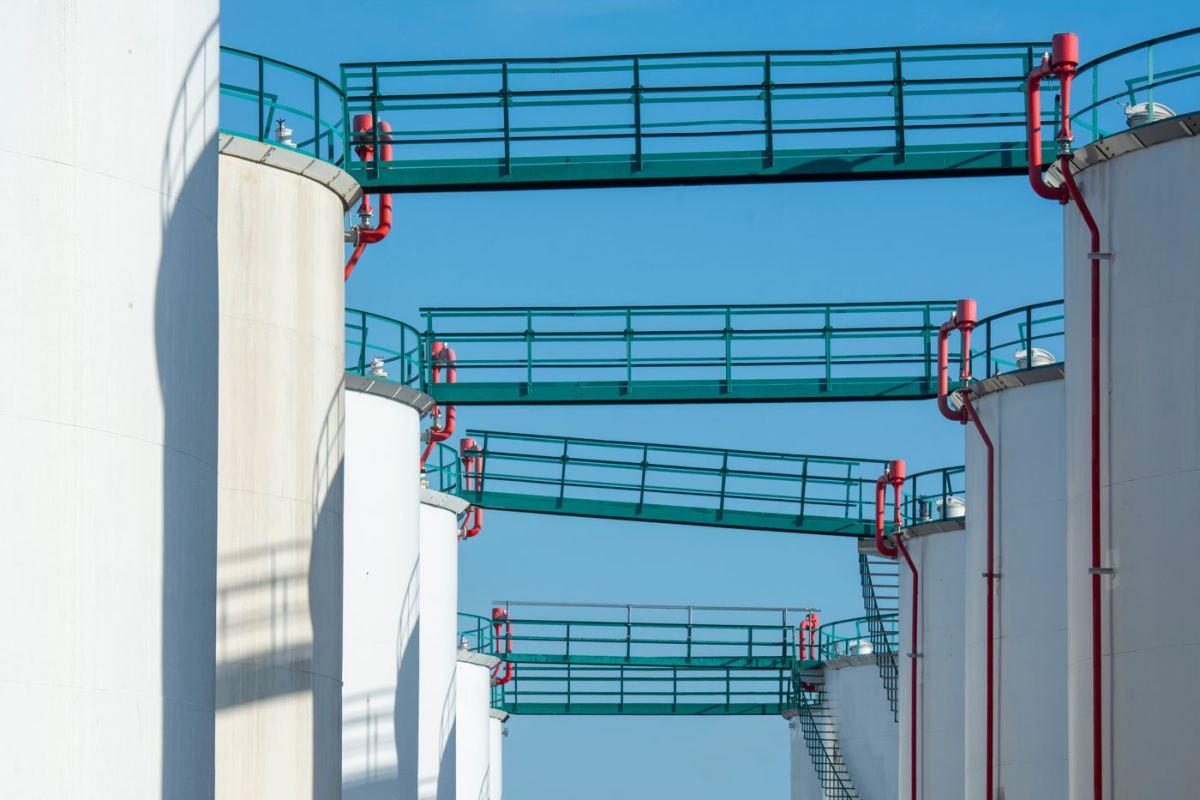
A tank roof is the highest balcony in the plant.
And often the only one without a guardrail. Funny: the tank is designed for millions of liters, and its guardrail, sometimes, for nobody. At Indumor we build the guardrails for tanks — roof perimeter, spiral stair handrail, walkways between tanks and valve and manway platforms — for new tanks and for those already in service, together with the tank, as in our line of fuel storage tanks, or on their own. If the tank is new, order them with it: the post supports are welded in the shop, before painting.
Quote guardrailsThe roof perimeter — or at least around the hatches, vents and gauging area, and along the path from the stair landing —; the handrail on the open side of the spiral stair; guardrails on both sides of every walkway between tanks; and those on valve and manway platforms.
API 650 calls for a 42 in (1,067 mm) top rail with a midrail and a toeboard on platforms and walkways, the same height OSHA requires. In Argentina, Decree 351/79 requires guardrails on any platform with a fall hazard of more than two meters, and Decree 911/96 sets a 1 m top rail with a midrail and a toeboard.
To the tank top angle or onto reinforcing pads, never straight onto the roof plate, which on many tanks is only 5 mm (3/16 in) thick. The roof plate holds off the rain. Not a person falling against the guardrail.
Because the roof perimeter is a circle. A guardrail built from straight sections ends up full of kinks and gaps; rolled to the actual radius of the tank, it follows the edge from end to end. More in curved guardrails.
Yes. But welding on a tank in service requires a hot work permit and a clean, gas-free tank, so wherever possible the guardrail is designed with bolted connections. Before quoting, we survey the tank and where each post can be fixed.
Argentina's Decree 351/79 requires the rim of open containers holding hazardous liquids to sit at least 0.90 m above the floor or work platform; where that is not possible, the whole perimeter gets a sturdy guardrail of that height.
It is supported on the shell and carries the stair rail and handrail on the outer side, which is the open one, rolled to follow the helix. At the top, the landing must tie into the roof guardrail without leaving gaps.
They get guardrails on both sides and have to let each tank move on its own, from settlement or thermal expansion: that is why one end is free or sliding, never rigid at both ends.
At least once a year: the base of every post, the bolts and the condition of the paint or galvanizing. A tank guardrail lives outdoors, sometimes in product vapors, and rust always starts at the bottom.
Hot-dip galvanizing, or the same coating system as the tank so they age together. In corrosive environments, stainless steel.
We build them to the same criteria as the rest of our guardrails: 1-1/2 in tube, a midrail halfway up, a 4 to 6 in toeboard and posts every 1.5 to 2 meters around the perimeter. For the full standards detail, see our guide to guardrails on tanks.
Send us the diameter, the height and photos of the roof, and we will quote the guardrails. Or email tecnica@indumor.com.
© Indumor 2010–2026 — Industrial steel fabrication, Córdoba, Argentina
