October 19, 2026 · Indumor
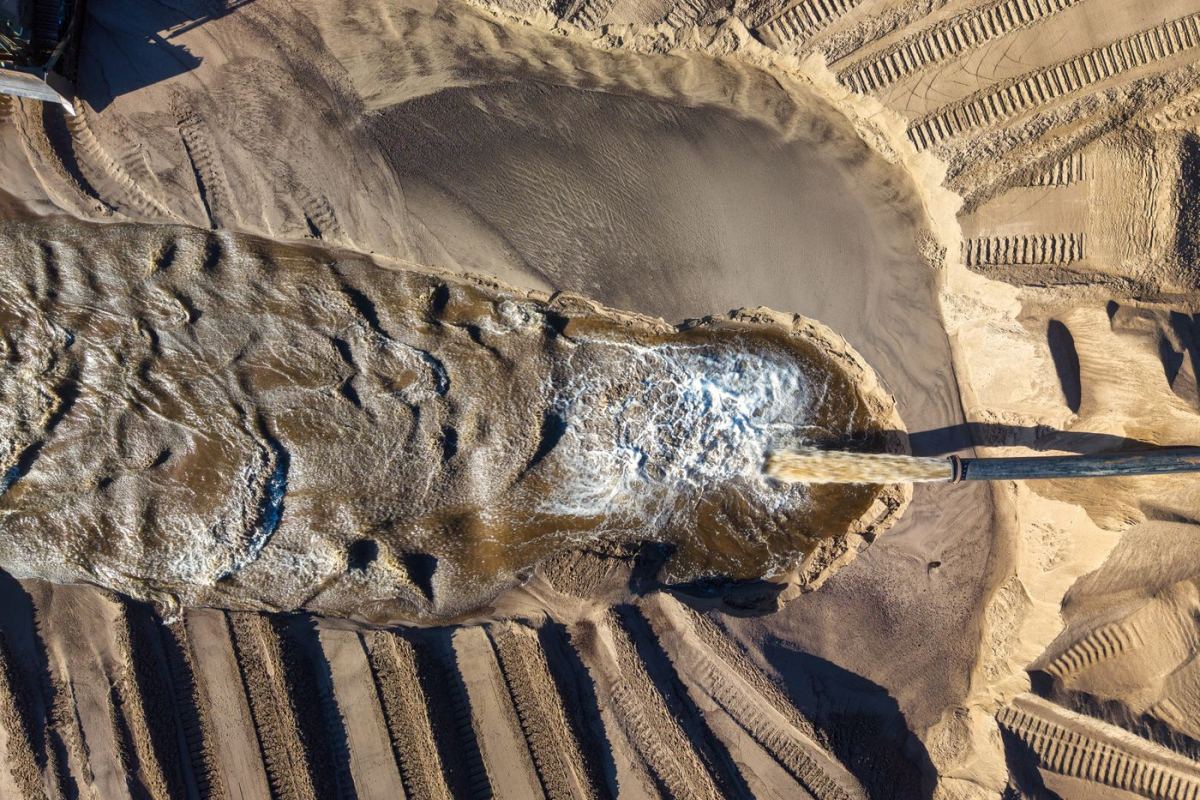
How much water rides hidden in a truckload of sand? If the sand leaves the plant at 6% moisture, a 30-tonne truck carries almost two tonnes of water. Water you pay freight on, that weighs on the road and that, depending on where it ends up, is either a problem or nobody’s concern. That question, which sounds like logistics, decides how a frac sand plant is laid out and what place the dryer takes in it.
Sand is the bulkiest input in Vaca Muerta, Argentina’s shale play. In June 2026 the basin pumped more than 600,000 tonnes of it in a single month, averaging 92 frac stages a day, and industry estimates put demand rising from about 5.5 million tonnes in 2025 to 7 or 8 million by 2027. Every one of those tonnes goes through a plant that washes it, sizes it and, in most cases, dries it. Here are the seven keys to that process.
Frac sand is not just any sand. It sells by grade — in Vaca Muerta the most used are 100 mesh and 40/70 — and it must pass tests for roundness, sphericity, crush resistance and fines content under API RP 19C (equivalent to ISO 13503-2). Sizing it means running it over screens, and screens work well on dry grain: with wet sand, fines stick to the coarser grains, the cloth blinds and the cut drifts.
Dry sand also flows. It runs freely through hoppers and silos, can be conveyed pneumatically and is metered precisely into the blender that mixes it with frac fluid on location. Wet sand bridges, sticks to walls and demands equipment built for it.
The typical route has five stops. First, extraction, from a pit or from dunes. Then washing and attrition scrubbing, which strip clay and fines from the grain; some plants process on the order of a hundred tonnes per hour of raw sand at this stage alone. Third, dewatering, which leaves the sand as dry as possible before the dryer, because every point of water removed by draining is a point you do not evaporate with gas. Fourth, drying. And fifth, screening and silo storage, from which the sand ships by truck, by rail or in bulk bags to the well sites.
For years, much of that sand reached Neuquén from far away: from Entre Ríos, Chubut, Mendoza and even overseas. Today local sand is growing, with processing and drying plants in Añelo, San Patricio del Chañar and Allen, across the line in Río Negro. The reason is simple: at hundreds of thousands of tonnes a month, every kilometer of freight shows up in the cost of every well. In sand, geography is paid by the tonne.
Two families of equipment dry sand. The rotary dryer is the most common: a slowly turning steel drum whose flights lift the sand and drop it through a stream of hot gas, usually in counter-current flow to reach very low final moisture. The fluid-bed dryer blows hot air upward through a layer of sand that behaves almost like a liquid; it is compact and very efficient with uniform grain, but more sensitive to changes in gradation and inlet moisture. Either way the goal is the same: sand reaching the screens at very low moisture, half a point or less, or whatever the customer specifies.
Silica sand is abrasive, and that shapes how the dryer is built: wear plate in the feed box and the first section of the drum, bolted flights that can be swapped without cutting the shell, and dust collection — cyclone and baghouse — that also recovers fines that can go back into the product or be sold separately. How the drum is sized, with its water balance and design choices, is on our rotary dryers page.
Drying sand is, at heart, evaporating water with natural gas, which Vaca Muerta has in abundance but not for free. The math is straightforward: from 6% inlet moisture to half a point at the outlet, every ten tonnes of wet sand leave about 550 kilograms of water to evaporate. Add the heat carried off by the sand itself, which leaves hot, and what escapes through the stack and the dryer walls. That is why prior dewatering, insulation on the drum and ducts, and a burner controlled on exhaust gas temperature are the three levers that cut fuel per tonne the most. None of the three is new. All three get forgotten.
In recent years a different path has appeared: pumping wet sand. The sand is washed, dewatered and shipped at up to 6% moisture, skipping the drying kiln. Gas is saved, the emissions from burning it are avoided and the plant gets simpler. In exchange, sizing has to be done wet, handling at the well site needs equipment built for a material that does not flow like dry sand, and the water rides in the truck. Not every operator uses it, and both approaches coexist in the basin.
For a fabricator, that means one thing: the dryer is no longer a given, so it has to earn its place with numbers — quality, logistics and cost per tonne delivered to the well. What used to be a process step is now a business decision.
A frac sand plant is, to a large extent, steel. Receiving and feed hoppers; belt conveyors and their structures; bucket elevators; screen structures and walkways; the dryer with its burner or furnace, cyclone, baghouse and ductwork; product silos holding hundreds of tonnes; and truck or rail loadout structures. All of it handling an abrasive material in wind and dust. Bolted connections for erection, wear protection at transfer points and safe access for maintenance matter as much as the structural design: a plant you cannot maintain is a plant you cannot run.
In short: dry sand is still the core of the business, but today the dryer has to earn its place with numbers, and that starts with a sound water and gas balance. If you are building or expanding a sand plant, at Indumor we help size the dryer and fabricate the steel for the whole line, from our plant in Córdoba, Argentina.
We size the dryer and fabricate hoppers, conveyors, structures and silos for the whole line.
© Indumor 2010–2026 — Industrial steel fabrication, Córdoba, Argentina
