October 26, 2026 · Indumor
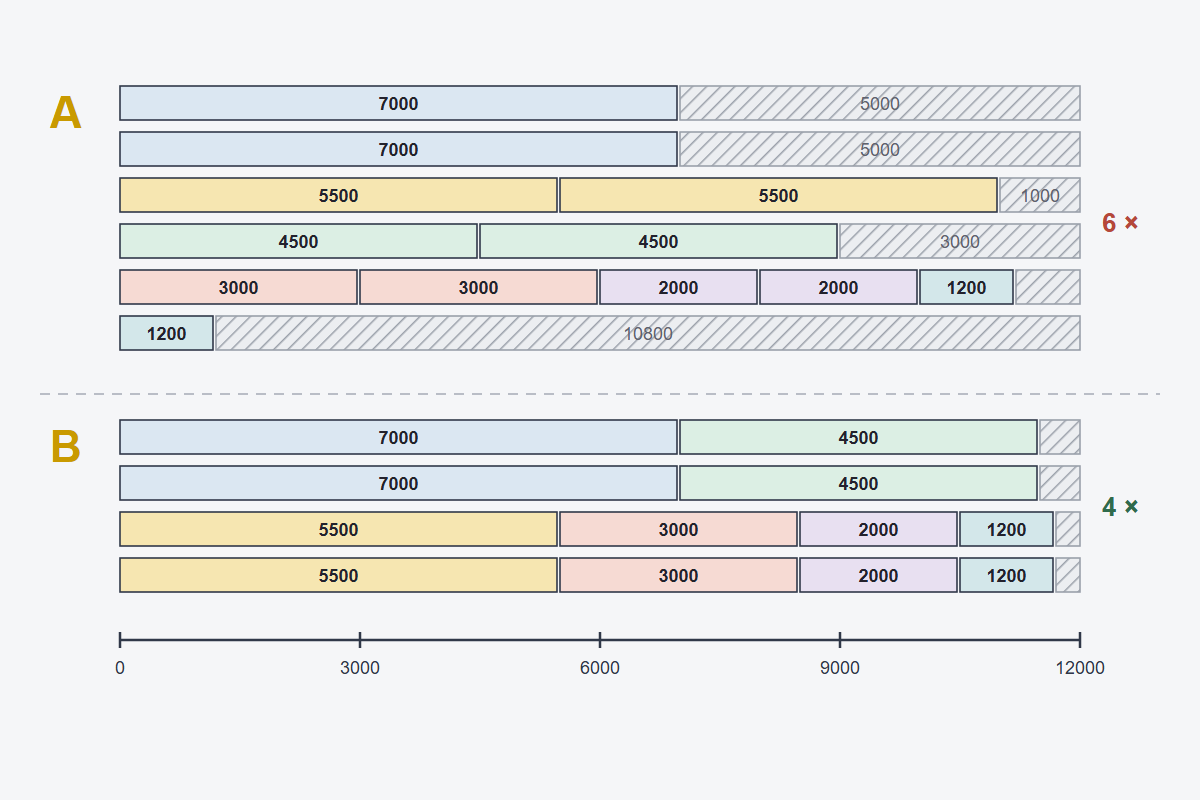
The same twelve pieces, 46,400 mm in total, cut from 12,000 mm bars. A: in list order it takes six bars. B: an optimized layout needs four. Hatched areas are offcuts.
The cut list usually arrives the way the designer wrote it: columns first, then beams, bracing last. The saw operator takes a 12-meter bar, cuts a 7-meter piece and leaves the rest “for later.” By the end of the month the offcut corner is full of good intentions, all of them 5 meters long and none the length anybody needs.
Before sorting anything, it pays to know what length you start from, and not everything comes in 12 meters. According to distributors' catalogs in Argentina, IPN beams over 100 mm come in 12 m and smaller ones also in 6; UPN channels up to 120 are available in 6 and 12. Structural tubes come in 6 m, angles up to 2¼" and narrow flat bar also in 6, and pipe for conveying fluids in 6.40 m. Rebar comes in 12.
The problem has a name and a fair amount of history: it is the one-dimensional cutting stock problem. The Soviet mathematician Leonid Kantorovich posed it in 1939, and in 1961 Gilmore and Gomory published the linear-programming method still in use. The shop rule, though, fits on one line: cut the longest pieces first and put each one in the first bar where it fits. It does not give the exact optimum, but it gets close, because the long pieces go in while the bars are still whole and the short ones fill the gaps.
In the example above, cutting in list order uses 72 meters of bar for 46.4 meters of pieces, and a third ends up as offcuts. Sorted, 48 meters are enough and offcuts drop to about 3%. In IPN 200, at 26.2 kg per meter, the difference is more than 600 kilos.
Every cut also eats material. A 355 mm abrasive disc takes 3 mm; a cold circular saw, 2 to 3 mm; a band-saw blade, somewhat more than its 0.9 to 1.6 mm body, because the teeth are set. Ten cuts with a disc are 3 centimeters that never come back.
There is no universal minimum length for keeping an offcut, and keeping everything has a cost: space, time to find it and the risk of grabbing the wrong section. In our shop, an offcut that goes back to the rack gets the section and length written on it in chalk; otherwise, a week later nobody knows what it is. The sensible rule is to keep what will really be used on upcoming jobs and send the rest to scrap without guilt.
If you have a structure to fabricate, at Indumor we quote it with the parts list already sorted for cutting.
Share it and we will quote it with the cutting already sorted.
© Indumor 2010–2026 — Industrial steel fabrication, Córdoba, Argentina
