October 21, 2026 · Indumor
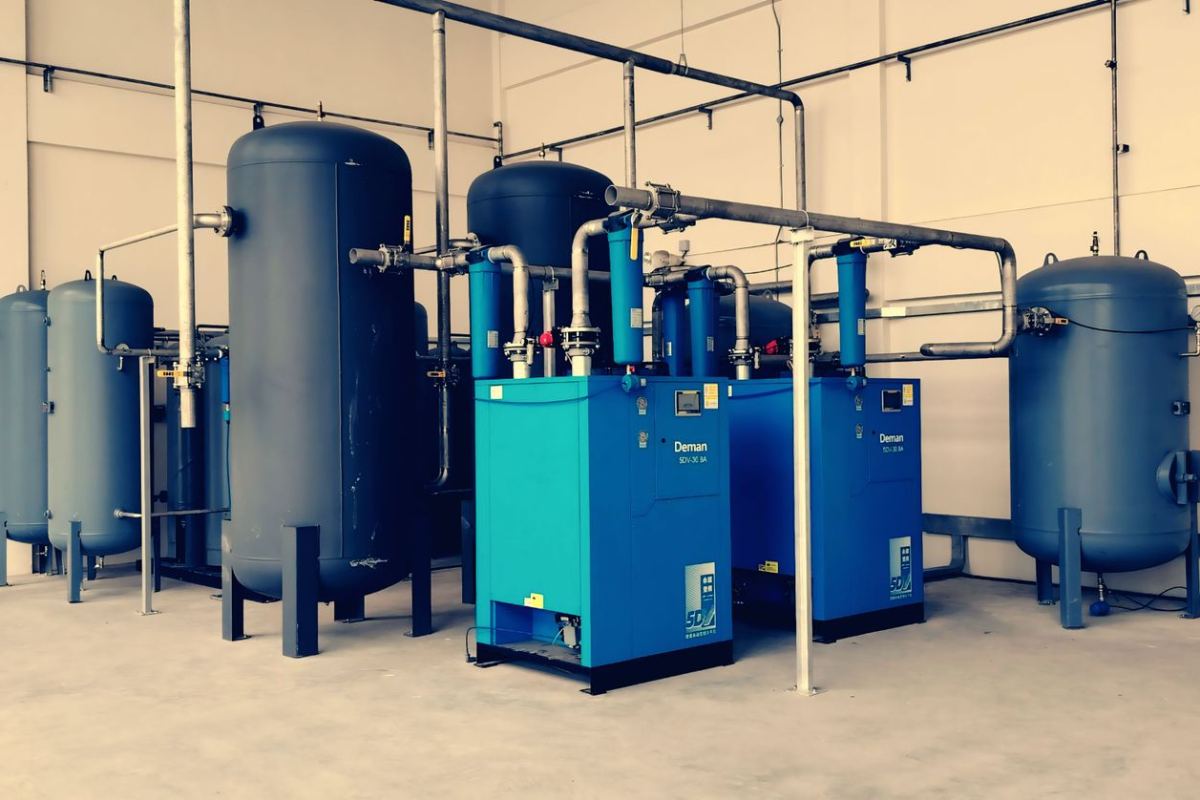
Who holds up a pipe? The quick answer is “the pipe rack.” The right one is longer: a family of supports, each with a different job, that let the pipe move where it has to and stop it where it must not. Most problems in a line — leaking flanges, misaligned pumps, pipes walking off their supports — start when someone confuses one with another.
Steel expands about 1.2 mm per meter for every 100 °C (roughly 0.8 in per 100 ft per 100 °F). On a fifty-meter steam line, that is several centimeters the pipe is going to look for no matter what. The supports decide where it goes. These are the seven types worth knowing.
Around those seven there are several accessories: clamps, saddles for large pipe, welded trunnions and dummy legs at elbows. Reference standards such as MSS SP-58 for hangers and supports define types, materials and loads.
Spacing, first. There are reference tables — ASME B31.1 has one — but they are a starting point: actual spacing depends on diameter, wall thickness, what the pipe carries and the valves and flanges that add concentrated weight. Then, at equipment: a pump is not a support. If the piping hangs off its nozzle, the pump goes out of alignment, vibrates and wrecks seals; that is why supports near equipment are designed to keep nozzle loads within what the manufacturer allows. And finally, in the field: the support someone held together with baling wire to finish the line lasts exactly until the first hot startup.
The pipe does not move when you want it to. It moves when the temperature goes up.
On hot lines, or lines connected to equipment, the type and location of each support come from a flexibility analysis: a calculation, done in software today, that simulates how the line moves with temperature and what loads it leaves on each support and each nozzle. On cold, simple lines, spacing tables and judgment are often enough. Either way, friction has to be remembered: a sliding pipe pushes on the beam, and that push, around 30% of the weight steel on steel and much less with PTFE, gets designed for too.
Two cases need special attention. Insulated cold lines, which need supports with insulating blocks so the pipe does not touch the support steel and no condensation or ice forms. And lines near reciprocating compressors or vibrating pumps, where the support does not just hold: it also restrains, so vibration does not end up cracking a weld.
A support is a small part that works like a big one. It has its drawing, its material, its welding and its finish — often galvanized, because it lives outdoors — and it should reach the site tagged with the line number and its location, so it does not end up somewhere else. Spring supports come from the factory set to their load, with a travel stop that is removed only after the hydrostatic test, when the line is about to go into service; if nobody removes it, the spring does not work. And a support is structure too: the load it delivers has to reach a beam or a foundation designed for it, and a support welded to whatever happened to be nearby can overload a member nobody checked.
The next time you see a pipe resting on a brick or hanging from a wire, you will know which job nobody is doing. If you need equipment and pipe supports, we build them at Indumor, to drawing and with the finish the plant calls for.
Send us the isometric or the support list and we will quote it to drawing.
© Indumor 2010–2026 — Industrial steel fabrication, Córdoba, Argentina
