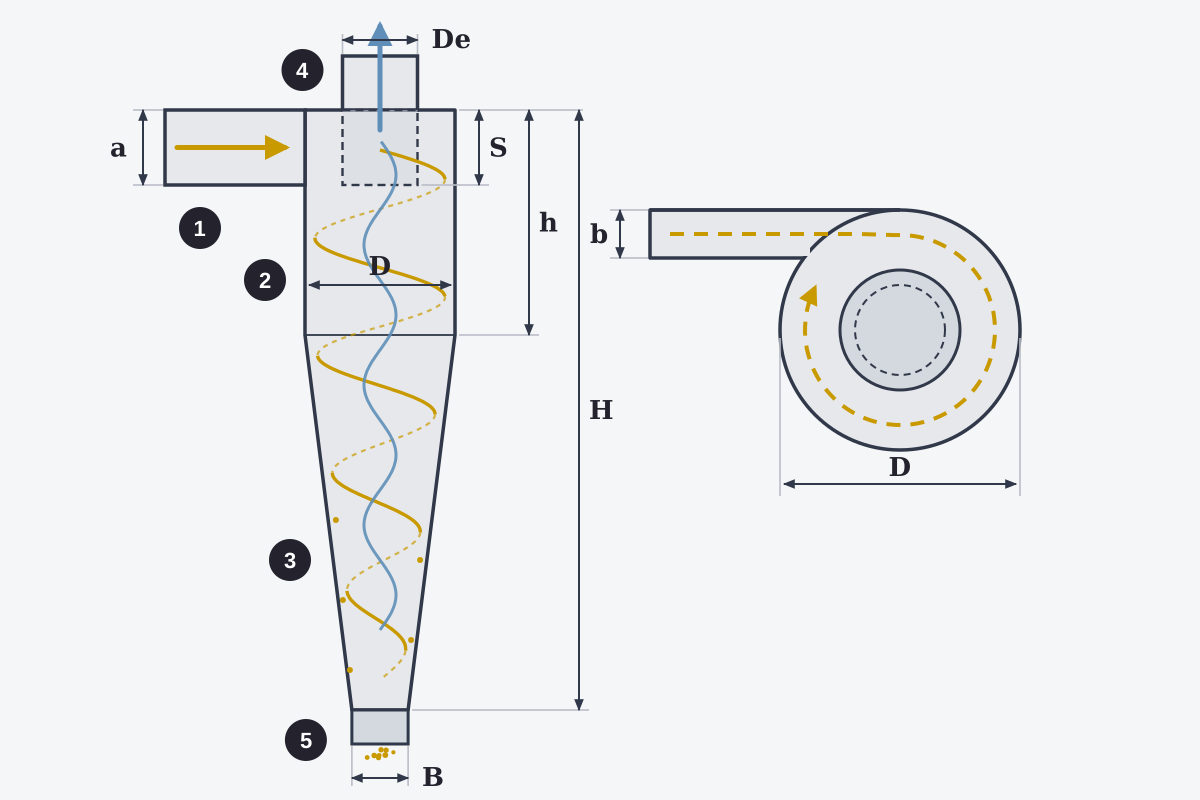
1 Tangential inlet · 2 Body · 3 Cone · 4 Outlet tube (vortex finder) · 5 Dust discharge
A washing machine does it every day. In the spin cycle the drum turns so fast that the water is flung against the wall and out through the holes, while the clothes stay inside. A cyclone does something similar with air: it forces it to spin, and the dust particles, heavier than the air carrying them, are flung against the wall, lose speed and fall.
At Indumor we build custom cyclone separators, on their own or as a pre-cleaner ahead of a baghouse filter, in carbon or stainless steel.
Quote a cycloneAir enters from the side, tangent to the body, and spirals down along the wall: that is the outer vortex. In the cone it narrows, spins faster and faster and, near the bottom, turns around: it rises through the center in a tighter inner vortex and leaves through the tube at the top, which reaches down into the body precisely so that incoming air does not short-circuit straight to the outlet. Dust that reached the wall slides down the cone to the discharge.
Two numbers rule. The inlet velocity, usually between 15 and 22 m/s (about 3,000 to 4,300 fpm): below roughly 12 m/s the cyclone loses efficiency, and above roughly 25 m/s the dust starts to wear the plate and get picked up again. And the pressure drop, which ranges from half a kilopascal to about 2.5 kPa (2 to 10 in. w.g.) depending on the design, and which the fan has to overcome.
A cyclone is very good with coarse dust and weak with fine dust. According to the US EPA, high-efficiency cyclones capture 80 to 99% of total particulate, but only 20 to 70% of particles below 2.5 microns. With chips, coarse sawdust, grain and coarse mineral dust it works very well and needs almost no maintenance, because it has no moving parts.
Asking a cyclone to catch welding fume is barking up the wrong tree: fume is made of particles so small that they go straight through and out the top without ever noticing they were in a cyclone. That is why, for fine dust or wherever an emission limit applies, the cyclone works as a pre-cleaner: it takes out the coarse and abrasive dust and lightens the load on the baghouse behind it.
A cyclone's proportions are not made up: there are classic designs, tested decades ago, that set every dimension as a fraction of the body diameter. Stairmand's high-efficiency design has a narrower inlet and a smaller outlet tube: it catches finer particles at the cost of more pressure drop. The high-throughput design opens up the inlet and outlet to move a lot of air with a smaller unit, and lets more fine dust through. Lapple's general-purpose design sits in between.
| Dimension / D | Stairmand high efficiency | Stairmand high throughput | Lapple |
|---|---|---|---|
| Inlet height (a) | 0.5 | 0.75 | 0.5 |
| Inlet width (b) | 0.2 | 0.375 | 0.25 |
| Outlet diameter (De) | 0.5 | 0.75 | 0.5 |
| Outlet tube length (S) | 0.5 | 0.875 | 0.625 |
| Body height (h) | 1.5 | 1.5 | 2.0 |
| Overall height (H) | 4.0 | 4.0 | 4.0 |
| Dust outlet (B) | 0.375 | 0.375 | 0.25 |
When the airflow is very large, several smaller cyclones in parallel beat one giant cyclone: at the same inlet velocity, a small cyclone separates finer particles than a large one.
Before fabrication comes the preliminary sizing: diameter, proportions, estimated efficiency and pressure drop. You can try it yourself in our Engineering Suite's cyclone calculator (in Spanish). And if you are torn between a cyclone and a filter, our Knowledge Hub explains when each one makes sense.
It depends on particle size and on the design. A high-efficiency cyclone can capture about 90% of 5-micron particles, but little of what is below 2.5 microns. That is why efficiency is estimated from the dust's particle-size distribution, not from a catalog figure.
For chips, coarse sawdust, grain or coarse mineral dust, often yes. For fine dust, welding fume or wherever an emission limit applies, no: the cyclone goes first, as a pre-cleaner, and a baghouse goes after it.
The cyclone loses much of its efficiency: air coming in from below picks up the dust that was already separated and sends it to the outlet. The discharge has to be airtight, with a rotary airlock or a double flap valve.
The particle-size distribution — how much of each size there is — tells you whether a cyclone is enough, whether it needs a filter behind it, or whether you should go straight to the filter. It is worth more than any catalog.
© Indumor 2010–2026 — Industrial steel fabrication, Córdoba, Argentina
