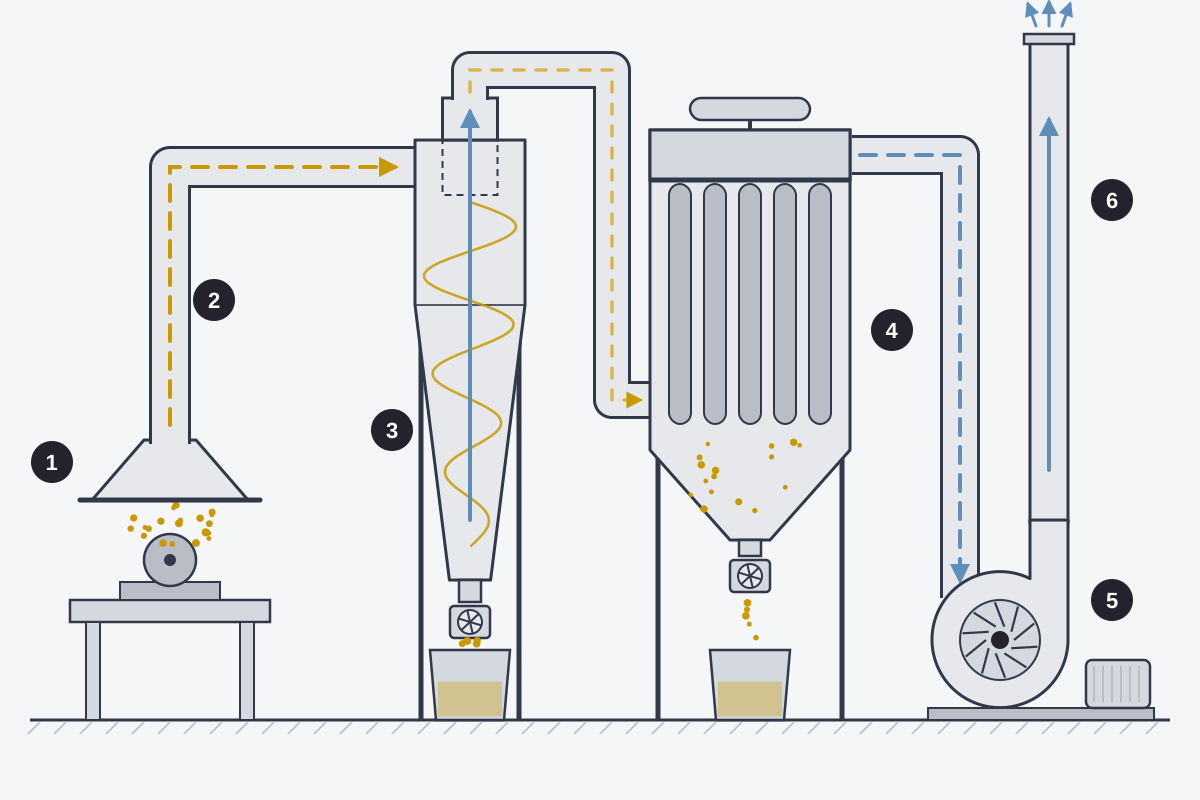
1 Hood · 2 Duct · 3 Cyclone · 4 Baghouse filter · 5 Centrifugal fan · 6 Stack
Dust you can see in the air has already escaped.
By the time someone sees it floating against the light, it has already been through the lungs of the people working there, got into the electrical panels and settled on the beams, where nobody cleans. We know it well in our own shop: every time we cut with an abrasive disc, a fine grey dust rises and ends up on the steel overhead, twenty feet off the floor.
A dust collection system catches it earlier, where it is generated. At Indumor we design and build the whole system or any part of it: hoods and ductwork, cyclones, baghouse filters, fans and the structures that carry them.
Quote a systemA dust collection system is a chain, and it works only as well as its weakest link. The hood has to sit close to where the dust is born, because suction fades very quickly with distance: moving it twice as far away takes almost four times the airflow to catch the same dust. The duct has to carry the air at a minimum velocity that depends on the dust; for ordinary industrial dust it is around 18 to 20 meters per second (3,500 to 4,000 fpm), and below that the dust settles inside and the duct plugs itself. The separator — a cyclone, a baghouse or both — takes the dust out of the air. And the fan has to move that airflow against the sum of all the losses.
That is why we calculate it as one system: the airflow at each hood, the velocity in each run, the pressure losses and, only at the end, the fan's operating point. Choosing the fan first and then seeing what can hang off it is the fastest way to end up with hoods that don't pull. Once the system is installed, duct velocities and hood static pressures are measured and compared with the design.
What we build for the system:
Watch out for combustible dust. Flour, sugar, wood, plastics and metals such as aluminum can explode inside a collector. In those cases the system is designed with explosion venting and isolation under NFPA 660 — which replaced the old NFPA 652, 654 and 664 —, NFPA 68 and NFPA 69. And aluminum dust never goes into the same collector as steel grinding dust.
Want a feel for the numbers before asking for a quote? Our Engineering Suite has free calculators (in Spanish) for the cyclone, the baghouse and the fan.
What dust or fume is generated and how much, how many machines or workstations there are and where, how many hours they run, the air temperature and humidity, whether the dust is combustible, and where the filter and the fan can go.
It depends on the dust. For chips, coarse sawdust or grain, often yes. For fine dust, welding fume or wherever an emission limit applies, the cyclone works as a pre-cleaner and a baghouse goes after it.
Yes, but first we measure what is there. Adding a hood to a system already running at its limit steals airflow from all the others: sometimes rebalancing the dampers is enough, and sometimes the pulley, the motor or the fan has to change.
Tell us what dust or fume you have, where it is generated and how many workstations there are, and we will engineer the whole system.
© Indumor 2010–2026 — Industrial steel fabrication, Córdoba, Argentina
