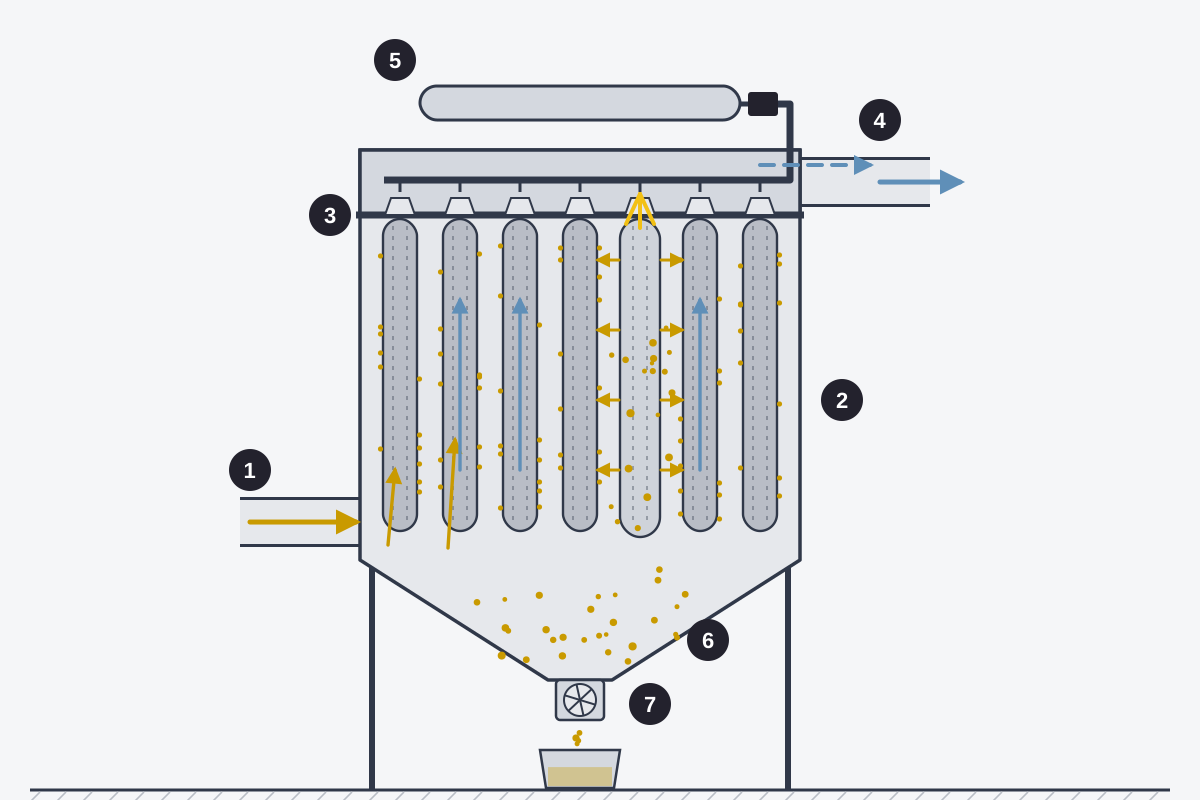
1 Dusty air inlet · 2 Bags on cages · 3 Tube sheet · 4 Clean air outlet · 5 Compressed air for the pulses · 6 Hopper · 7 Rotary airlock
A well-designed baghouse captures more than 99% of the dust that reaches it, and new units reach 99.9%. The surprising part is who does much of the work: not the cloth alone, but the layer of dust that builds up on it. That is why a filter is never cleaned completely: it is cleaned just enough to keep the air flowing.
At Indumor we build baghouse filters cleaned by pulses of compressed air, sized for each plant's airflow and dust.
Quote a baghouseThe air-to-cloth ratio. It is the speed at which air crosses the cloth, in cubic meters per minute per square meter (or cfm per square foot). There is no single figure: for pulse-jet filters with felt bags, the EPA gives design values from about 1.5 m/min (5 ft/min) for very fine dusts to more than 4 m/min (14 ft/min) for grain, and with fine dust many manufacturers run well below that. A bag 160 mm (6.3 in.) across and 3 m (about 10 ft) long has 1.51 m² (16.2 ft²) of cloth: the airflow says how many you need.
Fabric for the temperature. Polyester up to about 135 °C (275 °F); polypropylene up to about 93 °C (200 °F), but highly resistant to acids and alkalis; PPS up to about 190 °C (375 °F); meta-aramid, 190 to 204 °C (375 to 400 °F); fiberglass and PTFE, 230 to 260 °C (450 to 500 °F). An expanded-PTFE membrane catches fine dust better, but the temperature limit is still set by the fabric underneath.
The dew point. If the gas cools below its dew point, water or acid condenses on the bags and plugs them within minutes or hours. That is why the housing and ducts are insulated, and the filter is warmed up before dust arrives.
Cleaning. A pulse of compressed air lasting a tenth of a second or less blows each bag from the inside, with the filter on line. The air has to arrive clean, dry and at pressure, on the order of 4 to 7 bar (60 to 100 psig).
The hopper. Don't do this: use the hopper as a storage bin. Accumulated dust packs, bridges and ends up back on the bags. The hopper has to discharge continuously, through an airtight rotary airlock, and its walls have to be steep: about 60° is common practice.
Sparks. In grinding, cutting or foundry work, a spark that reaches the bags burns them. A drop-out box or a pre-separator goes ahead of the filter to stop it. And aluminum dust never goes into the same filter as steel dust.
Combustible dust. Wood, flour, grain, plastics and fine metals can explode inside the filter. It is designed under NFPA 660 — which replaced NFPA 652, 654 and 664 in December 2024 —, with vent panels that discharge to a safe area (NFPA 68) and isolation of the ducts (NFPA 69).
The differential pressure gauge. It is the filter's dashboard: if pressure keeps rising, the bags are blinding or cleaning is failing; if it drops suddenly, a bag has torn or the airflow has fallen.
To go deeper: when a cyclone makes sense and when a baghouse does, how the whole system is sized and how industry went from a 70-foot cotton bag to the air pulse. For a first estimate, the Engineering Suite's baghouse calculator (in Spanish) works out the bags, the tube sheet and the compressed air.
It depends on the dust, the temperature and the cleaning. The US EPA puts typical bag life at 2 to 4 years; with an aggressive dust or the wrong fabric it can be much shorter. The differential pressure gives warning before they fail.
According to the EPA, on the order of 1 to 2.5 kPa (4 to 10 in. w.g.) across the baghouse; in normal service many run between 0.5 and 1.5 kPa (2 to 6 in.). The fan is chosen with that figure.
If the dust is not combustible, yes. If it is, indoors it needs explosion protection: venting ducted safely outdoors or flameless venting, suppression and isolation. Often it makes more sense to put it outside.
Tell us what dust you have, how hot it comes off the process and how much air has to move, and we will size it with the right fabric and cleaning.
© Indumor 2010–2026 — Industrial steel fabrication, Córdoba, Argentina
