October 19, 2026 · Indumor
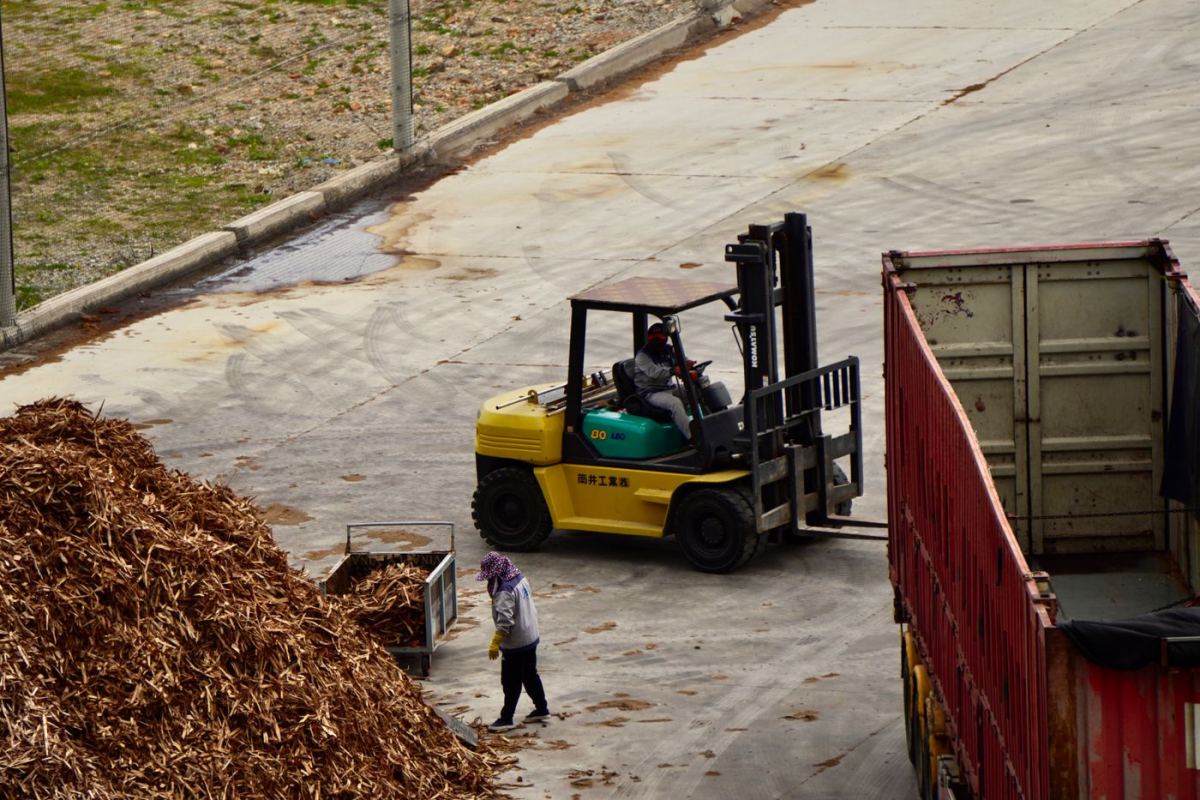
People assume a wood-fired dryer is an old-fashioned dryer: dirty, hard to control and needing someone to throw logs on all day. It is the other way around. A well-designed biomass furnace feeds itself, controls combustion air, separates sparks and ash before they reach the product and holds temperature with precision that gives nothing away to a gas burner. Wood is not the problem. When there is a problem, it is the furnace.
The yerba mate and tobacco dryers of northern Argentina have burned wood for generations, and the industry learned the hard way what works and what does not. Today the question is no longer whether you can dry with biomass, but how that heat gets to the dryer: directly or through a heat exchanger.
A combustion chamber lined with refractory. A grate — fixed for firewood, moving for chips or husks — where the fuel burns. A feed system, manual on wood-fired units and screw-fed for chips, husks or pellets. Two air inlets: primary air under the grate and secondary air above it, to finish burning the gases so no black smoke leaves. A settling chamber or cyclone that catches sparks and fly ash. And a dilution air inlet that blends combustion gas with fresh air down to the temperature the dryer needs. All of that, in steel and refractory, is what separates a furnace that runs steady from one you have to babysit.
Control closes the loop. A temperature sensor at the dryer inlet drives the feed screw speed and the air dampers: if temperature climbs, less fuel and more dilution air go in; if it drops, the reverse. On wood-fired furnaces, where loading is manual, the fine adjustment comes from the air, and the operator only has to keep the grate stocked.
| Direct-fired | Heat exchanger | |
|---|---|---|
| How it works | Combustion gas, blended with air, enters the dryer | The gas heats tubes; clean air bound for the dryer flows over them |
| Heat use | The maximum: all the heat enters the process | Lower: part of it leaves through the exchanger stack |
| Contact with the product | Smoke touches the product | The product only sees clean air |
| Cost and upkeep | Simpler and cheaper | More steel, and tubes to clean of soot and ash |
| Suited to | Minerals, sand, biomass for fuel pellets | Food, feed, fruit and anything sensitive to smoke |
The verdict: if the product allows it, go direct-fired, because it uses all the heat and the equipment is simpler. If the product gets eaten — by people or by animals — use a heat exchanger, no argument: fuel savings never make up for a product that smells of smoke or carries combustion residue. In the in-between cases, such as some white minerals, the ash decides: if it cannot mix with the product, choose an exchanger or a cleaner fuel.
Firewood is the most available and the hardest to automate: it needs someone to stoke the furnace, and its moisture changes from day to day. Chips and husks are screw-fed and automate well, although some, like rice husk, leave a lot of ash. Pellets are the most uniform and the cleanest, and also the most expensive per tonne. In nearly every case, the best biomass is whatever is already at the plant or in the region: bark, prunings, fruit pits, rejects. The alternatives, with heating values and an insulation calculation, are on our rotary dryers page and its related guides.
Do you have biomass on hand and a dryer that burns gas or diesel today? Tell us what fuel you have and what product you dry, and at Indumor we will tell you whether a direct or an exchanger-fired furnace fits, and how much you can save.
We build the furnace, the heat exchanger and the dryer around the fuel you have.
© Indumor 2010–2026 — Industrial steel fabrication, Córdoba, Argentina
