October 21, 2026 · Indumor
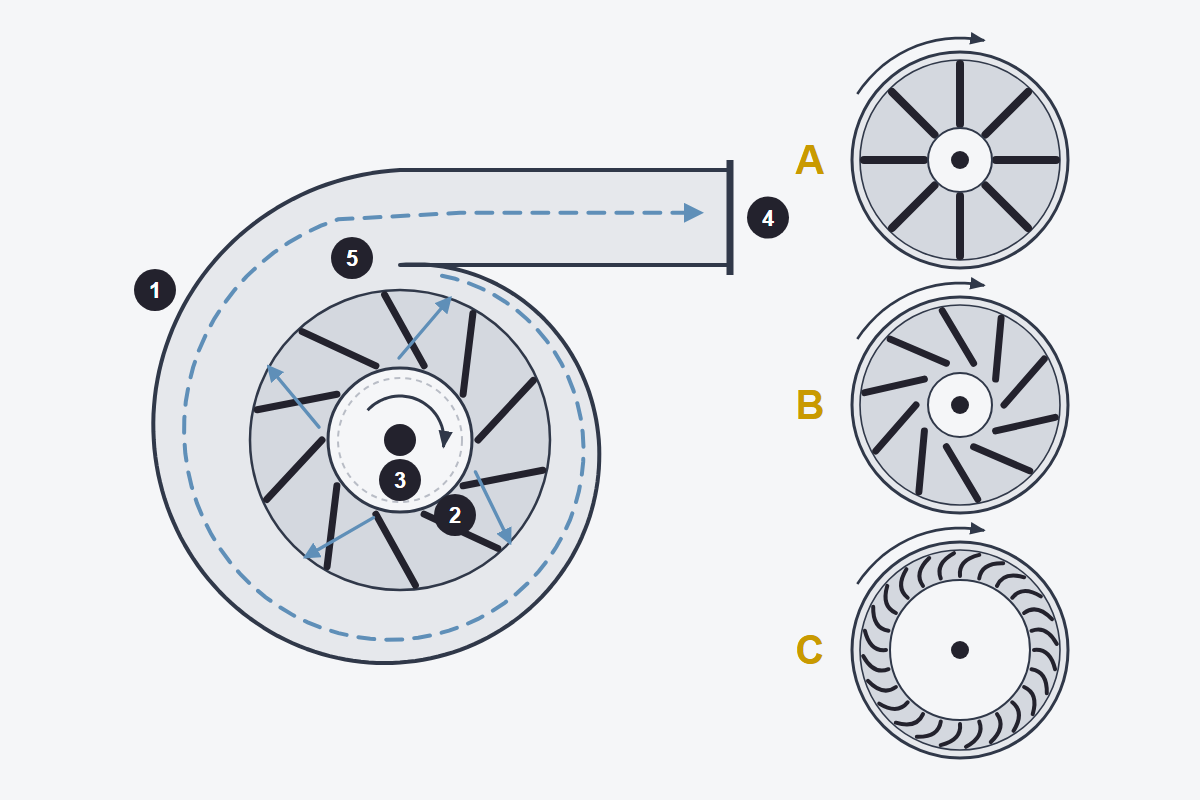
Choosing a centrifugal fan impeller is a lot like choosing tires for a pickup. Highway tires are quiet and easy on fuel, but they spin in the mud. Mud tires go anywhere, and on the highway they are loud and thirsty. Impellers are the same, and the mud is dust: some impellers put up with anything and some save energy every single day, but none does both well. Here are the nine keys to choosing.
Position is decided before the impeller. If the fan sits ahead of the filter, all the dust goes through it. If it sits after, it moves clean air. That one decision picks half the fan, and that is why, whenever possible, the fan goes on the clean side: the US EPA points this out precisely because it allows the more efficient impeller. It is also the cheapest decision to get right at the start: moving the fan later means new ducts, a new base and often a new motor.
Straight blades that run out from the center like the spokes of a wheel. It lets dust, chips and even scraps of metal through without snagging, fouls very little and delivers high pressure at low flow. It is the toughest. It is also the least efficient centrifugal type. It goes where the air is dirty, or where the fan itself conveys material.
Blades curved at the inlet that end straight at the tip. They reach efficiencies of around 75% and tolerate a moderate dust load and humid air. They are a good option when the fan sits after a cyclone, which has already taken out the coarse dust but let the fines through.
Blades that lean against the rotation: flat, curved or airfoil. They are the most efficient; manufacturers' catalogs claim peaks of roughly 80 to 90% depending on the profile, and the number that counts is the one on each fan's certified curve. They also have a welcome virtue: their power draw does not overload the motor even when the system changes. The problem is dust. It sticks to the blades, unbalances the impeller and, on airfoil blades, wears them down. Single-thickness blades tolerate some light dust; airfoils, none. They go after the filter.
Many short blades curved with the rotation, as in air-conditioning units. They are compact and quiet, run at about 55 to 65% efficiency and are meant for clean air at low pressure. Their power climbs with airflow until it overloads the motor, and dust clogs them. In industrial dust collection, no.
On a given fan, airflow rises in proportion to speed, pressure with the square of speed and power with the cube. Ten percent more speed takes 33% more power. Every time. That is why “bumping up the pulley a bit” so the hoods pull harder often ends with a motor running hot. And the laws apply to the same fan, or to a geometrically similar one: they cannot compare two different models. Pressure and power also follow air density: with hot air or at altitude, the same fan at the same speed delivers less pressure and draws less power, which is why catalog curves, drawn for standard air, are corrected before choosing.
The system has its own curve too: its resistance grows with the square of the airflow. The fan operates where its curve crosses the system's, and that point should sit close to the fan's best efficiency. What ruins it most often in the field is what AMCA 201 calls system effect: an elbow or a damper right at the inlet, which makes the air enter swirling, or an elbow right at the discharge, which can cost up to 30% of the airflow. The outlet needs at least two and a half diameters of straight duct up to about 12.7 m/s (2,500 fpm), plus one more for every additional 5.1 m/s (1,000 fpm).
In the shop, an impeller that comes back from working ahead of a filter tells its story without anyone explaining it: the blades' leading edges eaten away, the pressure face smooth as if sandblasted, and on the other side a crust of caked dust. Both throw it out of balance. And an unbalanced impeller does not just vibrate: it punishes the bearings, loosens the base bolts and, over time, cracks welds. That is why the impeller is balanced when it is built and again after every repair. AMCA 204 places baghouse and pollution-control fans up to 298 kW (400 hp) in category BV-3, with a G6.3 balance grade; above that, BV-4 and G2.5. It also sets vibration velocities: for BV-3 on a rigid base, measured in the field, the alarm is at 10.2 mm/s and shutdown at 12.7 mm/s.
The arrangement says where the bearings and the motor go. In AMCA nomenclature, Arrangement 1 has an overhung impeller and two bearings on a pedestal; Arrangement 4 mounts it directly on the motor shaft, with no bearings of its own; Arrangement 8 is Arrangement 1 with the motor on the same base; Arrangements 9 and 10 are belt-driven, with the motor outside or inside the pedestal; and in Arrangement 3 the bearings sit in the airstream, which is best avoided with hot or dirty air. Manufacturers give temperature limits by arrangement: around 54 °C (130 °F) for Arrangement 3 and 82 °C (180 °F) for Arrangement 4, where the motor sits right next to the air being moved. Rotation is viewed from the drive side, and the discharge is named by its angle: “clockwise 90” is top horizontal.
Where there is combustible dust or flammable gas, AMCA spark-resistant construction comes in three types. In Type A, everything in the airstream is nonferrous. In Type B, the impeller and a ring around the shaft opening are nonferrous. In Type C, no ferrous part can rub another ferrous part even if the impeller shifts. Two points that get forgotten: stainless steel does not count as nonferrous, and aluminum rubbing on rusty steel can strike a spark. The standard itself says it does not guarantee safety.
To see where the fan fits into the full calculation, read the guide to sizing a dust collection system, and the Engineering Suite's fan calculator (in Spanish) turns airflow and pressure into horsepower. At Indumor we build custom centrifugal fans. And if you are replacing one, measure the old fan before you pull it: airflow, inlet and outlet pressure, speed and amps. With those numbers, the new one gets chosen. Without them, it gets guessed.
Tell us what air it moves and where it goes, and we will tell you which impeller fits.
© Indumor 2010–2026 — Industrial steel fabrication, Córdoba, Argentina
