October 21, 2026 · Indumor
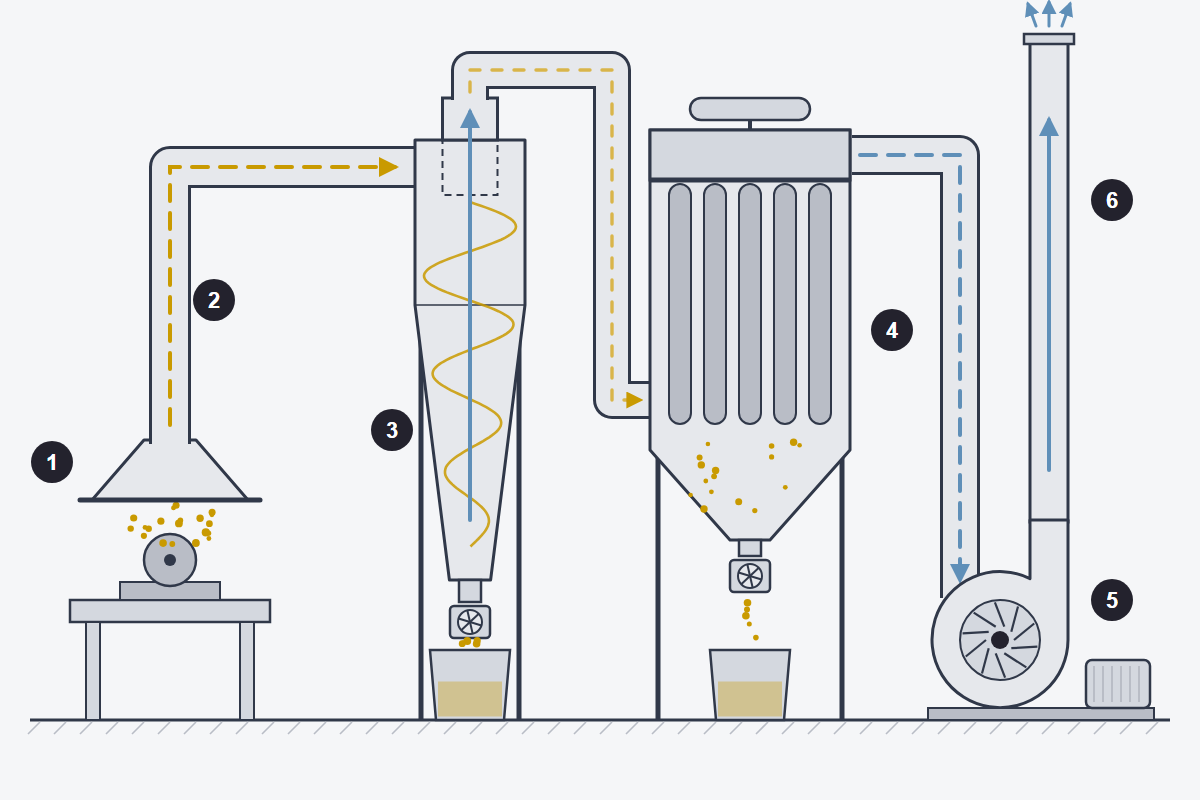
A hood moved from 6 to 12 inches (15 to 30 cm) away from where the dust is born needs three to four times more air to catch the same dust. That is Dalla Valle's arithmetic, the classic hood formula, and it explains why so many dust collection systems fail before the first yard of duct. Sizing one means following an order: first the dust and the hoods, then the ducts and the fan, and at the end, measuring.
Everything starts with the dust: what it is, how fine, whether it is combustible, whether it is damp or sticky, and how hot it comes off the process. Almost everything else depends on that, starting with the minimum velocity needed to carry it.
Then, each hood. The capture velocity depends on how much energy the contaminant is released with: 0.25 to 0.5 m/s (50 to 100 fpm) for vapors evaporating from a still tank; 0.5 to 1 m/s (100 to 200 fpm) for welding; 1 to 2.5 m/s (200 to 500 fpm) for filling or crushing; and 2.5 to more than 10 m/s (500 to 2,000 fpm) for grinding and blasting, which are better enclosed outright. With that velocity, the distance to the source and the face area, you get the airflow: Q = V · (10 X² + A), and 25% less if the opening is flanged.
Don't do this: hang a big hood five feet from the workstation “so it's not in the way.” With the operator in between and a draft from an open door, that hood catches almost nothing, and the whole system ends up sized for an airflow that does no good.
With each hood's airflow, the ducts are sized, choosing the diameter so the air never drops below the transport velocity: 10 to 12.7 m/s (2,000 to 2,500 fpm) for welding fume, 17.8 to 20.3 m/s (3,500 to 4,000 fpm) for ordinary industrial dust, and more than 20 m/s (4,000 fpm) for heavy or damp dust. These are minimums, and they apply to every branch: wherever the air slows down, the dust settles. The main duct grows as the branches join it.
Next, the losses along the longest path are added up: friction in the straight runs, elbows and branch entries, the entry loss at each hood, the cyclone — from half a kilopascal to about 2.5 kPa (2 to 10 in. w.g.) depending on the design —, the filter and the stack. The other branches are balanced by design or with dampers. Whatever is not calculated ends up held together with baling wire: a damper closed here, a hood disconnected there.
Only then is the fan chosen, with the airflow and pressure at actual conditions. Catalog curves are for standard air, 1.2 kg/m³ (0.075 lb/ft³); at 2,500 meters (8,200 ft) of altitude the air is about 25% lighter, and pressures are corrected before choosing. Power comes from multiplying airflow by pressure and dividing by efficiency.
With the system running, velocity is measured in every branch and static pressure at every hood throat, and the readings are recorded. Those numbers are the reference for the system's whole life: if a hood's static pressure drops, there is a plugged duct, a slipping belt or a worn impeller. The filter has its own gauge, the differential pressure gauge, and it deserves the attention you give a car's oil level.
For a first estimate, the Engineering Suite calculator (in Spanish) sizes the cyclone and the duct line. For the complete system, at Indumor we engineer and build industrial dust collection systems with their ductwork. And if anyone ever suggests moving the hood back “just a few inches,” you know the answer: three to four times more air.
Tell us what is generated and where, and we will engineer the complete system.
© Indumor 2010–2026 — Industrial steel fabrication, Córdoba, Argentina
