October 21, 2026 · Indumor
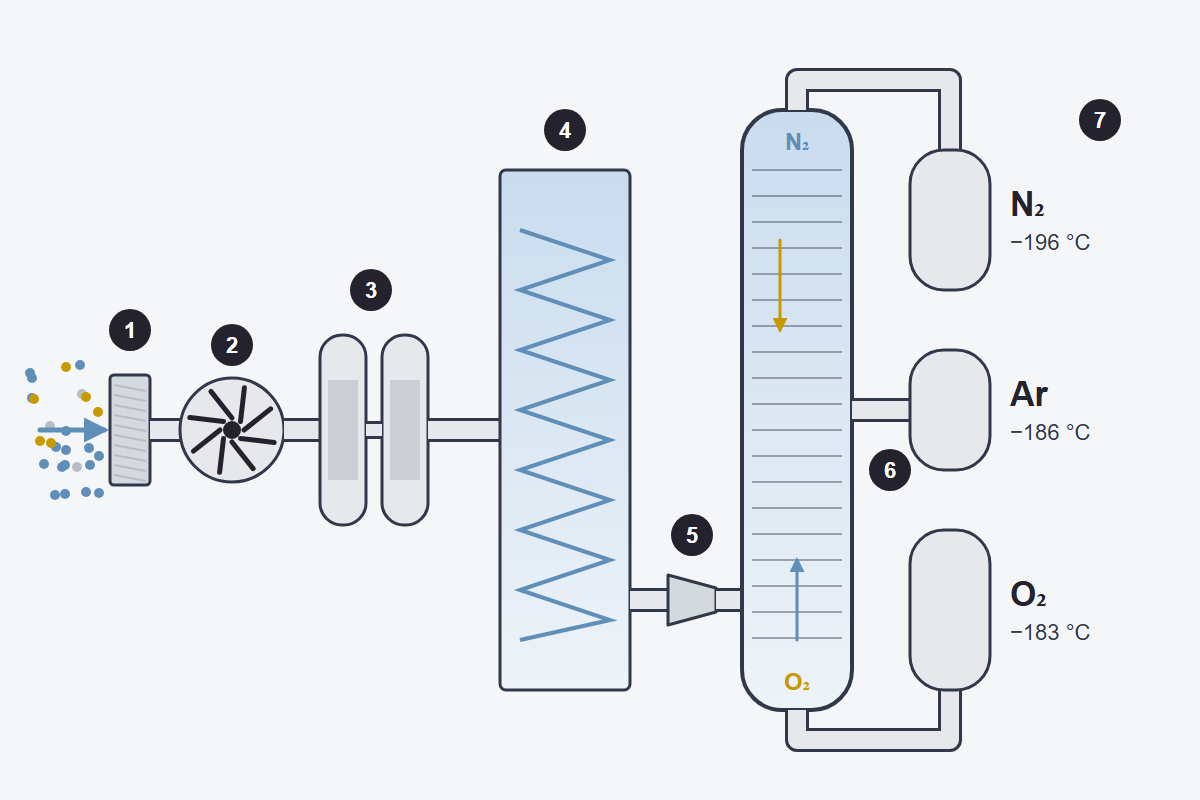
1 Filter · 2 Compressor · 3 Purification (water and CO₂) · 4 Heat exchanger in the cold box · 5 Expansion turbine · 6 Distillation column · 7 Nitrogen, argon and oxygen tanks.
The short answer first: almost every gas in the shop comes from the air and goes back to the air. Argon and nitrogen pass through the torch or the laser nozzle unchanged and return to the atmosphere as they came. The oxygen in oxy-fuel cutting ends up in the slag, combined with the iron. The CO₂ used for MAG welding is, for the most part, a gas other industries were going to release anyway. In practice they are renewable: what is really spent is the electricity to separate them. The exceptions are helium, which comes from gas fields and does not come back, and fuels such as propane. This is how we got here.
Dry air is 78.08% nitrogen, 20.95% oxygen and 0.93% argon; CO₂ is now around 0.043%, about 426 parts per million. None of that was known 250 years ago. Oxygen was isolated by two people separately: the Swede Carl Wilhelm Scheele, around 1771 or 1772, who was slow to publish because his book's printing dragged on until 1777, and the Englishman Joseph Priestley, on August 1, 1774. Lavoisier understood it was a part of the air that combines with whatever burns, and gave it its name. Nitrogen was described by Daniel Rutherford in his 1772 thesis.
Argon took longer, because it reacts with nothing. Lord Rayleigh noticed that nitrogen taken from the air weighed half a percent more than nitrogen made in the lab. With William Ramsay he found the cause: a new gas, argon, announced on August 13, 1894; in 1904 both received the Nobel Prize. Helium was first seen in the Sun, during an 1868 eclipse, and Ramsay isolated it on Earth in 1895. In 1903, in Dexter, Kansas, a gas well "would not burn": it carried almost 2% helium, which is how we learned that helium is trapped in some gas fields.
How do you separate something that is mixed molecule by molecule? By cooling it until it turns liquid and distilling it, like alcohol. At 1 atmosphere, nitrogen boils at −196 °C, argon at −186 °C and oxygen at −183 °C: those differences are enough. In 1895, the Englishman William Hampson and the German Carl von Linde patented, two weeks apart — Hampson first — machines that liquefied air by expansion. Linde's produced liquid air on May 29, 1895, at about three liters an hour. His first plant to separate oxygen ran in 1902 or 1903, depending on the source, and in 1910 the double column made it possible to produce pure oxygen and nitrogen at the same time. In France, Georges Claude liquefied air in quantity in 1902 with a more efficient expansion engine.
A plant today does the same at another scale: it compresses the air, removes water and CO₂, cools it against the outgoing products, expands it and distills it in columns. Separating a tonne of gaseous oxygen takes about 220 to 270 kWh; liquid oxygen, the kind in bulk tanks and dewars, takes about four times as much.
Acetylene was discovered by Edmund Davy in 1836, but it became cheap by mistake. In 1892, in North Carolina, Thomas Willson was trying to make calcium metal by heating lime and carbon in an electric furnace, and got calcium carbide, which gives off acetylene with water. To this day, much cylinder acetylene comes from that carbide, made from lime and coke at about 2,000 °C. In 1895, Henry Le Chatelier showed that the oxygen-acetylene flame is the hottest, at about 3,100 to 3,200 °C, and in 1903 Fouché and Picard built the torch.
The first documented oxygen cut, according to a Polish historical study, was a failed robbery: on Christmas Eve 1890, burglars tried to open a Hannover bank's safe with a burner and three small bottles of oxygen. In 1903, Ernst Wiss built the first complete cutting torch, and in 1908 a 24-meter span of a bridge over the Elbe was taken down in five days by oxygen cutting, instead of the four weeks it took to remove the rivets.
Shielding gases arrived with aviation. In 1930, General Electric patented an argon-shielded arc; in 1942, Russell Meredith of Northrop patented the “Heliarc”: a tungsten electrode shielded by helium, for welding magnesium. It was TIG, and by the mid-1940s argon had replaced helium because it was easier to get. In 1950, welding with continuously fed wire under argon or helium for aluminum was patented: MIG. CO₂ for steel came from the Soviet Union in 1953. And in May 1967, at the British welding institute, Peter Houldcroft blew oxygen around the beam of a 300 W CO₂ laser and cut 1 mm sheet: the first gas-assisted laser cut.
Nitrogen and argon do not burn: they shield, blow out the molten metal and go back to the air; in the heat of the arc only traces of nitrogen oxides form, and the arc's light turns a little oxygen into ozone. Cutting oxygen combines with the iron and stays in the slag. In the arc, CO₂ splits into carbon monoxide and oxygen, that oxygen carries some of the wire's silicon and manganese into the slag, and in the open air the monoxide turns back into CO₂. Acetylene burns in two stages and ends up as CO₂ and water.
Do they run out? The atmosphere holds about 1.2 million billion tonnes of oxygen, and industry separates 240 to 400 million a year: less than a millionth of it. Atmospheric oxygen is falling, but very slowly and because of fossil-fuel burning; industrial oxygen is a tiny fraction of that decline. Argon formed over billions of years in rocks and is, on a human scale, permanent. Welding CO₂ is mostly a by-product: in the United States it is recovered from ethanol, gas-processing and ammonia plants, and in Villa María, Córdoba, a bioethanol plant captures it from corn fermentation. When European fertilizer plants shut down in 2018 and 2022, CO₂ ran short.
Helium is another story. It comes from uranium and thorium decaying in rock, gets trapped in some gas fields and, once released, eventually escapes to space. Reserves are finite, the world has gone through four shortages since 2006, and in March 2026 the attacks on Ras Laffan, in Qatar, which produces about a third of the world's helium, doubled prices. In 2022, welding used 10% of the helium consumed in the United States.
Don't do this: leave the cylinder open at the end of the shift. Any leak in a hose or a fitting bleeds gas all night, and every liter is electricity someone paid for to separate it from the air. And in a confined space, leaking argon displaces oxygen without warning: it has no smell and no color.
Sources: NOAA Global Monitoring Laboratory; Science History Institute; Linda Hall Library; Science Museum Group; patents US 728,173 (Linde), US 1,746,191 (Devers, GE), US 2,274,631 (Meredith) and US 2,504,868 (Air Reduction); The Chemical Engineer; TWI; NIST; Szulc, Przegląd Spawalnictwa (2015); USGS, Mineral Commodity Summaries 2026; US EPA Greenhouse Gas Reporting Program; IEA; Global Carbon Budget; Scripps Institution of Oceanography; AP (March 2026).
Send us the drawing and we will quote it.
© Indumor 2010–2026 — Industrial steel fabrication, Córdoba, Argentina
