October 21, 2026 · Indumor
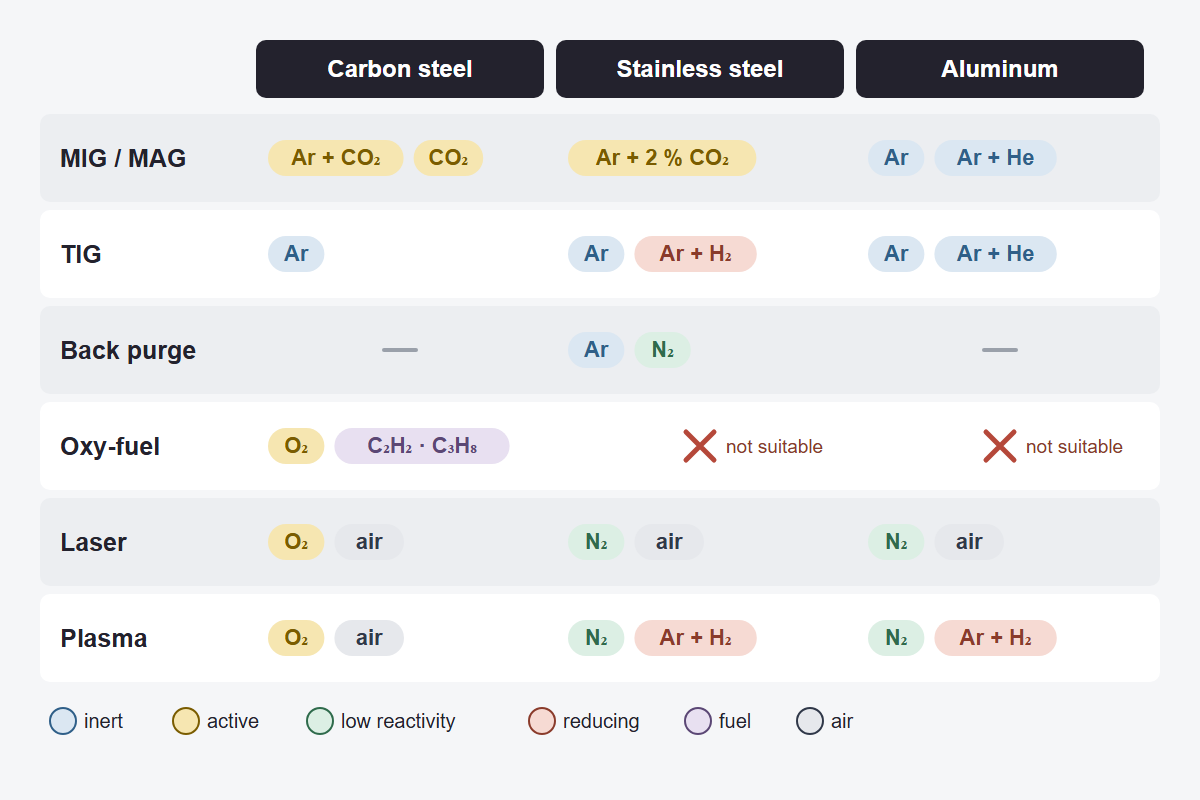
“It's just gas.” Someone in the shop always says it when the mix cylinder runs out and only a straight CO₂ one is left. It isn't: every gas does a different job, and the material decides which one goes in.
In MAG welding of carbon steel, the gas carries an active part — CO₂ or oxygen — that steadies the arc and helps the bead wet out; with pure argon, the arc on steel is unstable. On stainless that active part drops to 2 or 3% CO₂, because the weld picks up carbon from the gas, and a 304L allows at most 0.030%: above that, chromium carbides form and the steel corrodes between the grains. On aluminum, by contrast, only inert gases are used, because it oxidizes instantly.
Shields without reacting. It is the base of almost every mix and the TIG gas. It is separated from air, which is 0.934% argon.
Carries more heat into the work than argon: deeper penetration and less porosity on thick aluminum and copper. Expensive, with harder arc starts.
Unreactive at room temperature, but it splits in the arc and gives deep penetration on carbon steel, at the cost of more spatter.
A few percent stabilizes the MAG arc. In oxy-fuel and laser cutting it burns the iron, which is why oxygen cutting does not work on stainless or aluminum.
Not inert. In laser cutting it cuts stainless and aluminum with a clean edge, ready to weld or paint; on duplex a little is added so the weld keeps its nitrogen.
Mixed with argon it gives a hotter arc and a cleaner bead in TIG on austenitic stainless. On carbon steel, never: it cracks.
They only heat: they bring the steel to its ignition temperature so the oxygen jet can burn it.
If you are unsure about the gas for a job, send us the material, thickness and process, and we will tell you which one fits, free of charge. At Indumor we do MIG, MAG and TIG welding and laser cutting. And if you wonder where these gases come from, read the history of industrial gases.
Send us the material, thickness and process, and we will tell you which one fits.
© Indumor 2010–2026 — Industrial steel fabrication, Córdoba, Argentina
