October 21, 2026 · Indumor
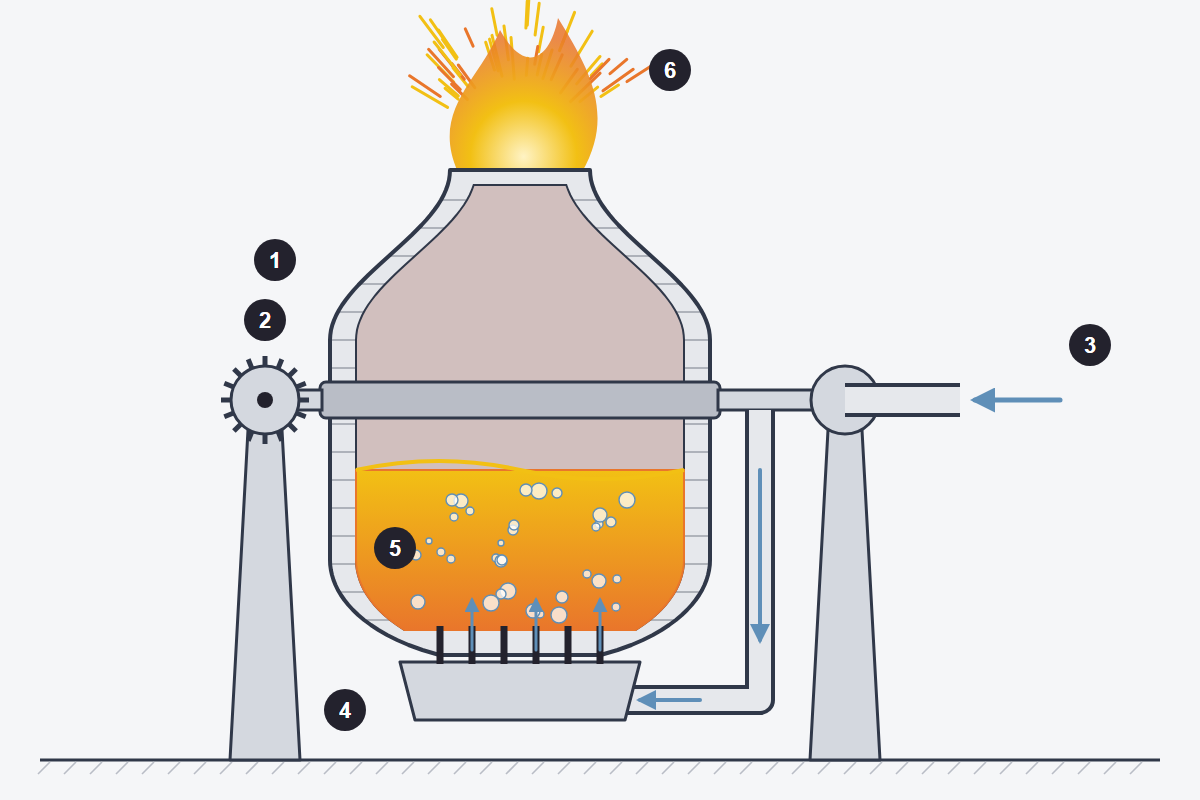
1 Vessel with refractory lining · 2 Trunnion and tilting gear · 3 Air inlet · 4 Wind box and tuyeres · 5 Molten pig iron · 6 Flame and sparks.
The conclusion first: the steel bought by the ton today — for beams, plate and pipe — is cheap because in 1856 an English inventor dared to blow air through molten iron. Henry Bessemer found that the oxygen in the air burned the silicon and carbon out of pig iron, and that this fire, inside the metal itself, was enough to keep it liquid without coal. In his early trials, about 350 kilograms (seven hundredweight) of pig iron were converted in about half an hour; a puddling furnace took two hours to make about 230. Steel, which sold at 50 to 60 pounds a ton and went into knives and tools, began to be made by the ton for rails, bridges and ships.
The invention nearly failed: the first licensees made useless metal, because their pig iron carried phosphorus and the process could not remove it. It was saved by Robert Mushet's manganese, Swedish iron and, twenty years later, Thomas and Gilchrist's basic lining. In the United States, steel rails fell from 158 dollars a ton in 1868 to under 18 in 1898. And the idea is still alive: the oxygen converter, which makes about 70% of the world's steel today, is its heir.
Bessemer, born in 1813, was already rich from a bronze powder when he took up iron. According to his autobiography, the Crimean War pushed him into it: a French officer supposedly told him cast-iron guns could not stand his projectiles. That is his own account, written some forty years later; what can be checked is his 1854 projectile patent. The decisive observation, again in his telling, was seeing lumps of pig iron exposed to air in his furnace turn into shells of carbon-free iron.
On August 13, 1856, he read his paper to the British Association in Cheltenham, and the next day The Times printed it in full. In less than a month he collected about 27,000 pounds in licences. A single works, Dowlais, paid 10,000.
The licensees' converters produced metal that broke. Without knowing it, Bessemer had run his trials with Blaenavon pig iron, almost free of phosphorus; the rest of British iron carried plenty, and the converter's silica lining could not take it out. The metal also kept dissolved oxygen and cracked when rolled. Bessemer ended up buying the licences back.
The invention worked. British iron didn't.
The fixes came from several directions. In September 1856 Robert Mushet patented an addition of spiegeleisen, an iron-manganese-carbon alloy added at the end of the blow to remove the oxygen and put carbon back; the patent lapsed in 1859 because nobody paid the renewal fee, and years later Bessemer paid him a pension of 300 pounds a year until his death. In Sweden, Göran Fredrik Göransson enlarged the tuyeres and on July 18, 1858, at Edsken, achieved the first fully successful blow. Bessemer opened his own works in Sheffield in 1858, using phosphorus-free pig iron, and sold tool steel at 42 pounds. And in 1879, in Middlesbrough, Sidney Gilchrist Thomas and his cousin Percy Gilchrist proved at industrial scale a basic lining that held the phosphorus in the slag: the phosphoric ores of continental Europe became usable, and the slag was sold as fertilizer.
In the United States, the patent office gave priority in 1857 to William Kelly of Kentucky, who said he had been blowing air on iron since 1847; historians still argue over how much he actually achieved. The first American blow took place at Wyandotte, Michigan, in 1864, and in 1875 Andrew Carnegie's Edgar Thomson Works, designed by Alexander Holley, opened. According to Bessemer, the first British steel rail was laid in 1862 at the Camden goods station in London, and by 1866 it had outlasted seventeen or eighteen faces of the iron rails beside it.
The open hearth overtook the converter — in Britain in the early 1890s, in the United States in 1908 —: it gave time to correct the charge, melted scrap and left less nitrogen, which makes steel brittle with age. In 1952, at Linz, pure oxygen replaced air, and the converter won again. The last British Bessemer converter went cold in the mid-1970s and now stands in a Sheffield museum.
The converter gave us mild steel, with 0.1 to 0.3% carbon, which replaced wrought iron in rails, plate, sections and rivets. And its failures left a habit: knowing what is in the metal. The 1856 licensees lost their money because nobody yet knew that the phosphorus in their pig iron ruined the steel. Today every heat travels with its analysis, in the mill test certificate.
Don't do this: accept plate or sections without a certificate “because they always came from the same supplier.” Without the heat analysis, an S355 is a promise, not a fact.
If you want to keep going, the history of alloy steel starts in Mushet's same workshop, and the story of steel erection tells what was built with all that cheap steel. And if you have a structure to build, at Indumor we quote it from the drawing.
Sources: Henry Bessemer, An Autobiography (1905); P. W. Bishop, The Beginnings of Cheap Steel (Smithsonian, 1959); patents US 16,082 (Bessemer, 1856) and US 17,628 (Kelly, 1857); Encyclopaedia Britannica; Grace's Guide; Science Museum Group; Bessemer steel rail price series from Iron Age (NBER Macrohistory Database, nominal values); Pennsylvania Historical and Museum Commission; Sheffield Museums; P. King, Historical Metallurgy; worldsteel, World Steel in Figures 2026.
Send us the drawing and we will quote it, steel and certificate included.
© Indumor 2010–2026 — Industrial steel fabrication, Córdoba, Argentina
