October 21, 2026 · Indumor
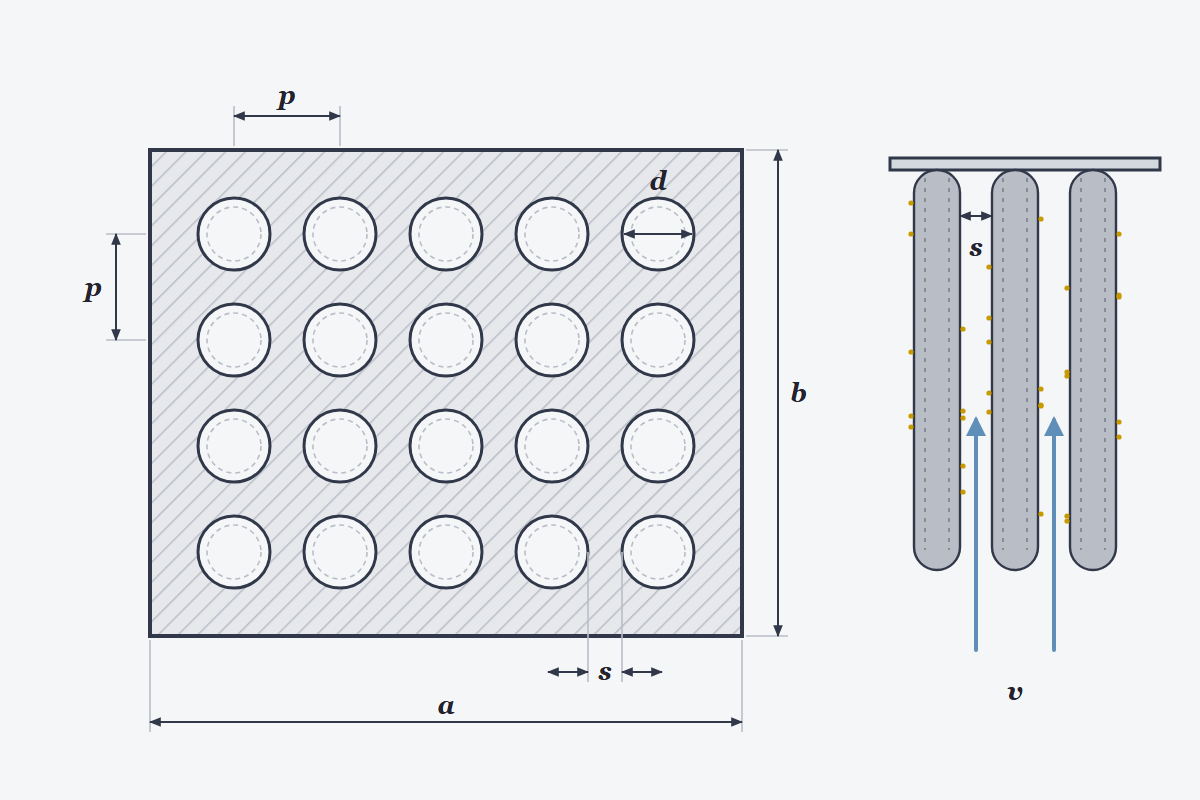
Let's start at the end: a baghouse is sized by the speed at which air crosses the cloth. The number of bags, the size of the housing, the hopper and even the compressed air all follow from that number, and getting it wrong is the most expensive mistake, because it cannot be fixed later without making the filter bigger. The why, and the full calculation, follow.
It is the airflow divided by the cloth area, in cubic meters per minute per square meter (or cfm per square foot): in other words, a velocity. If it is too high, pressure drop rises, more dust gets through, the bags need cleaning more often and they wear out sooner. And there is no single figure: it depends on the dust and on how the filter is cleaned. For pulse-jet cleaning with felt bags, the US EPA gives as generally safe design values 2.44 m/min (8 ft/min) for cement, 3.66 (12) for sawdust and flour, 4.27 (14) for grain, 2.13 (7) for silica and iron oxide, and 1.52 (5) for fly ash and carbon black. With fine dust, many manufacturers run well below that: one gives 1 to 1.2 m/min (3.25 to 4 ft/min) as its ideal range.
An example makes it clearer. A baghouse for 10,000 m³/h (about 5,890 cfm) of air with cement dust, at 2.44 m/min, needs 10,000 / 60 / 2.44 = 68.3 m² (735 ft²) of cloth. A bag 152 mm (6 in.) across and 3 m (10 ft) long has π × 0.152 × 3 = 1.43 m² (15.4 ft²), so 47.7 bags are needed: 48. A square 7-by-7 tube sheet holds 49, and the actual ratio drops to 2.37 m/min (7.8 ft/min). Longer bags give more cloth on the same tube sheet, but the pulse has a harder time cleaning them along their full length; beyond three meters, the length is best agreed with the cleaning-system supplier.
In our shop, the tube sheet is the part that gets measured most: 49 holes cut by laser, all at the same pitch, in a plate that has to come out flat. A bag that does not seat evenly lets dust past its edge, and that dust goes straight up the stack.
Dirty air entering from below rises through the spaces between the bags. If it rises too fast, the dust knocked off by the pulse never reaches the hopper: it sticks to the neighboring bags again. That is why the upward velocity between bags, the can velocity, is checked. There is no code figure; there are manufacturers' rules. One of them generally accepts up to 1.5 m/s (300 fpm) and adjusts the limit to the dust's bulk density, from 0.3 m/s (60 fpm) for very light dusts up to 1.8 m/s (360 fpm) for the heaviest. In the example, with about 64 mm (2.5 in.) of clearance between bags and 100 mm (4 in.) to the walls, it comes to 1.5 m/s.
The clearance between bags matters for another reason too: bags hang from the top and are free at the bottom, so they swing and can rub. That dimension, like the exact hole diameter, is confirmed by the bag and cage supplier.
According to the EPA, pulse cleaning uses about 2 scfm for every 1,000 acfm filtered: 0.2% of the airflow, with air at 4 to 7 bar (60 to 100 psig) and pulses of 0.03 to 0.1 seconds. In the example, about 20 m³/h (12 scfm). To choose the fan, the EPA gives typical pressure drops of 1 to 2.5 kPa (4 to 10 in. w.g.) across the baghouse; in normal service, many run between 0.5 and 1.5 kPa (2 to 6 in.). And the hopper, with walls at about 60° — common practice, not a code requirement —, discharges continuously through an airtight rotary airlock: it is not a storage bin.
The fabric is chosen for the gas temperature and chemistry: polyester takes about 135 °C (275 °F), and fiberglass and PTFE 230 to 260 °C (450 to 500 °F). We cover it in detail in the guide to baghouse filter fabrics. The gas has to stay above its dew point at all times, or the bags plug. If the dust is combustible, the baghouse is designed under NFPA 660 — which replaced NFPA 652, 654 and 664 —, with explosion venting (NFPA 68) and isolation (NFPA 69). And aluminum dust never goes into the same filter as steel dust.
To run the numbers with your own data, the Engineering Suite's baghouse calculator (in Spanish) lays out the tube sheet and the hoppers and gives you the DXF to cut. If you are still torn between a cyclone and a filter, start with cyclone or baghouse. At Indumor we build custom baghouse filters. And if you keep only one idea, make it the first one: a baghouse is sized by the speed at which air crosses the cloth.
Tell us the airflow, the dust and the temperature, and we will size and quote it.
© Indumor 2010–2026 — Industrial steel fabrication, Córdoba, Argentina
