October 21, 2026 · Indumor
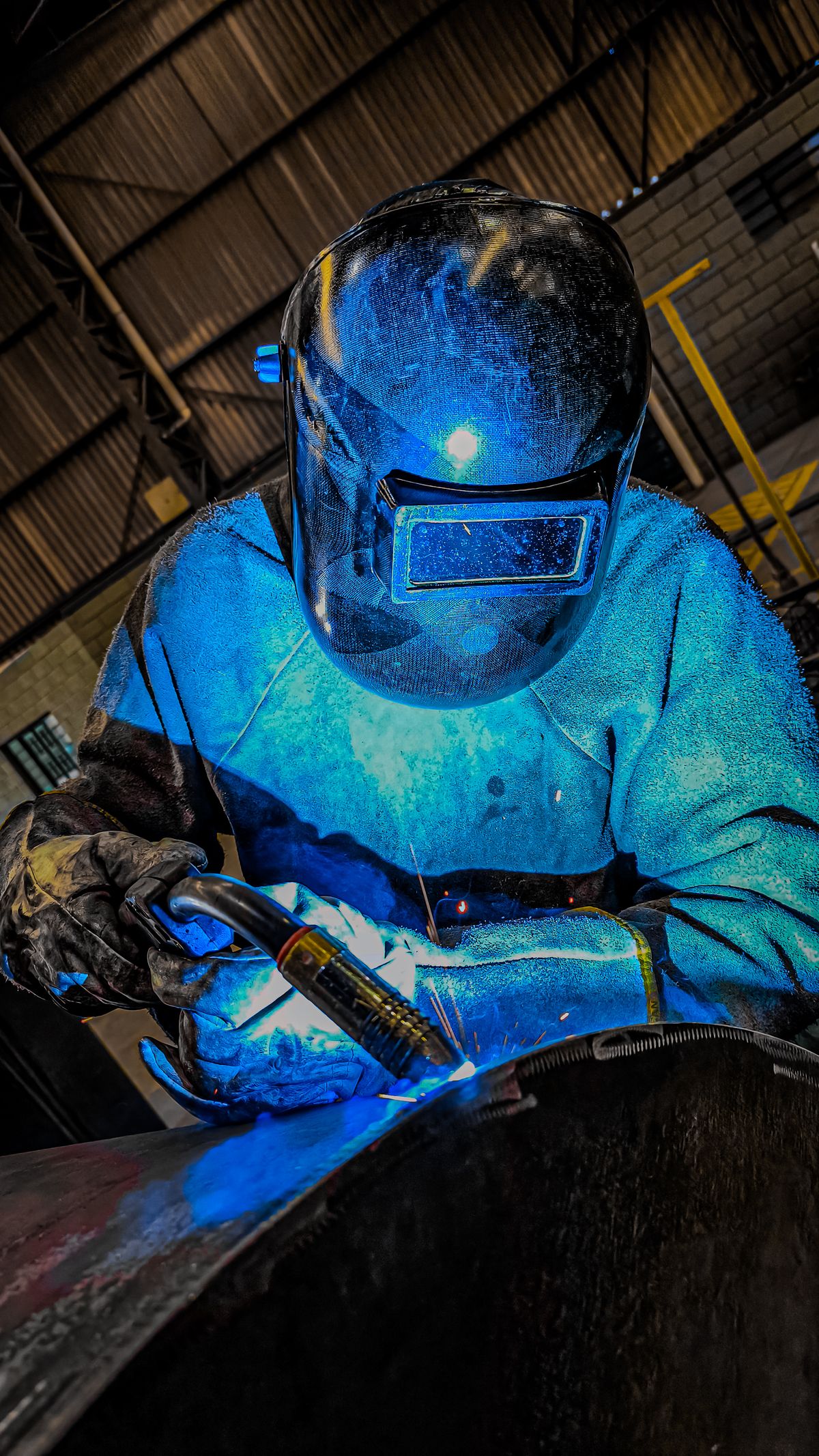
Zinc boils before steel melts.
That is the whole problem. Zinc melts at 419 °C (787 °F) and boils at 907 °C (1,665 °F); steel only melts above 1,400 °C. When galvanized steel is welded, the zinc around the joint vaporizes long before the weld pool forms, with three consequences: zinc oxide fumes that make whoever breathes them sick, porosity and spatter in the weld, and a coating burned off on either side. The fix also fits in one paragraph: if possible, weld before galvanizing; if not, remove the zinc from the joint area, weld with good fume extraction and respiratory protection, and then repair the coating.
Zinc oxide causes metal fume fever: chills, fever, headache and fatigue that show up hours after welding, like a flu that usually clears on its own in a day or two. Clearing on its own does not make it harmless, and getting it again and again is not some kind of training. And it is not just zinc: paint, oil or dirt left on the part also burns and goes to the same place. The protection is the usual one, taken seriously: local exhaust close to the arc, ventilation and, when that is not enough, suitable respiratory protection.
Do not do this: weld galvanized steel in a closed corner relying on the glass of milk someone in the shop recommended. Milk protects you from nothing. What protects you is keeping the fumes away from your face and lungs.
Zinc vapor passing through the pool leaves porosity, increases spatter and can cause lack of fusion. In some highly restrained joints, liquid zinc can even promote cracking. That is why the best practice is to remove the zinc from the weld area — by grinding, an inch or two on each side — before welding, and to adjust the technique: travel a little slower so remaining zinc burns off ahead of the pool, and leave a small gap in the joint so the vapor can escape. With stick welding, cellulosic and rutile electrodes usually cope better with leftover zinc. AWS published a specific standard on the subject, D19.0, on welding zinc-coated steel.
Welding galvanized steel in an operating plant adds the usual hot-work requirements — a permit, fire protection, a fire watch — and one of its own: zinc fumes build up faster in enclosed spaces, under a low roof or inside a box section. There, extraction stops being a recommendation and becomes a condition. It also pays to plan the weld so it is done in one go: every pass over the same area burns more of the surrounding coating and enlarges what has to be repaired afterwards.
After welding, the bead gets a closer look than on bare steel: zinc porosity usually breaks the surface, but not always. If the specification calls for testing, it is done before the coating is repaired, because paint covers exactly what the inspector needs to see. And in the shop, welding galvanized steel is messier: nozzles and contact tips clog with spatter sooner, so they get cleaned more often, and anti-spatter compound helps.
Wherever the zinc was removed or burned off, the steel is bare and will be the first thing to rust. It is repaired with zinc-rich paint, zinc-based solders or metallizing, per ASTM A780; the most common in the field is zinc-rich paint, applied over a clean surface at the thickness the specification calls for. Before painting, the area is cleaned to bright metal, by grinding or blasting, and a little beyond, into the sound coating, so the repair overlaps the edge instead of stopping right at it. The standard also requires zinc-rich paint repairs to be thicker than the coating the specification calls for on the galvanized part, because paint protects less per micron than kettle zinc. A careful repair lasts. A touch-up with any color of spray paint does not.
The option that avoids almost all of this is welding before galvanizing: the structure is fabricated complete, galvanized and erected with bolts. Those welds have their own preparation, though: all slag is removed, because acid does not dissolve it and it leaves bare spots, and overlaps are welded continuously so they do not trap acid. That is why field connections are best decided at the design stage. And when a galvanized structure needs new supports, a bolted connection often works better than a welded one.
Do you need to add supports to a structure that is already galvanized? Tell us what it is and we will tell you whether to weld or bolt.
Tell us what needs adding and we will tell you which connection fits and how the coating gets repaired.
© Indumor 2010–2026 — Industrial steel fabrication, Córdoba, Argentina
