October 21, 2026 · Indumor
It is worth starting at the end, because that is the surprising part: dust collection was not invented by industrial hygienists or environmentalists. It was assembled over a century by pigment makers who did not want to lose product, millers who were afraid of being blown sky-high and an engineer worried about silica dust. First, dust was captured because it was worth money; then, because it exploded; and only much later, because it made people sick and because the law required it.
The bag, the cyclone and the compressed-air pulse arrived in that order. This is how.
The first patented filter bag is American. On February 24, 1852, Samuel T. Jones of New York patented a system in which a fan blew zinc oxide fume from the furnaces into a cotton bag about 8 feet across and 70 feet long. The fume was the product: zinc oxide was white pigment, and whatever stayed in the cloth was sold. To clean the bag, it was beaten, shaken or turned inside out. Sources waver between 1850 and 1852 for the first trials, at the zinc works in Newark, New Jersey; by the 1870s those plants had entire rooms of 30-foot muslin bags, shaken every four hours.
Lead smelters followed the same path: the fume carried metal. In Denver, Malvern W. Iles's bag house, patented in 1892, held between 3,000 and 4,500 bags more than 30 feet long, and a 1906 manual already called the bag house a “standard accessory” of the trade.
In the mills, dust was worth nothing, but it killed. On May 2, 1878, flour dust in the Washburn “A” Mill in Minneapolis exploded and killed 18 people; the mill was rebuilt with ventilation and dust collectors.
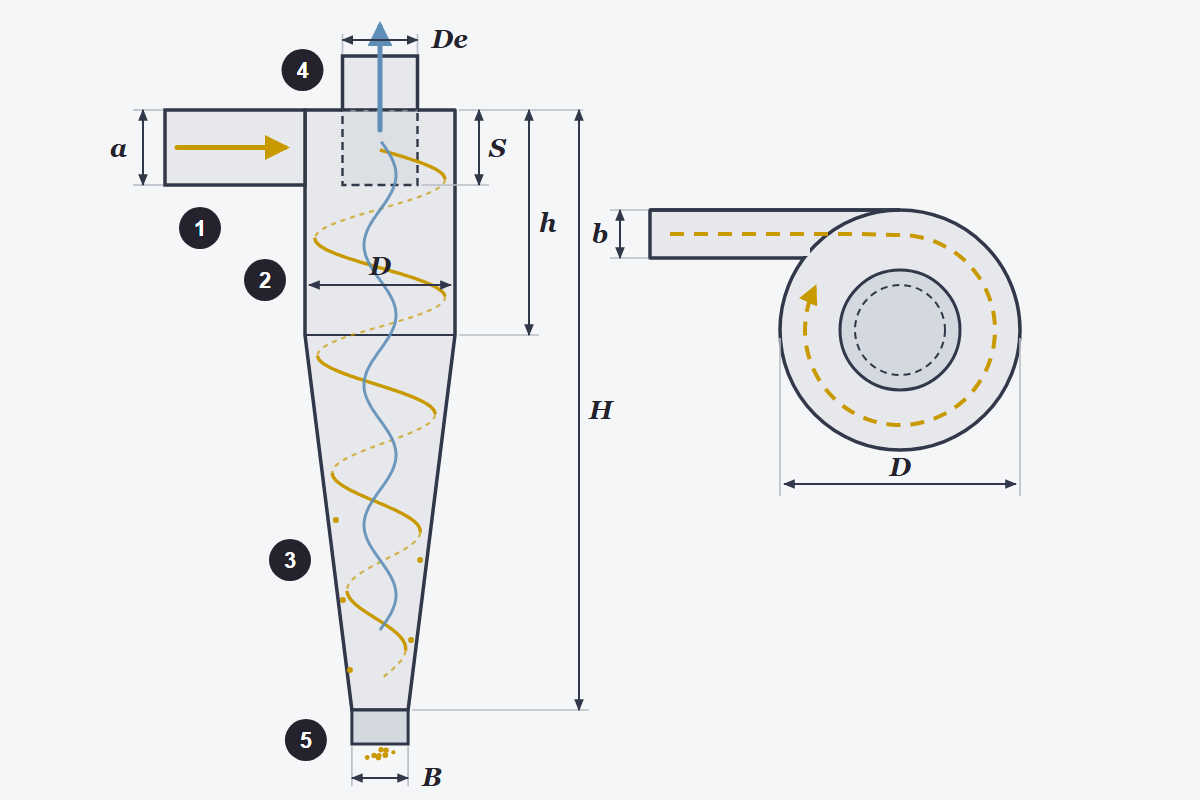
That is where the cyclone appears, and it appears in a single town: Jackson, Michigan, where the Knickerbocker Company built milling machinery. In 1885, John M. Finch patented a collector for the air leaving middlings purifiers that spun it in a roughly cylindrical case, mounted on its side, with a tangential inlet. It was a forerunner, not yet the cyclone we know. That one was filed by Orville M. Morse, from the same town and for the same company, on March 31, 1886: a conical chamber “like a funnel,” with the tangential inlet at the wide end, the dust leaving through the tip and, in the center, an outlet with a “tubular guard” that reached into the chamber. It is the tube now called the vortex finder. The US patent, held up by an interference at the patent office, was not granted until 1889.
Morse's collectors worked so well that they were copied, and Knickerbocker went to court to defend its patents. In 1894, in Chicago, Judge Grosscup ruled in its favor: Morse had been the first to hit on the right combination of cone, guard, openings and tangential inlet. And he admitted, with candor rare in a court opinion, that the physical laws by which the device worked still had no satisfactory explanation. In 1898, in Ohio, another of those cases reached a judge who would later become President of the United States, William Howard Taft, who wrote that Morse collectors had largely displaced every other kind in woodworking shops and flour mills.
In Germany, Wilhelm Friedrich Ludwig Beth, of Stockelsdorf near Lübeck, patented a cloth filter that cleaned itself: a mechanism jerked the bag and air passed back through the cloth, shaking the dust loose. A 1970 handbook dates the patent to 1881; its number, however, belongs to 1886.
The piece that pushes the air came from the mines: Georgius Agricola had already drawn drum fans turned by a crank, by the wind or by a water wheel in De re metallica in 1556, and in the mid-nineteenth century the Belgian Théophile Guibal gave mine fans a casing and a chimney.
The cyclone worked. Nobody quite knew why.
For half a century, cyclones were built by copying the ones that worked. Theory came later. In 1932, the Germans Rosin, Rammler and Intelmann studied their principles and limits; in 1939, Shepherd and Lapple measured the flow and pressure drop inside cyclones in the United States; around 1950, Lapple proposed the cut diameter, the particle a cyclone captures at 50%. And in 1951, the Englishman Stairmand published the designs that set every dimension as a fraction of the diameter: the high-efficiency and the high-throughput cyclone.
Twenty years of laboratory work to explain a funnel.
Something odd happened with bags. In 1908, Frederick Cottrell patented the electrostatic precipitator and, according to the 1970 fabric filter handbook, bag development practically stalled from 1910 until the early 1950s. Bags were still cleaned by shaking, and air moved through the cloth very slowly: about 0.2 feet per minute in hand-shaken bags and about 3 feet per minute in automatic ones.
The man who broke the stillness was Henry J. Hersey Jr., who around 1939 was working on silica dust from Idaho's ore-crushing plants. His idea, tested in 1941 in a grain elevator: a hollow ring traveling along the outside of the bag, blowing air backward through it, so it could be cleaned without ever stopping filtering. The patent was granted in 1950, with several hundred units already in service.
The last step came from Thomas V. Reinauer, of a pulverizing-mill maker in Summit, New Jersey. In 1957 he introduced a filter cleaned by a brief pulse of compressed air, with no moving parts inside the collector. With reverse jets and pulses, air began to cross the cloth at 10 to 20 feet per minute, fifty to a hundred times faster than in hand-shaken bags, and the cloth needed for the same airflow shrank in the same proportion.
Up to that point, dust was captured for money or out of fear. The law came later. In the United States, the Occupational Safety and Health Act was signed on December 29, 1970 and, two days later, the Clean Air Amendments that created emission standards for new plants. The first ones, in 1971, covered cement plants; the one for steel mills' electric arc furnaces came in 1975, and today that fume generally goes to baghouses.
In Argentina, Law 19,587 on Occupational Health and Safety dates from April 21, 1972, and its Decree 351/79 set the maximum permissible concentrations in workplace air, which Resolution 295/2003 updated: for dust not otherwise classified, 10 mg/m³ inhalable and 3 mg/m³ respirable.
All of that is still in every system built today. The tube that reaches into a cyclone's body is Morse's “tubular guard.” The proportions a cyclone is drawn with are Stairmand's. The compressed-air pulse that cleans the bags of nearly every new filter is the 1957 idea. When we at Indumor engineer an industrial dust collection system, we are working on top of that century of trial and error.
If your plant shuts down over the holidays, that is the time to install or rework a dust collection system: with production stopped, ducts and filters go in without a rush. To make the January shutdown, the site survey has to happen now.
Sources: patents US 8,756 (Jones, 1852), US 325,521 (Finch, 1885), US 403,362 (Morse, 1889), DE 38,396 (Beth), US 475,774 (Iles, 1892), US 895,729 (Cottrell, 1908) and US 2,495,635 (Hersey, 1950); Knickerbocker Co. v. Rogers (1894) and Allington & Curtis Mfg. Co. v. Globe Co. (1898); Billings and Wilder, Handbook of Fabric Filter Technology (1970); Ingalls, Lead Smelting and Refining (1906); Agricola, De re metallica (1556); Shepherd and Lapple (1939); Stairmand (1951); Minnesota Historical Society; US EPA; Argentine Law 19,587, Decree 351/79 and MTEySS Resolution 295/2003.
Tell us what dust you have and where it is generated, and we will engineer the whole system, from hood to stack.
© Indumor 2010–2026 — Industrial steel fabrication, Córdoba, Argentina
