October 21, 2026 · Indumor
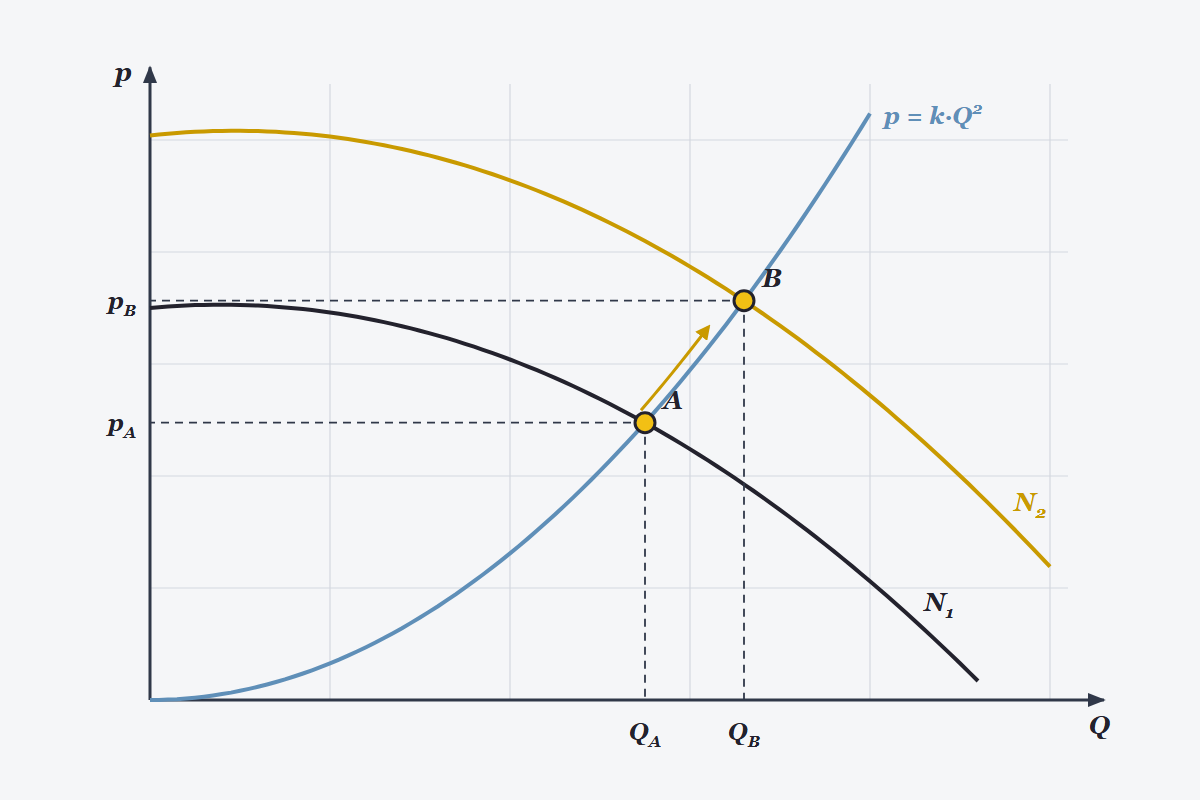
The motor is chosen for the heaviest air.
That line sums up almost everything you need to know to work out how much horsepower a centrifugal fan needs. Here it is unpacked as questions, in the order they come up when you run the numbers.
The power the air receives is the airflow times the pressure the fan adds: P = Q · Δp. With airflow in cubic meters per second and pressure in pascals, it comes out in watts. A fan moving 10,000 m³/h — 2.78 m³/s, or about 5,890 cfm — against 2,000 Pa, about 8 in. w.g., delivers 5.56 kW to the air. That is the useful power. The motor has to supply quite a bit more.
Total pressure is static pressure plus the velocity pressure at the discharge, ρ·V²/2. AMCA 210 puts it plainly: shaft power is airflow times total pressure divided by total efficiency, or airflow times static pressure divided by static efficiency. Both give the same answer as long as they are not mixed. Mixing them — static pressure with total efficiency — is the most common way to end up with an undersized motor.
The one on the fan's certified curve at your operating point. For a first estimate, the peaks published by manufacturers and agencies will do: radial paddle wheels around 60 to 65%; radial-tip wheels up to 75%; backward-inclined wheels around 82% flat, 86% curved and 90% airfoil; forward-curved wheels 55 to 65%. These are peaks: away from the best point efficiency drops, and sources do not always say whether they are total or static. For preliminary studies, the US EPA uses 40 to 70%.
In the example, at 75% total efficiency, shaft power is 5.56 / 0.75 = 7.41 kW: 9.9 hp.
New V-belts transmit 95 to 98% of the power, and less when they slip; notched belts about 2% more, and synchronous belts close to 98%, according to the US Department of Energy. With belts at 95%, the motor has to deliver 7.41 / 0.95 = 7.80 kW. On top of that a service margin is usually added, which is a design decision rather than a code requirement; our calculator uses 15%: 8.97 kW. The standard motor that covers it is the 11 kW size, sold as 15 hp.
The motor has its own efficiency too. IEC 60034-30-1 sets minimums by class: an 11 kW four-pole motor must reach at least 89.8% as IE2 and 91.4% as IE3. That difference shows up on the power bill every single day.
That is where the opening line comes in. A fan moves the same volume at the same speed, but pressure and power change with air density. If it handles hot gas and starts with cold air, it draws much more at start-up. In one manufacturer's example, a fan that draws 5.97 kW running with air at 176.7 °C (350 °F) needs 9.13 kW if it starts with air at 21 °C (70 °F): the cold air is 1.53 times denser. The motor is chosen for that start, or a damper is fitted that stays closed until the air reaches temperature. Hot air also lowers the impeller's maximum safe speed, which the manufacturer sets.
The opposite happens: at 2,500 m (8,200 ft) the air is about 25% lighter than at sea level, and the same fan delivers less pressure and draws less power. Since catalog curves are for standard air, 1.2 kg/m³ (0.075 lb/ft³), the pressure the system needs is corrected for density before looking the fan up in the table.
One horsepower is 745.7 W, and the metric horsepower, the CV used in Spanish-speaking countries, is 735.5 W. Motors are built in standard kW ratings, and catalogs list their commercial horsepower equivalent next to them. If you are checking a calculation in US units, the textbook formula is hp = cfm × in. w.g. / (6356 × η); AMCA 210 uses 6343.3, and the difference is about 0.2%. In the example it gives 9.91 hp, against 9.93 from the metric calculation.
Yes, but it is expensive. Airflow rises in proportion to speed, pressure with the square and power with the cube: 10% more speed takes 33% more power.
Don't do this: swap the pulley so the system “pulls harder” without running the numbers. An 11 kW motor that was running at 9 kW needs 12 kW with 10% more speed, and runs hot until the overload trips or it burns out. Before touching the pulley, check the motor and the impeller's maximum speed.
To run the numbers with your own data, the Engineering Suite's fan calculator (in Spanish) goes through all of this, cold start included. To choose the impeller, read the guide to centrifugal fan impeller types, and to see where the pressure comes from, the one on sizing a dust collection system. At Indumor we build centrifugal fans to fit each operating point. And if you keep only one idea from this guide, make it the first one: the motor is chosen for the heaviest air.
Send us the airflow and pressure, or the whole system, and we will quote it with its motor.
© Indumor 2010–2026 — Industrial steel fabrication, Córdoba, Argentina
