October 21, 2026 · Indumor
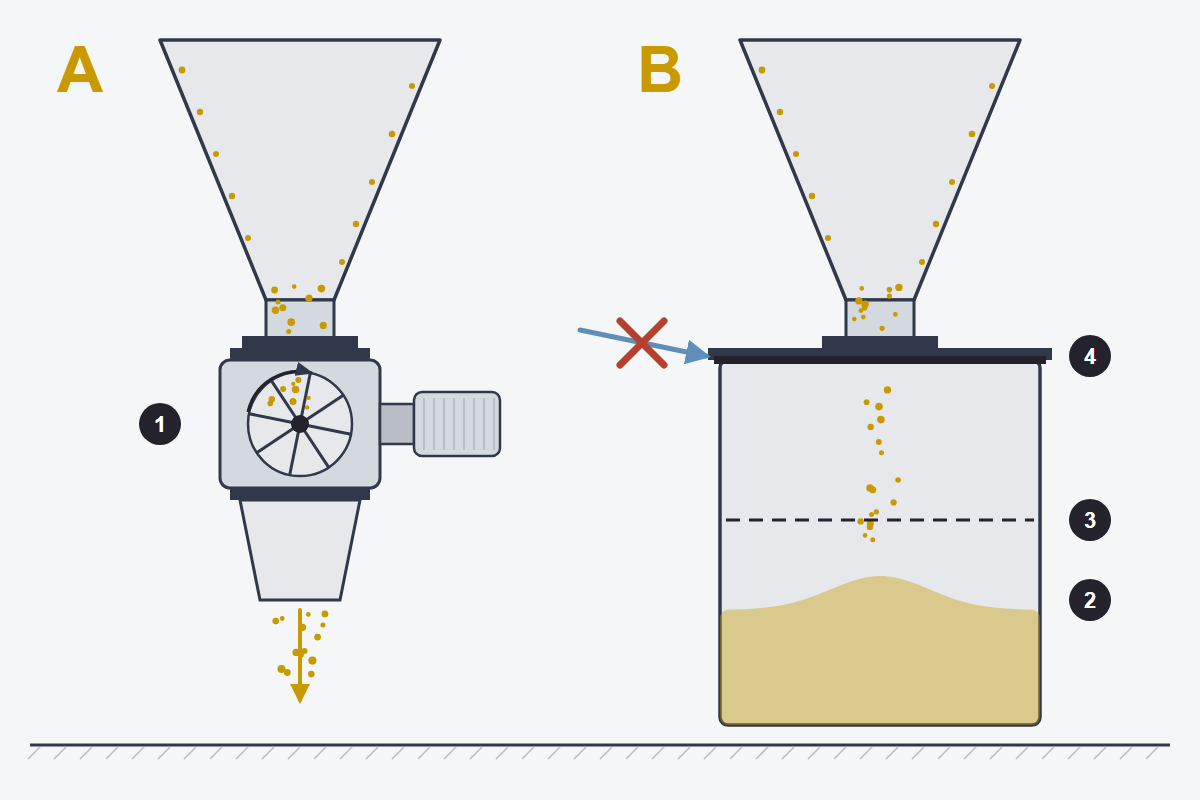
The common belief is that the discharge is the least of a cyclone's worries: it does not matter how the dust comes out, as long as it comes out. It is the other way around. The discharge is the one place where a sloppy detail can rob the cyclone of much of what it separates, and nobody notices until the stack starts puffing dust.
The essentials fit in one paragraph. The discharge has to be airtight: air leaking in from below picks up dust that was already separated and sends it to the outlet, and efficiency drops, above all for fine dust, as the US EPA warns. If dust comes out continuously, it needs a rotary airlock valve, which lets dust through without letting air in. If it comes out in small amounts, it can go into a sealed bin that is emptied in batches. And either way, the dust must never reach the cyclone's dust outlet.
In the diagram above: A, rotary airlock (1); B, sealed bin (2) with its maximum fill line (3) and airtight gasket (4). Air leaking in at the joint, crossed out.
It is a rotor with vanes turning inside a close-fitting housing: each pocket takes dust at the top and drops it at the bottom, and the vanes act as a plug against the air. Its capacity comes from the volume per revolution, the speed and how full each pocket gets. Manufacturers quote displacement at 80% fill, some use 70% for ordinary material and 50% for pellets, and typical speeds are around 20 rpm. These are manufacturers' figures, and the one that counts is in the table of whoever sells you the valve. With very fine dusts, which slip between the vanes as if they were liquid, clearances have to be tight.
It has an extra advantage when the dust is combustible: OSHA counts a properly designed rotary valve as passive isolation, one of the NFPA 69 tools for keeping an explosion from traveling down the ductwork.
When there is little dust, a closed container under the cyclone is enough. The rule is simple: airtight, with a gasket on the lid, and big enough that the dust never rises to the cyclone's outlet. If the system runs under negative pressure, the lid and the way the bin is emptied must be airtight too, and a level alarm is worth having: the end of the vortex settles on its own inside the cyclone and nobody can predict exactly where it ends, so the margin is not up for debate.
In the shop, when a cyclone's discharge is put together, the last thing checked is the thing that matters most: the lid gasket and the flange bolts. A loose bolt there does more harm than a badly rolled cone. The irony is that false air gets in exactly where the dust goes out: the cyclone separates it with great care and a leaky discharge hands it right back.
At Indumor we build cyclone separators with either discharge. And one piece of advice that costs nothing: with the system running, hold a light strip of paper next to the discharge joints. If the strip gets pulled inward, that is where air is getting in.
We build it with a rotary airlock or a sealed bin, depending on how much dust it collects.
© Indumor 2010–2026 — Industrial steel fabrication, Córdoba, Argentina
