October 27, 2026 · Indumor
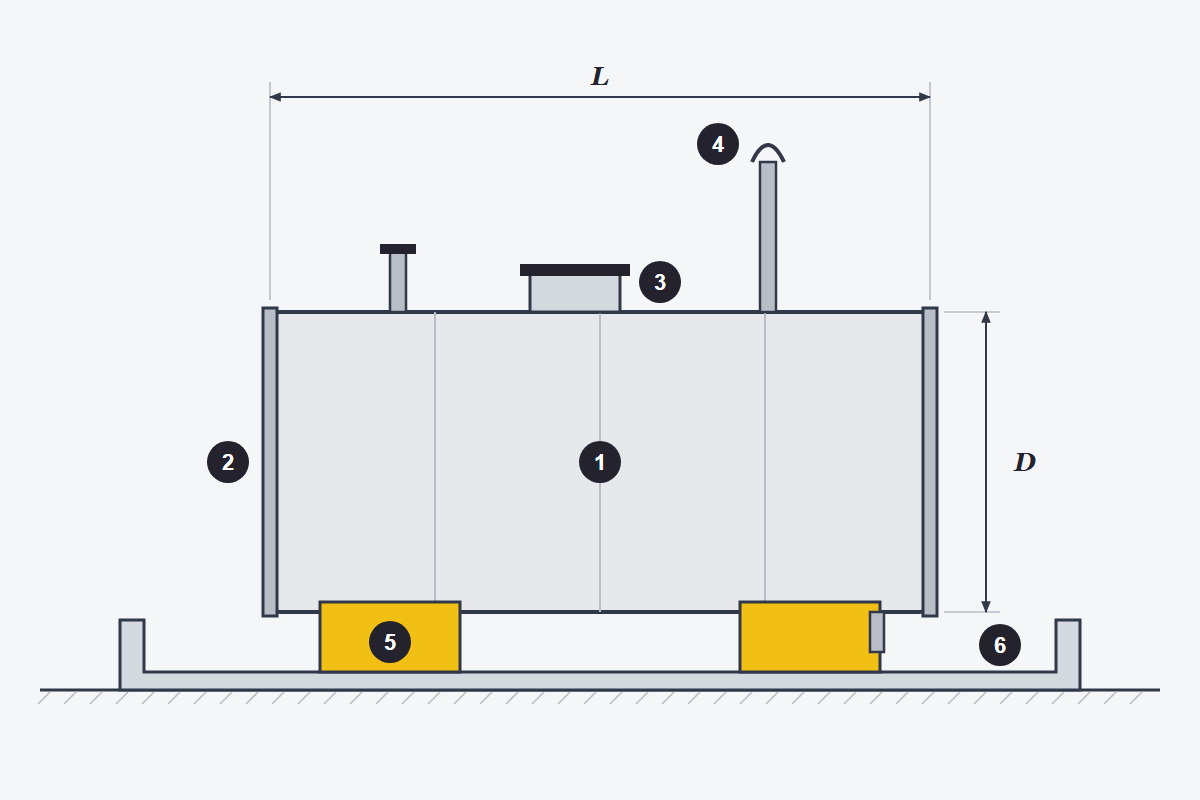
1 Shell · 2 Head · 3 Manway · 4 Vent · 5 Saddle · 6 Bund. D diameter, L shell length.
A 3,000-liter diesel tank measures 1.25 m in diameter by 2.45 m long. If that number is all you came for, there it is. The rest of this guide explains why the same capacity allows several sizes and which one suits each case, because the cheapest tank to build is not always the one that fits the site best.
The math is the cylinder's: volume equals the circle's area times the length, π × D² ÷ 4 × L. A 3,000-liter tank, which is 3 m³, can be 1.25 by 2.45 m or 1.10 by 3.15 m. The first takes less floor and the second sits lower, and both use nearly the same plate, only 6 % apart. With that same math we put together the sizes below at Indumor, balancing the floor the tank takes against its height.
These are shell dimensions with flat heads, rounded to the sizes used in the shop. With dished heads the overall length grows by a few centimeters, and so does the capacity.
Before settling on a diameter, measure the gate the tank has to pass through and the space where the delivery truck will maneuver. A tank that does not fit into the building stays outside, however right the liters are. And if it goes under a roof, add the height of the saddles to the tank's own, plus the room needed to open the manway.
Capacities are nominal. A fuel tank is never filled to the brim, because diesel expands with heat and the vent has to breathe, so usable volume ends up somewhat below the figure on the nameplate.
On top go the fill connection, the vent and the manway. At the bottom, the outlet to the pump or dispenser with its valve, and a drain at the lowest point to remove the water that condenses inside, which diesel does not forgive.
In a horizontal tank the dipstick can fool you. With the level at half the diameter, half the tank is left, but when the stick reads a quarter of the diameter you do not have a quarter, you have less than 20 %, because the circle narrows at the bottom. In the 3,000-liter tank, a stick wet up to 31 cm means about 590 liters, not 750. That is why horizontal tanks are read with a calibration chart, worked out from the geometry of the circle and worth asking for along with the tank.
Up to about 20,000 liters the horizontal tank is the most practical: it is built complete in the shop, travels assembled and rests on two saddles over the bund slab. A vertical tank takes less floor per liter and suits larger capacities better, but it needs a level concrete base, plus a ladder and a guardrail on top. It also means pumping from a greater height difference, something to weigh if the dispenser works by gravity.
In Argentina, an aboveground single-wall tank goes inside an enclosure that holds its usable volume plus 10 %, under Decree 10,877/60. For a 3,000-liter tank that is a bund of about 3.3 m³, which with a 40 cm wall takes a little over 8 m² of floor. If the space is short, a double-wall tank solves containment without a bund; we compare both in bund or double wall.
To choose capacity from your machines' consumption, see what size fuel tank to choose. Plate thickness, vents and tests come from the standard, and we build to UL 142 guidelines, explained in the UL 142 standard.
Between two tanks with the same liters, keep the one that lets you walk around it comfortably. You will be glad of it the day a filter needs changing, a leak needs checking or the side facing the wall needs paint. A passage wide enough for one person holding a wrench will do; anything narrower turns every job into a contortion act.
Send the capacity and the site, and we will propose a size with its bund.
© Indumor 2010–2026 — Industrial steel fabrication, Córdoba, Argentina
