October 19, 2026 · Indumor
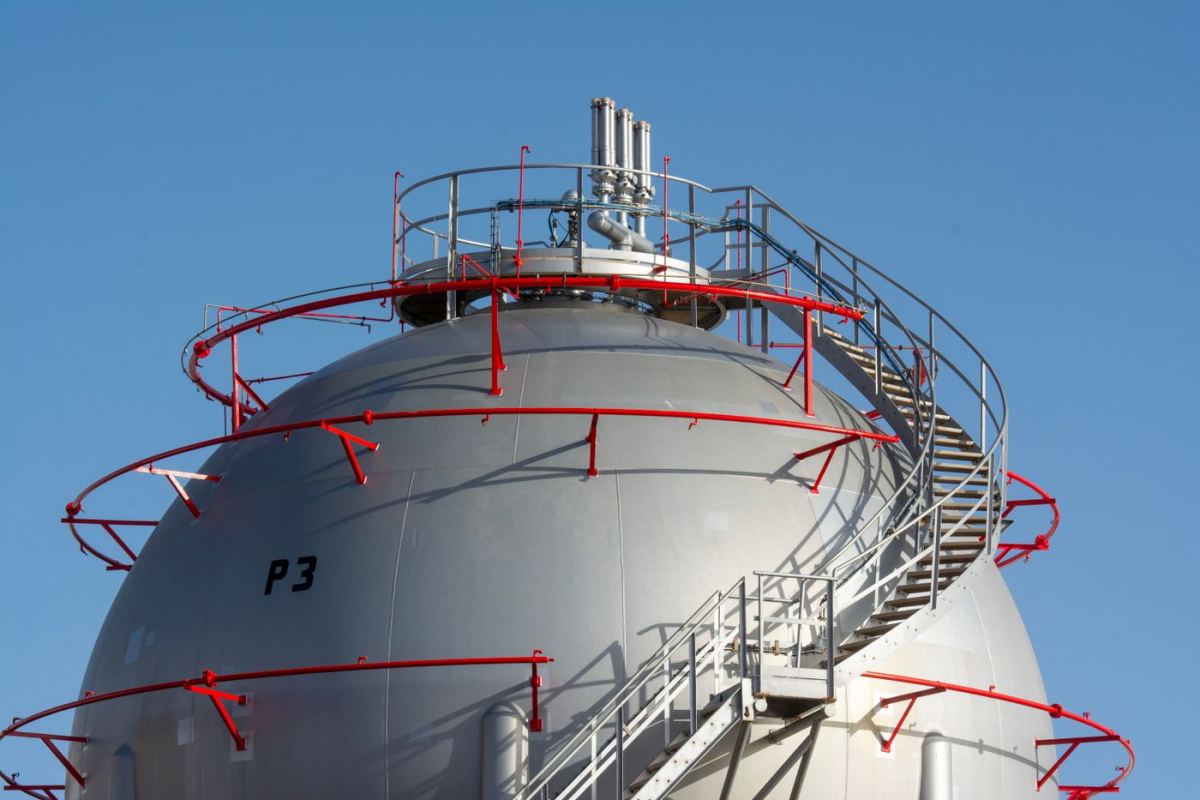
At night, from the highway into Bahía Blanca, Argentina’s largest petrochemical complex looks like a city of its own: lights climbing distillation towers, flares flickering on and off, and in between, rows of tanks holding what the complex produces and consumes. Beside the estuary, Dow, Unipar, Profertil, TGS, a refinery and a power plant share one stretch of coast. And almost everything in that landscape passed through a fabrication shop at some point.
The essentials first: a petrochemical tank differs from a fuel tank in three ways. The product, which may be volatile, toxic or reactive with air or moisture; the pressure, which in some cases exceeds atmospheric and calls for other standards; and the material, which is no longer always carbon steel. Those three decide roof type, standard, material, venting and safety systems.
For products stored at atmospheric pressure, the reference is API 650, with annexes for almost everything: external or internal floating roofs for volatile products, aluminum domes, internal pressure slightly above atmospheric, high temperature, austenitic and duplex stainless, seismic design and under-bottom leak detection. When the product is stored at low pressure, API 620 takes over. And liquefied gases under pressure go into spheres or vessels designed under other rules.
Many chemicals must stay away from oxygen or atmospheric moisture, because they degrade, get contaminated or form a flammable atmosphere above the liquid. The usual answer is blanketing: a cushion of nitrogen filling the tank’s vapor space and replenished as the level drops. It demands properly sized vents and valves, and a truly tight tank.
In petrochemicals, fittings weigh as much as the tank. Pressure-vacuum valves so the tank breathes without deforming; flame arrestors where flammable vapors may be present; level measurement and alarms to prevent overfills; cooling rings and foam chambers to fight a fire; containment sized for the largest tank; and stairs, platforms and railings to reach every valve without improvising. Each of those elements gets fabricated, installed and maintained.
A petrochemical tank gets inspected periodically: shell and floor thickness, lining condition, floating-roof seals, nozzle welds. API 653 organizes that work for tanks in service. When a problem appears, it has to be repaired without stopping the whole plant, and that takes shops that know the standard, work with qualified procedures and can fabricate plates, nozzles or entire roofs to order.
Besides Bahía Blanca, the main hubs are in Ensenada and La Plata, Campana and Zárate, Dock Sud and San Lorenzo, alongside refineries such as Luján de Cuyo and Plaza Huincul. And the pipeline is growing: in October 2026, Fértil Pampa filed a RIGI project with two urea plants and an ammonia plant, and Profertil is studying a new urea plant. More plants mean more tanks, more structures and more maintenance.
There is an irony in this industry: the one that makes the plastics for drums, pipes and small tanks needs giant steel tanks to exist. Steel remains irreplaceable wherever there is volume, temperature or the possibility of fire.
The roof is one of a petrochemical tank’s biggest decisions; we explain it in fixed vs. floating roof. And if your plant needs tanks, fittings or repairs, Indumor builds industrial tanks in carbon and stainless steel, ready for export.
We build in carbon and stainless steel, with the documentation the industry asks for.
© Indumor 2010–2026 — Industrial steel fabrication, Córdoba, Argentina
