October 19, 2026 · Indumor
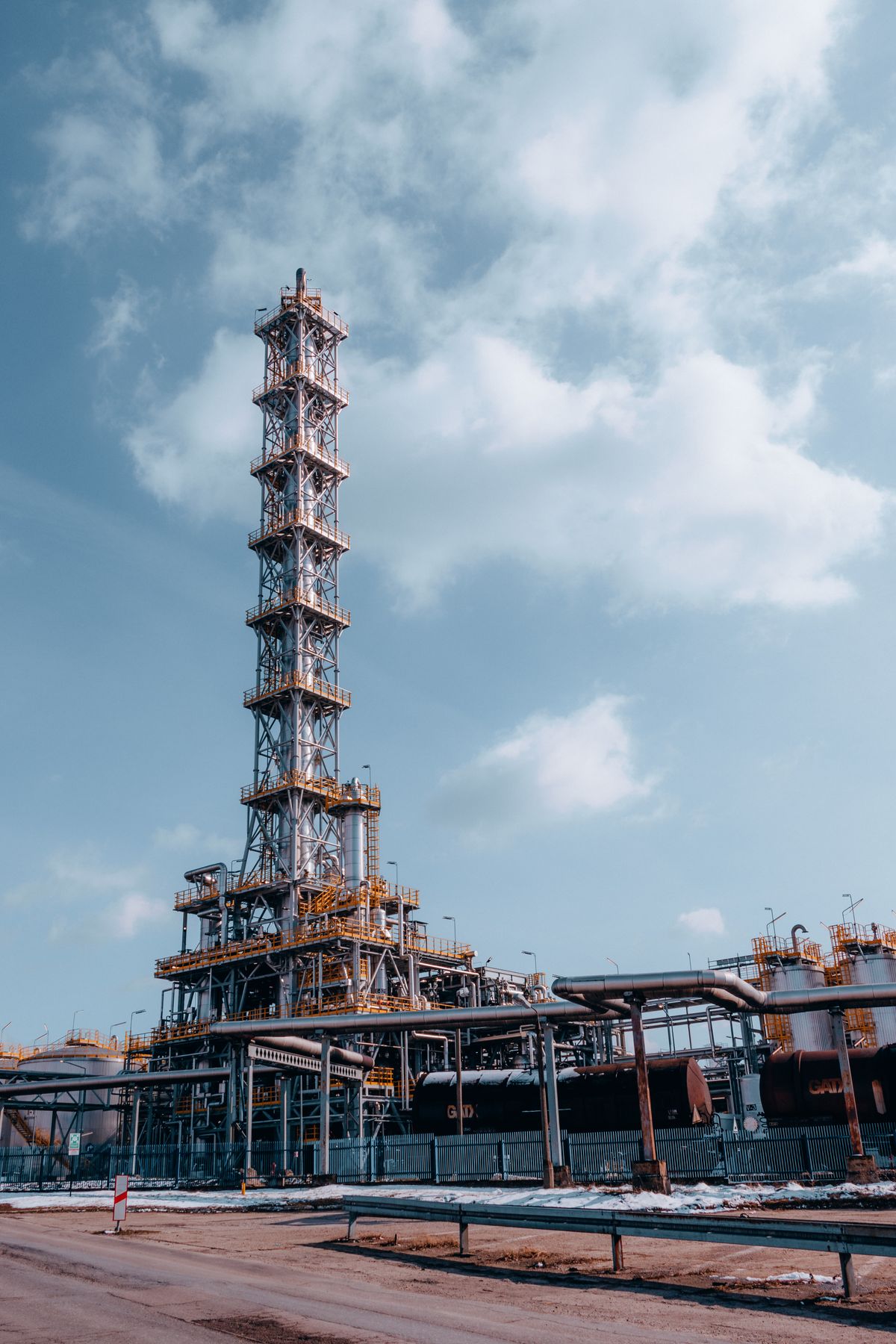
In Ensenada, a few kilometers from La Plata, Argentina’s largest refinery has been running for a century. It opened in 1925 and has never stopped growing since: new units, new tanks, piping replaced, structures reinforced. Every so often part of the refinery stops for a major turnaround, and for those weeks thousands of people work round-the-clock shifts: welders, fitters, inspectors, scaffolders, crane operators. Outside, in the shops supplying it, parts get finished against the clock. A refinery is never finished being built.
Argentina refines about 530,000 barrels a day. In July 2025, La Plata processed the most, followed by Luján de Cuyo in Mendoza and by Dock Sud and Campana in Buenos Aires; Bahía Blanca, Plaza Huincul in Neuquén and Campo Durán in Salta complete the map. Two thirds of the crude processed that month came from the Neuquén basin. Petrochemical hubs grew around several of those refineries: the largest is Bahía Blanca, where Dow, Unipar, Profertil and TGS share the coast with a refinery and a power plant; Ensenada, Campana and Zárate, Dock Sud and San Lorenzo complete the picture. It is an industrial geography that has existed for decades, with constant needs.
A refinery or petrochemical plant buys in three ways. To maintain, every day: supports replaced, platforms and stairs renewed, piping sections changed, tank repairs under API 653. For major turnarounds, by package: everything to be replaced gets built in advance, numbered and delivered in erection order. And to grow, when new units are built: pipe racks, structures, tanks, platforms and kilometers of prefabricated piping. That third way has news: in October 2026, Fértil Pampa filed a RIGI project with two urea plants and an ammonia plant, and Profertil is studying another urea plant. Vaca Muerta gas is driving a new petrochemical wave.
A major refinery turnaround is planned a year or more ahead. Heat exchangers get opened, columns inspected inside, valves changed, corroded piping sections replaced and structures repaired. Kilometers of scaffolding go up, contractors of every specialty move in, and for weeks the plant becomes a giant construction site. Everything that can be built in advance is: piping spools, supports, platforms, structural pieces and tank fittings arrive numbered by work package.
A refinery stores crude, intermediates and finished fuels in dozens of tanks of different sizes, many with floating roofs. Each gets inspected under API 653, and those inspections produce repairs: floor plates replaced, floating-roof seals, new nozzles, stairs and platforms renewed. It is continuous work, independent of the big turnarounds.
The Bahía Blanca complex lives on gas: it separates its components, makes ethylene, plastics, urea and ammonia, and exports through the port of Ingeniero White. With more Vaca Muerta gas available, expansion projects are multiplying, and with them demand for structures, tanks, piping and maintenance. It is one of the places in Argentina where heavy industry has the most future ahead.
Two refineries have a special tie to Vaca Muerta. Plaza Huincul, in Neuquén, sits in the same province as the formation, in the town where Neuquén’s first oil flowed in 1918. And Luján de Cuyo, in Mendoza, receives light crude from the basin: part of it travels on the Vaca Muerta North pipeline to Puesto Hernández and continues from there. As Vaca Muerta crude takes a growing share of what Argentina refines, these plants adapt their units and logistics, and every adaptation is work for the supply chain.
In every case, the rules are the industry’s. Qualified welding procedures, traceable materials, documented testing and a quality dossier with the piece. Process plants handle hydrocarbons, pressure and temperature, and they tolerate no improvisation. Nor dead time. Every turnaround has its date. And its penalty.
Don’t do this: show up to a refinery turnaround with pieces needing field welds that could have been done in the shop. Inside an operating refinery, every weld requires a hot-work permit, gas testing, a fire watch and coordination with operations. What takes an hour in the shop can take a full shift inside. That is why, in this world, prefabrication is not an option: it is how the work gets done.
The tanks at these plants, their types and standards, are covered in petrochemical storage tanks; their inspection in API 653 tank inspection; and the logic of prefabricated piping in piping: shop vs field. If you want one more read, the article that best explains why the next petrochemical wave depends on gas is the one on petrochemical tanks. And if you have a turnaround on the calendar, Indumor builds the packages early, numbered and documented — in English if you prefer.
We build the packages early, numbered and with their dossier.
© Indumor 2010–2026 — Industrial steel fabrication, Córdoba, Argentina
