October 27, 2026 · Indumor
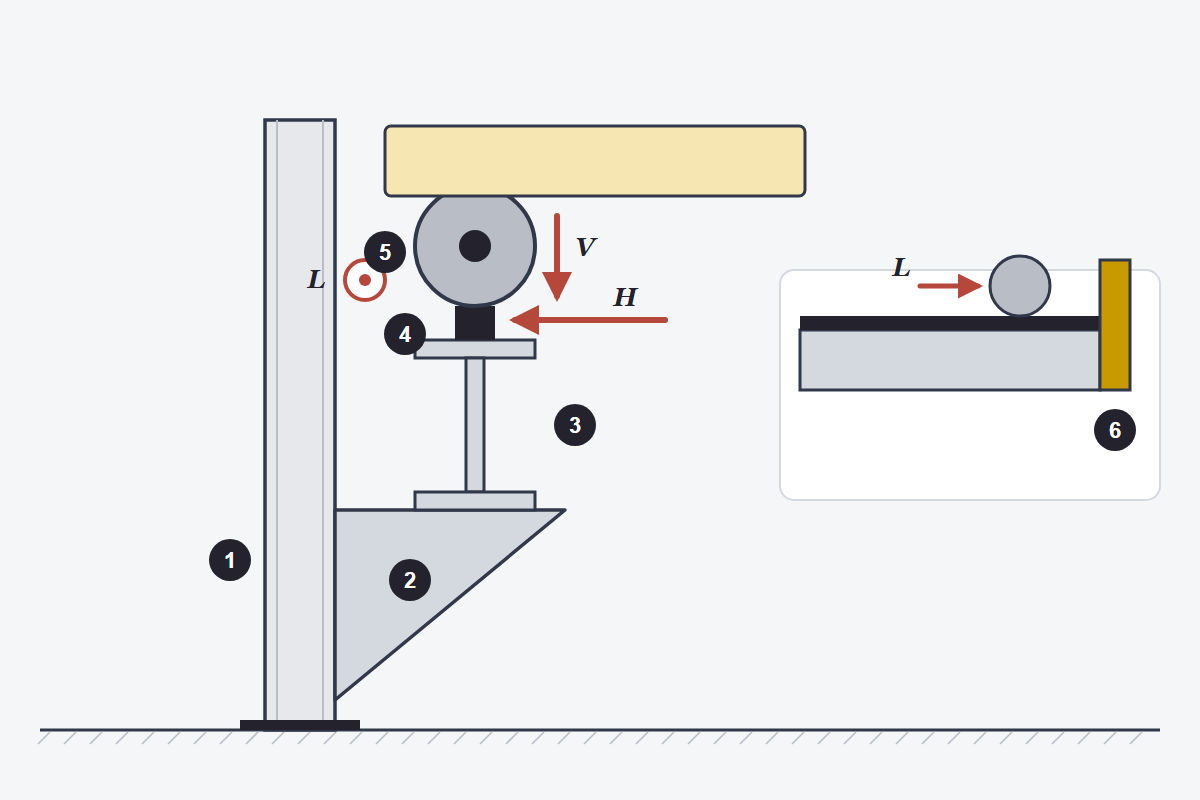
1 Column · 2 Bracket · 3 Runway girder · 4 Rail · 5 Bridge wheel · 6 End stop. V vertical wheel load, H lateral thrust, L longitudinal force.
The crane arrives knocked down on a flatbed, its nameplate still readable: 5 t. It was bought used from a plant that closed, at a good price, and the plan is to hang it from the columns of the building they already own. Someone in the office asks whether those columns can take it, and the question just hangs in the air.
A 5-ton crane does not put 5 tons on a building. Between the bridge, the trolley and the jolt of every lift, each wheel can bring more than 3 t down on the runway girder, and the crane also pushes sideways when the trolley brakes and lengthwise when the bridge brakes. A column designed without a crane rarely copes without reinforcement.
An example in round numbers. Take a 15 m single-girder bridge weighing 2.5 t, with a hoist and trolley of 0.4 t, and the loaded hook pulled up to one meter from a rail. That side takes half the bridge plus nearly all the load, about 6.3 t, shared by two wheels: 3.1 t per wheel.
Hoisting impact comes on top. The American standard ASCE 7 takes it as 25 % extra for cranes run by radio or from a cab, and 10 % for pendant-operated ones, so the wheel ends up carrying between 3.5 and 3.9 t. The same standard adds a lateral thrust of 20 % of the load plus trolley, a bit over one ton, and a force along the runway of 10 % of the wheel loads. That lateral thrust is what demands bracing from the columns.
Buying the bridge is half the job. Before closing, get the span, the wheelbase, the rail type and, if the maker published them, the maximum wheel loads in writing. With the crane in front of you, check the wheels, the stops and the rail, which often needs replacing.
On the building side, look at the columns, the footings and the clear height to the hook. Hanging a crane from an old structure is no walk in the park: sometimes brackets and bracing are enough, and sometimes a runway on its own columns, clear of the existing frame, is the better call. We go into detail in the guide on crane runway structures, and how those new columns are anchored in anchor rods and base plates.
That is the work we do at Indumor when we fabricate and erect crane runway structures, both for existing buildings and for new buildings and warehouses.
If a used crane is on your shopping list, ask for the wheel loads and the wheelbase before paying the deposit. With those two figures an engineer can tell you quickly whether your building can carry it or what reinforcement it needs, and the cost of that reinforcement becomes part of the purchase instead of a surprise.
Send us the crane and building data, and we will tell you what structure it needs.
© Indumor 2010–2026 — Industrial steel fabrication, Córdoba, Argentina
