October 27, 2026 · Indumor
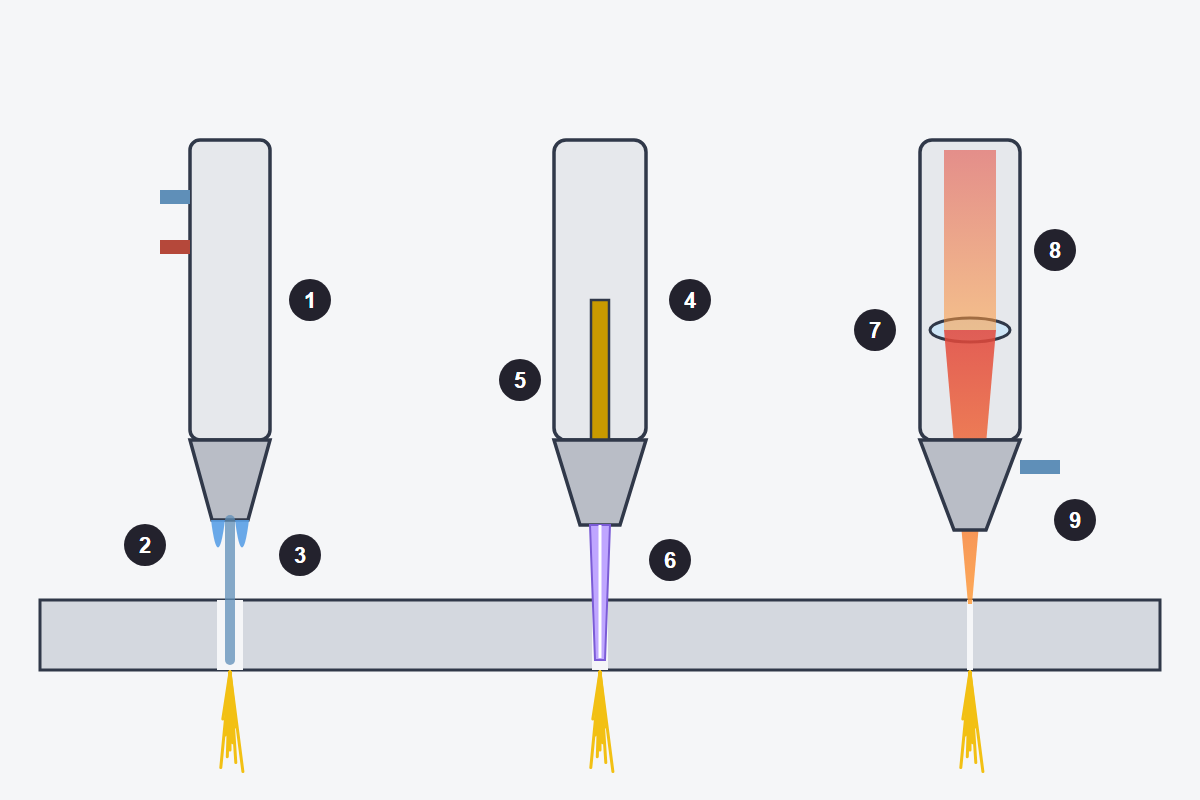
1 Oxy-fuel torch · 2 Preheat flame · 3 Oxygen jet · 4 Plasma torch · 5 Electrode · 6 Plasma arc · 7 Lens · 8 Laser beam · 9 Assist gas.
Between 700 and 900 °C. Iron only melts at 1,538 °C, and yet at that much lower temperature steel can already be cut. All it takes is heating it until it ignites and blowing pure oxygen on it: the metal burns, the jet carries the oxide away and a clean slot is left behind. That chemical trick, which came out of German blast furnaces at the start of the twentieth century, was for half a century the way thick steel was cut in shipyards, scrapyards and workshops.
Everything that came later was a race to cut what oxygen could not. Stainless steel and aluminum do not burn that way, and for them the plasma arc arrived in the 1950s, melting instead of burning. Then came the laser, which in 1967, in an English laboratory, made the first cut assisted by a gas jet, and which today, turned into an optical fiber, cuts a large share of the sheet metal parts being made.
To cut with oxygen, it first had to be cheap, and that came with the air liquefaction Carl von Linde patented in 1895 and with acetylene from Thomas Willson's calcium carbide. We cover that part in the history of industrial gases.
The first to use the jet as a tool was a blast furnace chemist. Ernst Menne worked in Kreuztal and had an everyday problem: opening tapholes clogged with cold metal. His method, for which he applied for a patent on 26 May 1901, heated the mass and attacked it with oxygen at over 30 atmospheres. In 1903 he cut steel blocks in front of the German iron and steel association. Sources disagree on what he heated with, acetylene or a hydrogen flame, and either way his was an oxygen lance, not a torch.
The cutting torch took shape soon after. In Frankfurt, Ernst Wiss built one with the oxygen in the center and the preheat flame around it, the layout nozzles still have, and in 1904 he showed it cutting plate up to 20 mm thick. In Belgium, Félix Jottrand described a hydrogen flame that preheats and an oxygen jet that cuts "by chemical action", in United States patent 866,866, granted in 1907. In France, Edmond Fouché and Charles Picard had achieved a stable oxyacetylene flame, patented in 1902 or 1903 depending on the source, but theirs was a welding torch.
Oxygen has its whims. Stainless steel only ignites above 1,500 °C, and aluminum covers itself with alumina, which melts at 2,072 °C when the metal underneath has already melted at 660. With iron powder they can be cut, but the edge comes out ugly. And purity rules: cutting oxygen has to be at least 99.5 %, and one point less cuts the speed by 25 % and raises consumption by about as much.
When scale was needed, the torch delivered. In the shipyards Henry J. Kaiser set up during the Second World War for the Liberty ships there were no heavy cutting machines, and the plate was cut with oxyacetylene torches.
What oxygen would not burn had to be melted. Robert M. Gage, in the gas division of Union Carbide, put an electric arc inside a cooled nozzle that squeezed it. United States patent 2,806,124 was filed in July 1955 and granted in September 1957; the text presents it as especially suited for cutting, with examples on aluminum plate, and estimates the arc at between 8,000 and 20,000 kelvin. Sources place the invention anywhere from 1953 to 1955, so the safe statement is that it was patented in 1957.
In the late sixties, in Hanover, New Hampshire, Richard Couch and Robert Dean tried injecting water radially around the arc. The jet reached about 30,000 °C, the cut came out squarer and the nozzle started to last longer; the patent was filed in 1970 and granted in 1972. Next came air plasma, numerical control in the late eighties and, in the mid-nineties, high-definition plasma, which on sheet up to about 6 mm cuts at 60 to 80 % of a laser's speed.
Einstein described stimulated emission in 1917, but the first laser to work was switched on by Theodore Maiman on 16 May 1960, at the Hughes laboratories in Malibu, with a ruby rod and a flash lamp. It was called a solution looking for a problem; some attribute the line to Maiman and others to his assistant Irnee D'Haenens, and the problems, in any case, showed up on their own.
The laser that would cut steel was born at Bell Labs. Kumar Patel got it working with carbon dioxide in 1963 and 1964, with barely a milliwatt at 10.6 microns, and adding nitrogen brought the power. One of the first industrial jobs was drilling diamond: in 1966 the trade press reported that wire-drawing dies were being pierced this way. The "first laser cut of 1965" that many websites repeat does not appear in the period sources we could check.
The idea of assisted cutting came from a bad cut. In 1965 Peter Houldcroft, of the British welding research association, watched plasma trim some car body panels poorly. In May 1967, with Arthur Sullivan, he aimed a 300 W military CO2 laser at 1 mm sheet with coaxial oxygen, and it cut. They reached 2.5 mm of tool steel and stainless, at one meter per minute at most and with a half-millimeter kerf. On 3 August The Times reported the news with a generous typo, one to ten inches instead of a tenth, and for a day the laser cut steel a quarter of a meter thick. Germany refused the patent.
From there on it was industry. According to John Hilton, of the British institute, around 1970 came what was probably the first laser cutting machine tool, and around 1975 the first commercial flying-optics systems. By 2002 there were about 20,000 sheet cutting machines installed worldwide and by 2007 about 48,000, and with 6 kW and oxygen, mild steel of 20 mm could be cut.
The fiber laser is not new. Elias Snitzer and Charles Koester got one working in 1961, in neodymium glass, and in 1964 they built the first amplifier. The missing piece came in 1988, when Snitzer proposed the double-clad fiber, which could be pumped with cheap diodes. In 2009 a 10 kW single-mode laser went on sale, and fiber cutting machines went from fewer than a dozen sold in 2006 to about 170 installed by 2009. Their 1.06 micron light, ten times shorter than the CO2's, is absorbed better by metals such as copper and brass.
None of the three fully pushed out the others. Oxy-fuel still rules thick carbon steel, plasma medium thicknesses plus stainless and aluminum, and the fiber laser sheet with fine detail; the full comparison is in laser, plasma or oxy-fuel. And Menne's jet is still at work inside laser heads, because when carbon steel is cut with oxygen, the reaction that burns it adds its own energy to the beam.
At Indumor we cut with a fiber laser at our Córdoba plant. If you have a plant shutdown or a project starting before year end, send the files as early as you can, because December brings holidays and vacations, and lead times stretch everywhere.
Sources: Neue Deutsche Biographie, vol. 17 (Menne); T. Szulc, Przegląd Spawalnictwa 7/2015; patents US 866,866 (Jottrand), FR 325,403 (Fouché), US 2,806,124 (Gage) and US 3,641,308 (Couch and Dean); TWI, Job Knowledge 049 to 052, and J. Hilton, "In the beginning: the history of laser cutting" (2002) and "The early days of laser cutting" (2007); T. H. Maiman, Nature 187 (1960); C. K. N. Patel, Physical Review 136 (1964); IEEE Milestones (first laser, 1960; fiber laser and amplifier, 1961-1964); J. Hecht, Optics & Photonics News, October 2024; University of Houston, The Engines of Our Ingenuity.
Send the DXF with material, thickness and quantity, and we will quote the cutting.
© Indumor 2010–2026 — Industrial steel fabrication, Córdoba, Argentina
