October 26, 2026 · Indumor
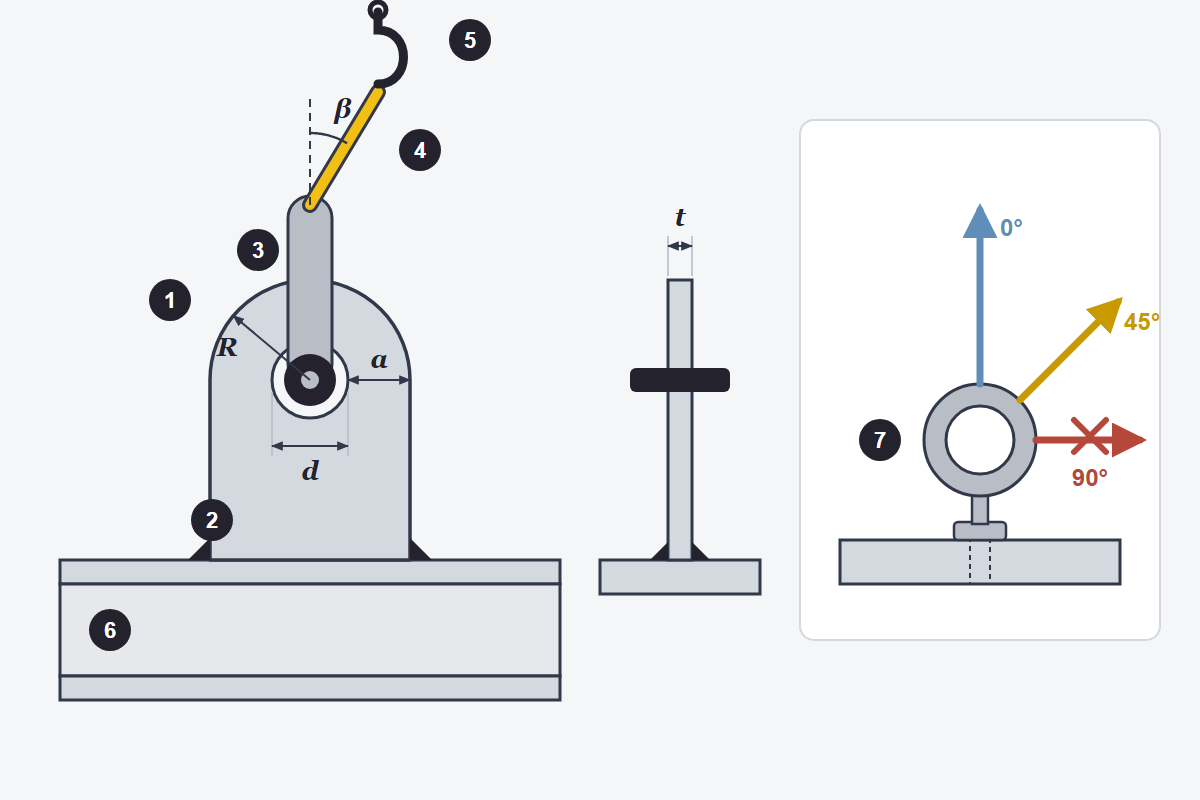
1 Lug · 2 Weld · 3 Shackle · 4 Sling · 5 Hook · 6 Member being lifted · 7 Eye bolt. d hole diameter, R outer radius, a edge distance, t thickness, β sling angle from vertical.
Lifting lug (also padeye): a plate with a hole, welded to the piece being lifted, where the shackle connects. Eye bolt: a bolt with an eye for a head, screwed into a tapped hole, doing the same job on small or machined parts.
That is the dictionary. In practice the difference that matters is another one: a lug is designed for a given pull and angle, and an eye bolt comes with a load table that changes with the direction of the sling. Using either one by eye is the surest way to lift a piece twice, the second time off the floor.
Rarely where people look. A lug can tear across the net section beside the hole, split ahead of the hole, shear out as the pin plows toward the edge, crush where the pin bears or buckle sideways if it is thin. And down at the base the weld can fail, the plate it is welded to can bend, or a thick plate loaded through its thickness can tear in layers. ASME BTH-1, the US standard for below-the-hook lifting devices, checks each of those modes separately and asks for a design factor of 2 for predictable loads and occasional use, and 3 for everything else, which is the usual case.
The sling angle does the rest. With two legs, each one carries half the weight divided by the cosine of its angle from vertical. At 30° the force rises 15%; at 45°, 41%; at 60°, it doubles. A 5-tonne tank hung from two lugs on slings at 45° puts 3.5 tonnes on each lug and also pulls each one 2.5 tonnes inward.
And the eye bolt? An M20 to DIN 580 lifts 1,200 kg in a straight pull and 860 kg inclined up to 45°, always with the collar fully seated; a pull across the plane of the eye is not allowed. Other makers publish harsher tables: one of the large ones drops to 30% of the load at 45°. The table that counts is the one for the eye bolt in your hand. For genuinely angled pulls there is the swivel hoist ring, which rotates on its axis and lines itself up with the sling, and which according to its makers' tables keeps its full rating up to 90°.
In the United States, OSHA requires custom lifting accessories to be marked with their working load and proof-tested to 125% before use. A load test helps, but it does not replace testing the welds: a US nuclear regulator found indications in the welds of a device that had passed its proof test. In that world, ANSI N14.6 for special lifting devices calls for a design factor of 3 on yield and 5 on ultimate strength. Is that much needed for a shop lug? For the one that will hold a tank over someone's head, yes.
To run the numbers, the Suite's lifting lug calculator (in Spanish) checks the lug, the weld and the sling angle. And if you need to lift a tank, a skid or a structure, at Indumor we design and build the lugs from your piece's weight and center of gravity.
Share the weight and the center of gravity, and we will design and build the lugs.
© Indumor 2010–2026 — Industrial steel fabrication, Córdoba, Argentina
