October 26, 2026 · Indumor
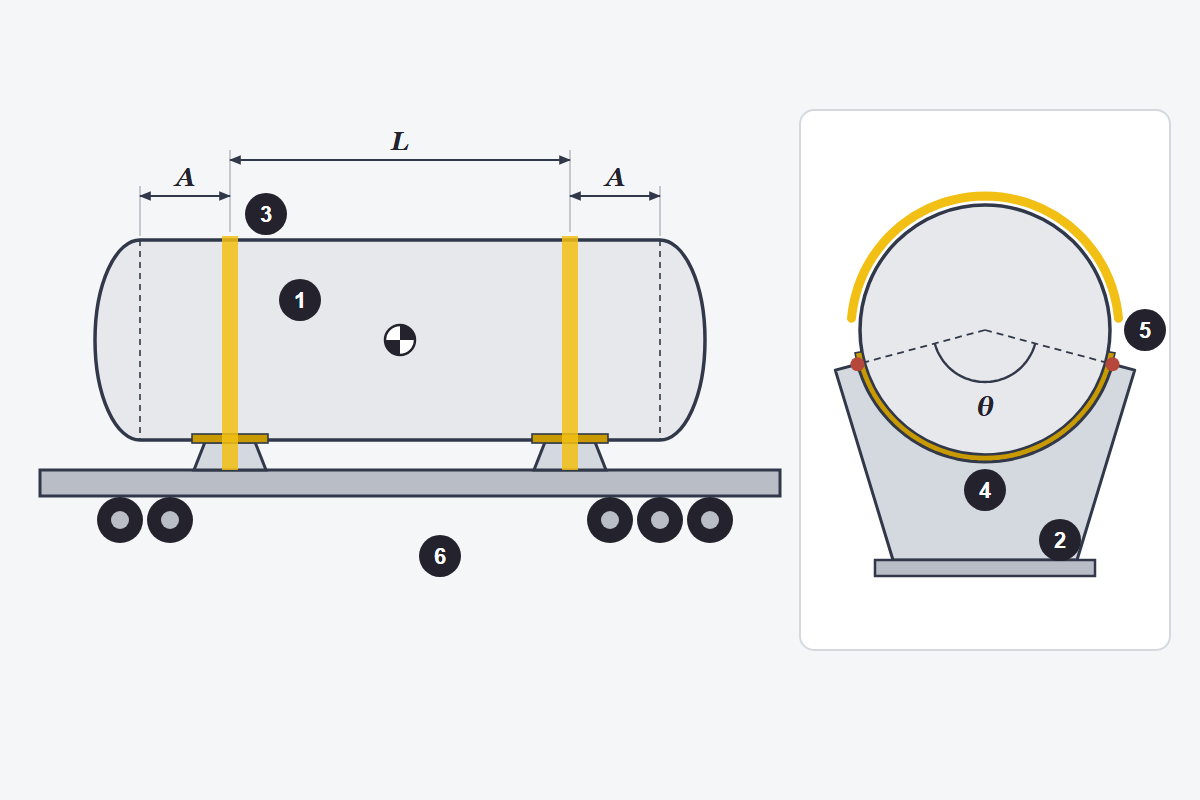
1 Tank · 2 Saddle · 3 Tie-down strap · 4 Wear plate · 5 Saddle horn · 6 Trailer. Dimensions: A distance from the saddle to the start of the head, L distance between saddles, θ contact angle.
When a tank arrives with the shell dented right where the saddle ended, the first explanation is nearly always the same. The saddle was too narrow, so the next one should be wider. It sounds reasonable. The tests say otherwise.
A group at the University of Strathclyde, in Scotland, used tests and computer models to study how much load a vessel resting on a saddle can take before the shell collapses. In their model, making the saddle five times wider raised the collapse load by just 12%. Opening the contact angle from 120° to 150°, with the width unchanged, raised it by 46%. And once they moved to vessels with real-world proportions, the factor that weighed most turned out to be the distance between the saddle and the head.
A saddle that marks the shell rarely needs more width. It needs to wrap more arc or to sit somewhere else, and sometimes moving it half a meter is enough.
A horizontal tank on two saddles works like a beam on two supports, and each saddle takes its share of the weight according to where the center of gravity falls. With nozzles, a ladder or an agitator on one side, the split is no longer half and half. What is particular to a tank happens at the tips of the saddle, which the trade calls horns. Below that edge the shell is supported and above it the shell is free, so the shell bends right there, like a hoop someone squeezes from below. In thin plate, that bending governs over every other check.
The way to calculate it was published by L. P. Zick in 1951, in a paper on large vessels resting on two saddles, and with some revisions it is still the basis of what the ASME VIII code and the British standard PD 5500 require. In that formula the bearing width appears in a single term, the one that weighs least, while the contact angle and the distance to the head go into the coefficient that governs. That is why widening helps so little.
An example in the Suite's saddle calculator (in Spanish) shows it better. Take a tank 3 m in diameter with a 9 m shell, in 4.75 mm F-24 plate (similar to A36), with cones at both ends. Empty, it weighs about 3,900 kg and measures 10.2 m end to end. With 120° saddles, a 300 mm bearing width, set 1.8 m from the start of each cone and a travel factor of 2 for a gravel road, the shell at the horn reaches 187 MPa. The allowable for that steel in that check is 159. It fails.
Move the same saddles to 60 cm from the cones and the stress drops to 50 MPa. When the saddle sits less than half a radius from the head, the head stiffens the shell and Zick's method divides the bending coefficient by four. Opening the angle helps too. At 1.8 m, going from 120° to 150° brings the stress down to 114 MPa and the tank passes. And the width? With the saddles at 1.8 m and 120°, taking the bearing from 200 to 1,000 mm moves the stress from 188 to 184 MPa. Five times the steel to gain four megapascals.
That is why one loading-yard habit needs to go, root and branch: sliding the saddles toward the middle so the tank “sits even,” the way you would rest a beam on two blocks. With a beam, the instinct works. With a thin-shell tank, don't do it. In the example it means going from 50 to 187 MPa at the same point of the shell without adding a single kilogram, and the dent it leaves will not hammer back out.
Nor should you swing to the other extreme without checking, because in very long tanks pushing the saddles against the heads leaves a lot of unsupported shell in the middle. The calculator checks the horn and the midspan separately, and it can place the saddles for you.
There are two saddles, and not out of habit. With two, the split comes from a one-line calculation; with three, it depends on how much the trailer flexes and how each support was shimmed, and the middle one can end up carrying far more than its share. Zick already preferred two supports for that reason, because if one settles the load shifts and nobody notices.
If the shell still does not pass with the saddle well placed, the next step is a wear plate, rolled to the tank radius and welded to the shell, wider than the saddle and reaching a little above the horn, which spreads the load over more area. Since it stays welded to the tank, it is decided along with the tank design and not on shipping day. Between saddle and tank there is always a rubber strip of about 10 mm, which keeps road chafing from marking the plate and, on stainless, keeps the saddle's carbon steel from contaminating the surface and leaving rust spots.
The saddle itself leaves just 100 mm between the lowest point of the tank and the deck, because every centimeter saved there is travel height. No rolled section fits in that space, so at the center it works as a flat beam built from the rolled plate and two flat bars, and the diagonals only appear from the feet outward.
Once loaded, the tank stops being a beam and becomes a load that wants to keep going every time the truck brakes. The European cargo-securing standard, EN 12195-1, designs for braking that pushes forward with 80% of the weight and for curves that pull sideways with 50%. For the example tank that is about 3,100 kg forward and nearly 2,000 kg sideways, shared among straps, stops and friction. The straps go over the saddles, where the shell has support underneath, with protectors where they touch the plate; tensioned over the middle of the shell they can dent it. And each saddle is locked to the deck so it cannot slide with the tank on top.
Then comes height. In Argentina, Traffic Law 24,449, as amended by Law 27,445 of 2018, sets a 4.30 m height limit for freight vehicles and a 2.60 m width. The 4.10 m figure many people carry around in their heads is the one for buses. The sum is deck height plus clearance under the tank plus diameter. On a standard semitrailer, with the deck at 1.40 m, the 3 m tank reaches 4.50 m and does not make it; on a lowboy with the deck at 0.55 m, it stays at 3.65 m. But that tank was already out on width, because 3 m is more than 2.60. It travels as an oversize load, with a permit that the national highway agency, Vialidad Nacional, grants for national routes through the TAD online platform, and with the route driven beforehand to check bridges, power lines, roundabouts and toll booths.
All of that takes time. If the tank has to be installed before harvest or before a plant shutdown, the saddles and the permit get sorted out along with fabrication, not on the day the tank leaves the shop. For moving large pieces in general, the guide on transporting large structures covers breakdown and permits, and for loading and unloading there is the one on lifting lugs and eye bolts. The industrial steel tanks and fuel storage tanks made at Indumor leave with their transport saddles designed in. With the diameter, the length and the date it has to be on site, we can say which saddles it needs and when it has to leave the shop.
Tell us the diameter, length and date, and we will design and build the saddles in time for the trip.
© Indumor 2010–2026 — Industrial steel fabrication, Córdoba, Argentina
