October 28, 2026 · Indumor
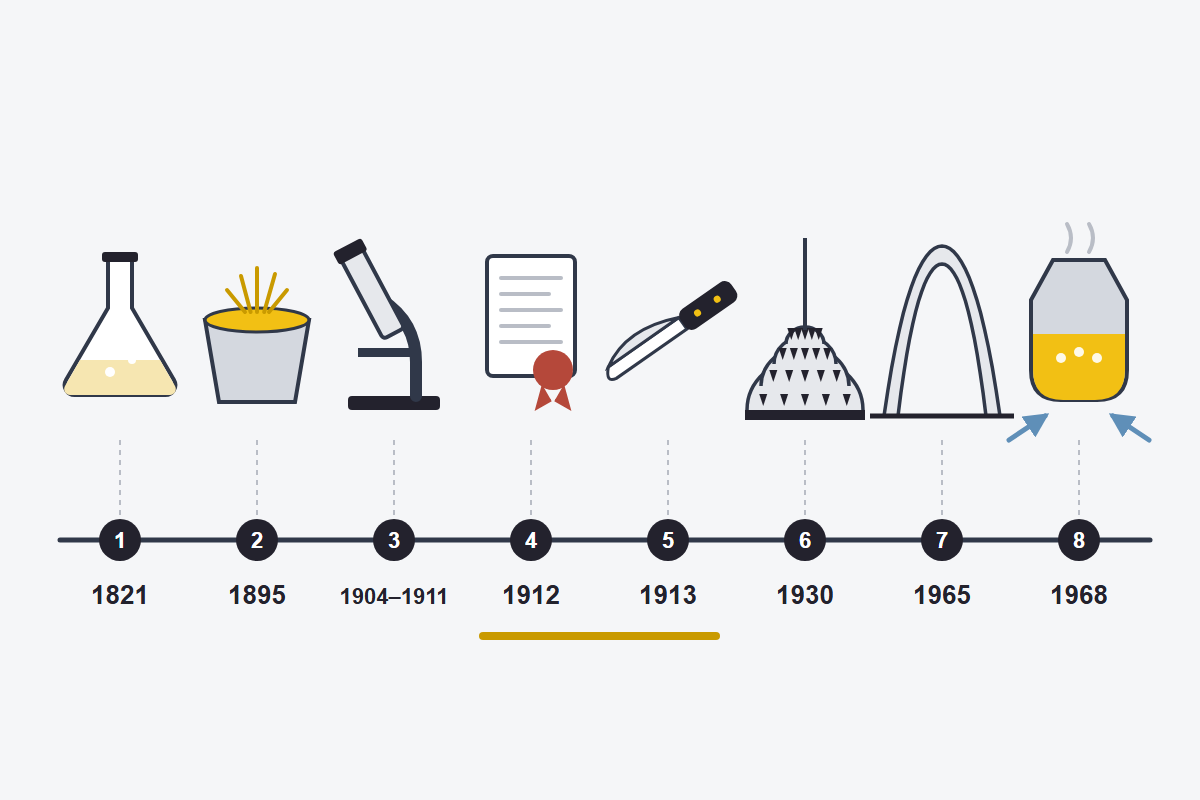
1 Berthier · 2 Goldschmidt · 3 Guillet, Portevin and Monnartz · 4 Krupp patents · 5 Brearley · 6 Chrysler Building · 7 Gateway Arch · 8 AOD process.
Stainless steel: steel with at least 10.5% chromium and no more than 1.2% carbon, under the European standard EN 10088-1. The chromium forms a transparent oxide film one to three nanometers thick on the surface, and the film heals itself when scratched. That is the standard's definition. In the shop we put it shorter, as the steel you do not paint, and both definitions hide the same thing: it took nearly a hundred years of attempts, and the man who got the credit was looking for something else.
In 1821 the Frenchman Pierre Berthier reported in the Annales des Mines that iron-chromium alloys resisted acids, the more so the more chromium they held. The most resistant had 60% chromium, scratched glass and crumbled in a mortar. It was useless. His knife steels, on the other hand, carried only 1 or 1.5% chromium, and what he liked about them was the damask pattern that came up when acid was wiped on. The following year in London, the cutler James Stodart and Michael Faraday tried steels with 1 and 3% chromium, credited Berthier as the first, and reported no corrosion resistance at all.
The obstacle was carbon, which pulls chromium away into carbides, and the chromium of the day came loaded with carbon. In 1895 Hans Goldschmidt patented in Essen the reduction of oxides with aluminum, which made carbon-free metals possible.
With clean chromium available, metallurgists started measuring. In Paris, Léon Guillet published series of chromium and chromium-nickel steels in 1904 and 1906 in which the three stainless families can be recognized today, although what he was after were mechanical properties. Albert Portevin noticed that steels above 9 or 10% chromium would not etch with laboratory reagents and published it in 1909. In 1911 Philipp Monnartz showed in the journal Metallurgie that above about 12% chromium the steel resisted nitric acid, and explained it with the idea of passivity.
In October 1912 Krupp filed two German patents for corrosion-resistant chromium-nickel steels, intended for gun barrels, turbine blades, vessels and pipes. They were filed in the name of Clemens Pasel, of the company's patent office, but rested on the work of the physicist Benno Strauss and the young metallurgist Eduard Maurer, who later fell out over who deserved the credit. Maurer received 5,000 marks in compensation, stayed unhappy and left Krupp in 1919. The austenitic family born from those patents was sold from the 1920s under the trademarks Nirosta, from nichtrostender Stahl, and V2A. Strauss, persecuted by the Nazi regime on racial grounds, was forced to retire in 1935 and died in September 1944 in the Vorwohle labor camp.
In Sheffield, Harry Brearley had a different problem. The son of a worker at the Firth steelworks, he had started work at 12 as a cellar lad and washing bottles in a laboratory, and by 1912 he ran the Brown-Firth Research Laboratories. A small-arms maker asked him to study the wear that firing gases caused inside gun barrels, and Brearley made steels with 6 to 15% chromium. When he prepared the samples for the microscope, the high-chromium ones barely etched, and he understood that this stubbornness was corrosion resistance. In August 1913 he cast, in an electric furnace, the steel with 12.8% chromium and 0.24% carbon that went down in history; sources disagree on the day.
He called it rustless steel. The name that stuck, stainless, is credited to Ernest Stuart, cutlery manager at R. F. Mosley, and the first knives came out in 1914. Brearley did not patent it at home, and in 1915 he left the laboratory over a dispute about patent rights.
In Kokomo, Indiana, Elwood Haynes had a patent for an iron-chromium alloy rejected in 1911 or 1912 because the alloy was not new. He filed again on March 12, 1915. Brearley filed his in the United States on March 29, seventeen days later. Brearley's was granted in 1916, for cutlery with 9 to 16% chromium, and Haynes's in 1919. Instead of fighting, they pooled their patents in the American Stainless Steel Company of Pittsburgh, which charged royalties by the ton to anyone making alloys with 8 to 60% chromium.
By the late 1920s, in Sheffield, W. H. Hatfield, Brearley's successor, had popularized 18/8, with 18% chromium and 8% nickel. In 1929 and 1930 the crown and spire of the Chrysler Building were clad in Nirosta 18/8 steel made in the United States to Krupp's formula.
In the 1930s, the great weakness of 18/8 showed up in welds. If the steel spends some time between about 425 and 900 °C, carbon and chromium form carbides at the grain boundaries, leaving a chromium-depleted zone around them that corrodes. In a welded part it shows as a band on each side of the bead, and it was named weld decay. In 1933 Bain, Aborn and Rutherford explained the mechanism. Out of that came the grades stabilized with titanium or niobium, 321 and 347, and later the L grades, with 0.030% carbon at most.
Stainless steel also gets dirty with someone else's iron. A grinder, a disc or a brush that has touched plain steel leaves particles on the surface, and weeks later brown stains appear that look like the stainless is corroding. In a serious shop, stainless tools are never shared.
Getting carbon that low without losing chromium was expensive, because the oxygen blown in to burn off carbon also oxidizes chromium. In 1954 William Krivsky, at Union Carbide's laboratories, mixed argon into the oxygen and saw carbon drop without the chromium going into the slag. The patent came in 1966, and the first plant started up in July 1968 at a small steelworks in Fort Wayne, Indiana. According to the technical literature, about three quarters of the world's stainless now goes through that process, AOD, and that is why 304L and 316L stopped being a luxury.
Three years earlier, on October 28, 1965, the last section of the Gateway Arch in St. Louis was set in place, clad in 1/4-inch type 304 stainless plate. Today is its 61st anniversary. When the National Park Service studied the stains on its skin, it found heat tint along the welds, spatter, poorly finished repairs and, at the base, chloride corrosion.
Those are the same stains we see when a stainless weld is poorly finished. The color TIG welding leaves, from straw to blue, is a warning that chromium went into the oxide and left a chromium-depleted layer underneath, easier to pit. A stainless wire brush takes the color off but not that layer, which only pickling removes. And pickling is not passivating: pickling removes a very thin layer of metal, and passivation helps the chromium film rebuild. That is why welding calls for L grades, an argon purge on the root and pickling at the end.
If your plant has a summer shutdown and pipe runs, a tank or a hopper in stainless need replacing, settle the grade and the welding before the material is bought. At Indumor we do TIG welding of stainless steel with final pickling, at our plant in Córdoba.
Sources: P. Berthier, Annales des Mines (1821); J. Stodart and M. Faraday, Philosophical Transactions (1822); patents DRP 96317, DRP 304126 and 304159, US 1,197,256, US 1,299,404 and US 3,252,790; E. Maurer, Stahl und Eisen 49 (1929); Neue Deutsche Biographie (Strauss, Maurer); Sheffield City Archives (2011); H. M. Cobb, The History of Stainless Steel (ASM, 2010); C. R. Simcoe, Advanced Materials & Processes (2015); NYC Landmarks Preservation Commission (1978); National Park Service; IMOA, Euro Inox and TWI.
Tell us what needs replacing and what it handles, and we will propose the grade and the welding.
© Indumor 2010–2026 — Industrial steel fabrication, Córdoba, Argentina
