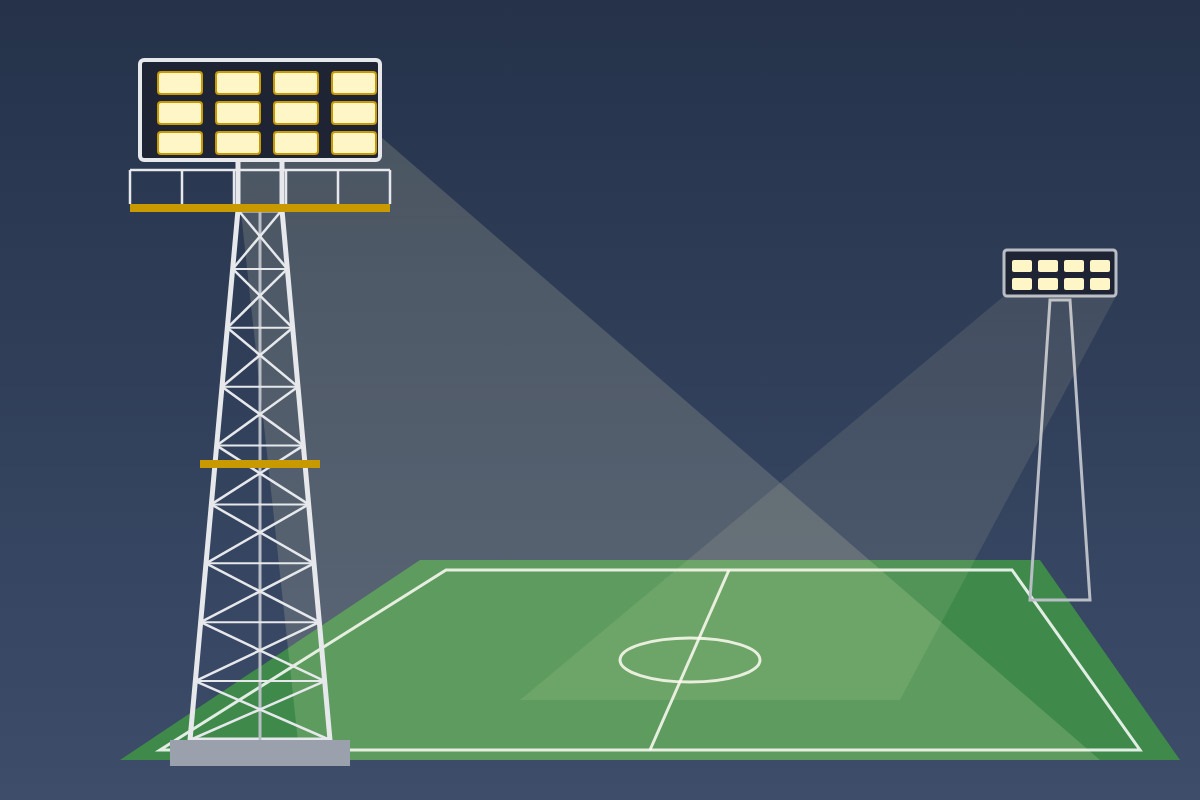
Every floodlight on a sports field is aimed at a precise point on the pitch. The lighting designer sets that point with angles of a few degrees, and the tower has to hold it in the wind for years. If the head moves, the light drifts from where it was calculated and the field ends up uneven. That's why, in these structures, strength is often not what governs the design. Stiffness is.
At Indumor we fabricate lattice towers and poles to light stadiums, club fields, truck yards and industrial or mining sites. We work from the lighting design's fixture schedule (number of floodlights, weight, wind area and mounting height), design the structure and deliver it in galvanized sections that bolt together on site.
Quote towersThree or four legs tied with bracing, in angles or tube. These are the stadium towers: they reach high with little weight, the wind passes between the members, and they go up in bolted sections. The ladder climbs inside or along one face, with its rest platforms.
A single shaft of rolled or brake-formed plate, tapering toward the top. It takes less room at the base and looks cleaner, so it's the usual choice for clubs, yards and entrances. Being slender, it's checked for strength and also for the vibration a steady, even wind can set off.
For stadiums and big heights, the lattice tower wins: for the same height it weighs less and deflects less at the top. At a club field or an industrial site, a pole does the job with less room and less upkeep. For small courts such as padel, tennis or five-a-side, we also make shorter poles in series.
A stiff head
Head displacement under service wind is limited, so the floodlights keep pointing where they were aimed.
A head frame to suit
The floodlight frame is designed for the number, weight and wind area of the fixtures, with room for electrical panels and a maintenance platform with guardrails.
Safe access
A fixed ladder with a cage or a ladder safety system. Argentina's Decree 351/79 requires a cage from 2.25 m and rest platforms every 9 m on fixed ladders.
Base and sections
Anchor rods set with a template in the foundation, and galvanized sections that fit the kettle and a truck. On site, a crane and bolts.
The lighting design (how many floodlights, what power, and where they point) belongs to the electrical designer or the fixture manufacturer; our part is a structure that holds it. If the project would rather avoid work at height, a pole with a lowering ring is an option: the floodlight ring comes down to the ground on a winch for maintenance. In that case the structure is designed around that system from the start.
Lattice towers or poles, galvanized, in bolted sections and with their ladder. Or email [email protected].
© Indumor 2010–2026 — Industrial steel fabrication, Córdoba, Argentina
