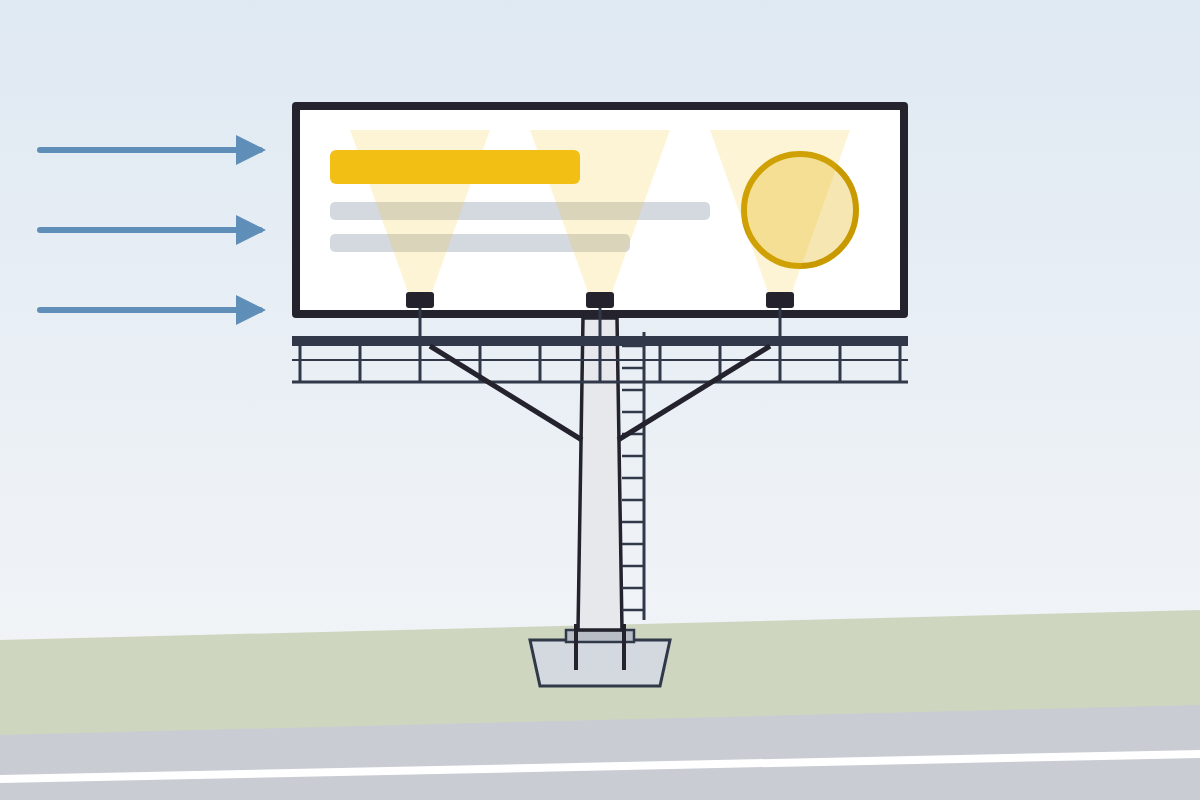
To the wind, a 12 × 4 m billboard face (about 40 × 13 ft) is a solid surface that lets no air through. Run a quick number with the reference speed that Argentina's CIRSOC 102 code sets for Córdoba and Buenos Aires (45 m/s in the 2005 edition, roughly 100 mph), open country and the bottom of the face 10 m up: the push comes out in the order of six tonnes-force, around 13,000 lbf. It doesn't act at ground level. It acts at the center of the face, 12 m up, and that whole lever arm runs down a single column into a single foundation.
At Indumor we fabricate billboard structures: monopoles, bipoles, frames for LED screens, and rooftop or wall-mounted signs. If the project already has its engineering, we build to those drawings. If it doesn't, we do the structural design with a calculation report under CIRSOC, which is what most municipalities in Argentina ask for before they approve a sign.
Quote a structureA single large-diameter tubular or polygonal column with the frame on top. It's the classic highway billboard: a small footprint, and the face lifted clear of trees and warehouses. It can carry one face, two back to back, or two opened in a V so the sign reads from both directions of traffic.
Two columns tied together by a beam or a truss. The moment is split between two smaller foundations, so it pays off when the face is very wide or the soil can't take one big footing.
A screen weighs far more than a vinyl and is serviced from behind. The frame carries the grid the modules fix to, a service catwalk at the back and room for electrical panels and ventilation. We build it to the screen supplier's drawings.
Here the structure sits on a building that was never designed for it. Before fabrication we check where the loads go and reinforce whatever needs it, so the wind on the sign doesn't end up in a slab or a wall that can't take it.
On a highway the answer is nearly always the monopole: one leg, little ground taken and the face up high. The bipole comes in when the face gets very large or the site makes the foundation difficult. We also make overhead sign gantries and cantilever sign supports, to the road authority's or the client's specifications.
The wind at the site
The design starts from the wind pressure at the location: the basic wind speed of the region, whether the terrain is open or built-up, and the height of the face.
The column base
A thick base plate, gussets and complete-joint-penetration welds. Wind pushes and lets go millions of times over a sign's life, and fatigue cracks start at poorly detailed joints.
Rods set by template
Anchor rods are cast in with a steel template that locks their exact position. One rod out of place and the column won't go on.
Bolted sections
The column is split into flanged sections that fit on a truck and in the galvanizing kettle. On site it goes up with a crane, with no welding.
The catwalk and the ladder are not extras. That's how the crew that changes the vinyl and fixes the floodlights gets up there, 12 m in the air and often in the wind. They come with a guardrail and a fixed ladder with a cage or a ladder safety system: Argentina's Decree 351/79 requires back protection from 2.25 m, and OSHA asks for fall protection above 24 ft, with a ladder safety system rather than a cage on new ladders.
Site and permits (the municipality, plus the road authority if the sign stands next to a highway) are handled by the sign owner. We supply the drawings and calculations those filings require.
Monopoles, bipoles and LED screen frames, galvanized and in bolted sections. Or email [email protected].
© Indumor 2010–2026 — Industrial steel fabrication, Córdoba, Argentina
