Updated October 29, 2026 · Indumor
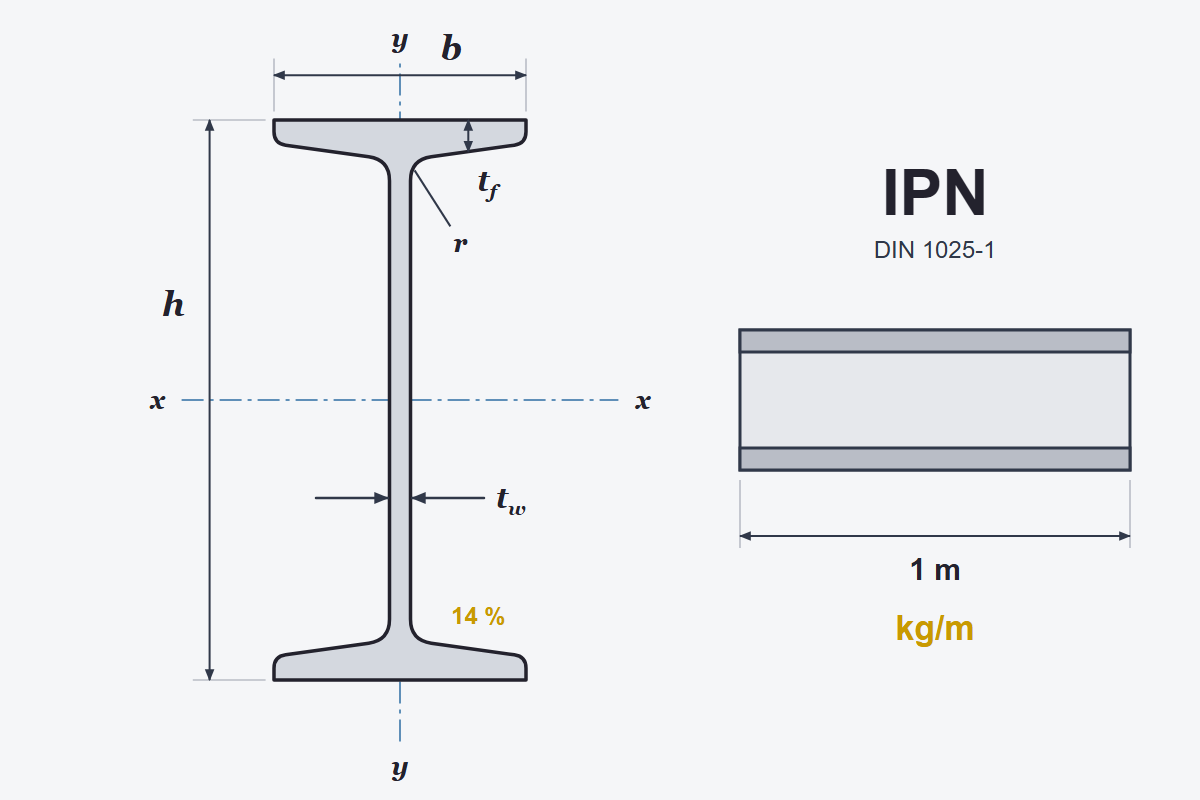
A 12-meter bar of IPN 80 weighs 71 kilograms, and two people can shoulder it. An IPN 600 of the same length weighs almost 2.4 tonnes and does not move without an overhead crane. Nineteen more sizes of the same family sit in between. All twenty-one are on this page, with the weight per meter and the properties used in design.
The first table is the one for buying and estimating: depth, flange width, thicknesses, area and kilograms per meter. The second belongs to the engineering office, with moments of inertia, section moduli and radii of gyration. Below them is a calculator that multiplies weight per meter by length and number of bars.
| Section | h mm | b mm | tw mm | tf mm | r mm | A cm² | Weight kg/m |
|---|---|---|---|---|---|---|---|
| IPN 80 | 80 | 42 | 3.9 | 5.9 | 3.9 | 7.57 | 5.94 |
| IPN 100 | 100 | 50 | 4.5 | 6.8 | 4.5 | 10.6 | 8.34 |
| IPN 120 | 120 | 58 | 5.1 | 7.7 | 5.1 | 14.2 | 11.1 |
| IPN 140 | 140 | 66 | 5.7 | 8.6 | 5.7 | 18.2 | 14.3 |
| IPN 160 | 160 | 74 | 6.3 | 9.5 | 6.3 | 22.8 | 17.9 |
| IPN 180 | 180 | 82 | 6.9 | 10.4 | 6.9 | 27.9 | 21.9 |
| IPN 200 | 200 | 90 | 7.5 | 11.3 | 7.5 | 33.4 | 26.2 |
| IPN 220 | 220 | 98 | 8.1 | 12.2 | 8.1 | 39.5 | 31.1 |
| IPN 240 | 240 | 106 | 8.7 | 13.1 | 8.7 | 46.1 | 36.2 |
| IPN 260 | 260 | 113 | 9.4 | 14.1 | 9.4 | 53.3 | 41.9 |
| IPN 280 | 280 | 119 | 10.1 | 15.2 | 10.1 | 61.0 | 47.9 |
| IPN 300 | 300 | 125 | 10.8 | 16.2 | 10.8 | 69.0 | 54.2 |
| IPN 320 | 320 | 131 | 11.5 | 17.3 | 11.5 | 77.7 | 61.0 |
| IPN 340 | 340 | 137 | 12.2 | 18.3 | 12.2 | 86.7 | 68.0 |
| IPN 360 | 360 | 143 | 13.0 | 19.5 | 13.0 | 97.0 | 76.1 |
| IPN 380 | 380 | 149 | 13.7 | 20.5 | 13.7 | 107 | 84.0 |
| IPN 400 | 400 | 155 | 14.4 | 21.6 | 14.4 | 118 | 92.4 |
| IPN 450 | 450 | 170 | 16.2 | 24.3 | 16.2 | 147 | 115 |
| IPN 500 | 500 | 185 | 18.0 | 27.0 | 18.0 | 179 | 141 |
| IPN 550 | 550 | 200 | 19.0 | 30.0 | 19.0 | 212 | 166 |
| IPN 600 | 600 | 215 | 21.6 | 32.4 | 21.6 | 254 | 199 |
These are the nominal values of DIN 1025-1, which Argentina adopts as IRAM-IAS U 500-511. Weight is the area times the density of steel, 7.85 kg/dm³, and already includes the fillets between flange and web.
| Section | Ix cm⁴ | Wx cm³ | ix cm | Iy cm⁴ | Wy cm³ | iy cm |
|---|---|---|---|---|---|---|
| IPN 80 | 77.8 | 19.5 | 3.20 | 6.29 | 3.00 | 0.91 |
| IPN 100 | 171 | 34.2 | 4.01 | 12.2 | 4.88 | 1.07 |
| IPN 120 | 328 | 54.7 | 4.81 | 21.5 | 7.41 | 1.23 |
| IPN 140 | 573 | 81.9 | 5.61 | 35.2 | 10.7 | 1.40 |
| IPN 160 | 935 | 117 | 6.40 | 54.7 | 14.8 | 1.55 |
| IPN 180 | 1450 | 161 | 7.20 | 81.3 | 19.8 | 1.71 |
| IPN 200 | 2140 | 214 | 8.00 | 117 | 26.0 | 1.87 |
| IPN 220 | 3060 | 278 | 8.80 | 162 | 33.1 | 2.02 |
| IPN 240 | 4250 | 354 | 9.59 | 221 | 41.7 | 2.20 |
| IPN 260 | 5740 | 442 | 10.4 | 288 | 51.0 | 2.32 |
| IPN 280 | 7590 | 542 | 11.1 | 364 | 61.2 | 2.45 |
| IPN 300 | 9800 | 653 | 11.9 | 451 | 72.2 | 2.56 |
| IPN 320 | 12510 | 782 | 12.7 | 555 | 84.7 | 2.67 |
| IPN 340 | 15700 | 923 | 13.5 | 674 | 98.4 | 2.80 |
| IPN 360 | 19610 | 1090 | 14.2 | 818 | 114 | 2.90 |
| IPN 380 | 24010 | 1260 | 15.0 | 975 | 131 | 3.02 |
| IPN 400 | 29210 | 1460 | 15.7 | 1160 | 149 | 3.13 |
| IPN 450 | 45850 | 2040 | 17.7 | 1730 | 203 | 3.43 |
| IPN 500 | 68740 | 2750 | 19.6 | 2480 | 268 | 3.72 |
| IPN 550 | 99180 | 3610 | 21.6 | 3490 | 349 | 4.02 |
| IPN 600 | 139000 | 4630 | 23.4 | 4670 | 434 | 4.30 |
Ix and Iy are the moments of inertia; Wx and Wy, the elastic section moduli that turn bending moment into flange stress; ix and iy, the radii of gyration that govern when the section works as a column and can buckle. Self-weight comes from here too: an IPN 200 adds 0.26 kN per meter to its beam.
The name says almost everything. IPN comes from the German abbreviation for a standard I section, and the number is the depth in millimeters: an IPN 200 is 200 mm deep. Flange width is not a round number, and it is the figure people forget. The classic mistake is ordering by depth alone and finding out in the shop that the 90 mm flange of an IPN 200 cannot seat a 100 mm plate.
Catalogs also list it as INP, and on site most people simply call it an I-beam, although IPE and wide-flange sections are I-beams too. Write the full series on the order: an IPE 200 and an IPN 200 share the same depth and are not interchangeable.
The flanges are not even, either. On the inside they slope at 14 %, thicker against the web and thinner at the tip, which is why the tf in the table is measured at an agreed point on the flange. The slope shows up when bolting: a bolt through the flange bears at an angle, and a taper washer with the same slope, the one in DIN 435, lets the nut sit square.
An IPN is strong in one direction only. For the IPN 200, the moment of inertia is 2140 cm⁴ about the strong axis and 117 about the weak one, roughly eighteen times less. Standing on edge it works well as a beam. As a long, unbraced column it swings sideways far sooner than one expects, and wide-flange sections or two UPN channels boxed together usually do better.
For a first sketch, a shop rule of thumb gets quoted a lot: beam depth around one twentieth of the span, so a 4 m span would suggest a 200 mm section. It is good for a preliminary drawing and nothing else, because it knows nothing about the load, the supports or how much the beam may deflect.
Against the IPE, with its parallel flanges, the IPN loses on efficiency. An IPE 200 weighs 22.4 kg/m with a section modulus of 194 cm³; the IPN 200 weighs 26.2 kg/m for 214 cm³. That is 3.8 kilograms more per meter for 10 % more bending strength. The IPN is still around because it is available, because many older drawings call for it and because its bottom flange is the running track for hoist trolleys on monorails and on single-girder overhead cranes.
The series is more than a century old. The German standard section series was fixed in 1881 as one common list of sizes for every rolling mill. It was promoted by the VDI engineers' association and the federation of German architects' and engineers' associations, and drafted by two engineers from Aachen, Friedrich Heinzerling and Otto Intze. The point was simple: a drawing should not depend on which mill rolled the beam. DIN 1025-1 descends from that list, a story we tell in the history of the I-beam.
In Argentina, the usual steel for these sections is grade F-24 to IRAM-IAS U 500-503, with 240 MPa yield and 370 MPa tensile strength; F-26 is available on request in the small sizes. The domestic catalog goes up to IPN 500, and distributors mostly stock IPN 80 to 240. How far each dimension may stray from the table is set by EN 10024. Design uses the nominal values; for a tight fit, measure the bar that arrived. Measure twice, cut once. Bars also come with a slight bow within tolerance, and a long beam goes up with that bow facing upward, crown up.
On a drawing or a bill of materials, the section is written as series, depth and length: IPN 200 × 5900 is an IPN 200 cut to 5.9 m. That length is no accident: two 5.9 m pieces come out of one 12 m bar with a short offcut. A 6.2 m piece, on the other hand, takes a whole second bar, and the 5.8 m left over sits in the yard waiting for another job.
When even the IPN 600 falls short, or a depth is needed that the series does not have, the answer is a built-up girder welded from plate. We explain it in welded I-beams, and the built-up beam tool in our engineering Suite sizes one.
How much does an IPN 200 weigh per meter?
26.2 kg. A 12 m bar weighs about 314 kg.
What is the difference between IPN and IPE?
IPN flanges slope at 14 %; IPE flanges are parallel. At the same depth the IPE weighs less and bolts up without taper washers.
Is the table enough to pick a beam?
The table gives the section properties. The load a beam can carry also depends on span, supports and bracing, and that has to be calculated.
What lengths are available?
In 12 m bars, the standard length. IPN 80 and 100 also come in 6 m.
If your IPN beams need to arrive cut to length, drilled or welded into a structure, that is everyday work at Indumor. Send us the list of sections and lengths and we will quote the finished job.
We deliver them cut, drilled or welded into the structure.
© Indumor 2010–2026 — Industrial steel fabrication, Córdoba, Argentina
