October 29, 2026 · Indumor
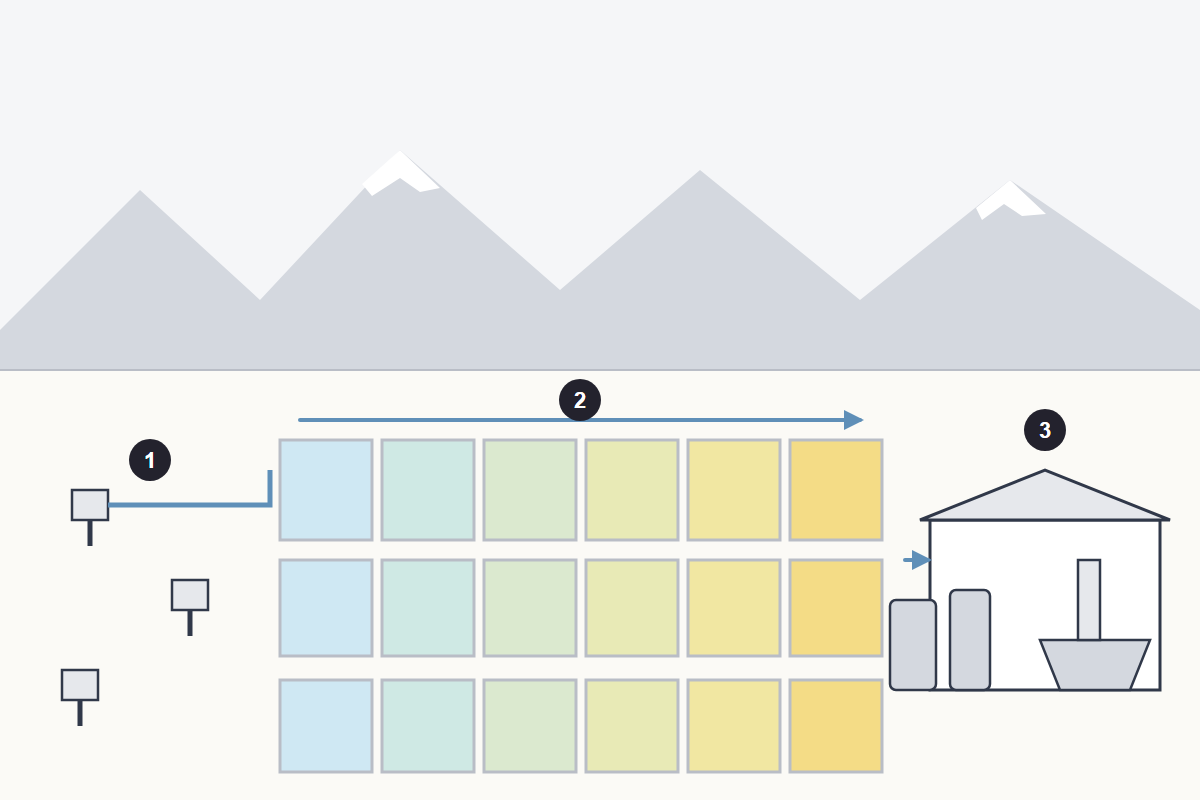
1 Brine wells · 2 Evaporation ponds · 3 Carbonate plant.
On February 21, 1991, in San Fernando del Valle de Catamarca, a contract was signed over a salt flat that Fabricaciones Militares, the state defense manufacturing agency, had been studying since the 1970s. The signatories were that agency, the government of Catamarca, represented by governor Ramón Saadi, and the American company FMC, which took the usufruct of the Hombre Muerto salt flat for twenty years, with an option for twenty more. Three years later Fabricaciones Militares handed all its rights to the province free of charge, and the company committed to build a pilot plant, a laboratory and the first industrial ponds that same year. A geologist, Gonzalo Tufiño, signed for the company, and he later led the start-up with chemists and geologists from the National University of Salta.
That contract produced Fénix, which ran at pilot scale in 1997 and commercially in 1998, the country's first commercial lithium-from-brine operation. Before it there was hard-rock lithium, hand-sorted in quarries in San Luis and Córdoba from the mid-1930s. After it came Olaroz in Jujuy, Cauchari-Olaroz, Centenario in Salta and the projects approved under the RIGI investment regime. In 2025 Argentina produced 23,000 tonnes of contained lithium, about 122,000 tonnes of lithium carbonate equivalent, and ranked fifth in the world according to the United States Geological Survey (USGS).
The country's first lithium mining was not in the Puna but in the pegmatites of the Sierras Pampeanas, coarse-grained rocks where spodumene grows crystals you can see with the naked eye. San Luis began producing in the mid-1930s, and the La Viquita pegmatite reportedly yielded some 2,400 tonnes of spodumene between 1939 and 1945, according to Brodtkorb's compilation. The figures from that era do not add up against each other and are only an order of magnitude. The ore went mostly into ceramic glazes, the surplus was exported to the United States, and a few tonnes of lithium carbonate were imported to make chloride and fluoride for welding aluminum.
Córdoba had its share too. At Las Tapias, 12 kilometers from Villa Dolores, the Arce adit produced spodumene between 1960 and 1970, with crystals up to two meters long. In recent years, though, all Argentine lithium has come from the salt flats.
The first to notice the lithium in the salt flats was the chemist and geologist Luciano Catalano, who traveled the Puna in the 1920s and 1930s. In 1964, as undersecretary of mining under President Illia, he published a book that treated lithium as a critical element and called for a state reserve on it. The reserve was never declared. His study of Hombre Muerto was the only geological work on that salt flat until the companies arrived.
Between 1969 and 1974, Fabricaciones Militares explored the salt flats of Jujuy, Salta and Catamarca under its Salt Flats Plan, and the university in Salta came in through another door. In the 1970s, the Chilean geologist Guillermo Chong gave a talk there about the lithium of Atacama. In the audience were Antonio Igarzábal and Rolando Poppi, who split the work between them: one took the geology of the salt flats, the other the chemistry of the brines.
In 1980, Law 22,259 moved lithium into the first category of the Mining Code, the substances the state grants to private parties. In that same decade, the Salta businessman Luis Party tried to produce lithium from the Rincón salt flat with technical backing from Igarzábal and Poppi. It did not work. He ran short of capital, and the brine carried so much magnesium that separating the lithium cost too much.
Fénix sits at about 4,000 meters, on a salt flat of some 600 square kilometers that gets 100 millimeters of rain a year and winter nights down to minus 30 degrees Celsius. The investment in the 1990s was around 150 million dollars. The plant does more than evaporate. Brine first goes through a selective adsorption plant that uses fresh water to separate the lithium, then it is concentrated in solar ponds and finishes in the carbonate plant, where it reacts with sodium carbonate. Another share becomes lithium chloride in General Güemes, Salta.
The sources disagree on the start date. One academic paper speaks of production from 1995, but the company's own technical report gives 1997 for the pilot plant and 1998 for commercial production, and those are the dates used here. In 1998 the plant produced 2,254 tonnes of lithium in concentrated brine. Ownership changed several times. FMC spun the business off as Livent in 2018 and 2019, Livent merged with Allkem into Arcadium in January 2024, and Rio Tinto bought Arcadium in March 2025.
Jujuy declared lithium a strategic natural resource by a decree in March 2011, later approved by provincial Law 5674. In December 2014 Olaroz opened at Susques, the country's second brine project, and at the end of April 2015 it shipped its first carbonate to Japan. Cauchari-Olaroz started producing in June 2023, and in July 2024 Eramet opened the Centenario plant in Salta, which according to the company extracts the lithium in a week, against the 12 to 18 months the ponds take.
The RIGI sped up what was already under way. Rio Tinto's Rincón, in Salta, was the first mining project approved, on May 20, 2025. Galan's Hombre Muerto West followed in July, and the Fénix expansion was announced in March 2026.
One line keeps turning up in talks, articles and supplier presentations: that Argentina has the largest lithium reserves in the world. Don't use it. According to the 2026 edition of the USGS summaries, the largest reserves belong to Chile, with 9.2 million tonnes of contained lithium, and Argentina has 4.4, tied for fourth with the United States. What Argentina does have is the largest identified resources, 28 million tonnes. Reserves are what can be extracted at a profit today; resources are everything known to be there. And don't mix tonnes of lithium with tonnes of carbonate: one tonne of lithium equals 5.3 of carbonate.
In 1994, the Fénix contract called for a pilot plant, a laboratory and evaporation ponds. Thirty years later, the Rincón environmental impact report describes a tank farm, reactors, adsorption columns, filter presses, drying and micronizing, all set on modular steel structures covering some 50,000 square meters. The ponds are earthworks and geomembrane. Nearly everything else is steel, and it has to stand up to brine and to the Puna cold.
Fénix has been producing for almost three decades on the same basic idea from 1997, and in 2026 it added an expansion. If you are putting together a project on a salt flat and need tanks or structures for the plant, Indumor fabricates them with those conditions in mind.
Sources: the Hombre Muerto salt flat contract and its amendments (exhibit 10.9 to Livent's S-1 filed with the SEC, 2018); Livent, Fénix technical report (S-K 1300, 2023); R. N. Alonso, M. K. de Brodtkorb and E. Calvo in Litio. Un recurso natural estratégico (ANCEFN, 2017); F. Nacif, "La prehistoria del litio en Argentina" (Divulgatio, 2020); USGS, Mineral Commodity Summaries 2026; Jujuy Law 5674 (2011); Eramet (2024) and Rio Tinto (2025 and 2026) releases; Rincón Environmental Impact Report (2024).
We fabricate tanks and structures for lithium plants in the Puna.
© Indumor 2010–2026 — Industrial steel fabrication, Córdoba, Argentina
