October 31, 2026 · Indumor
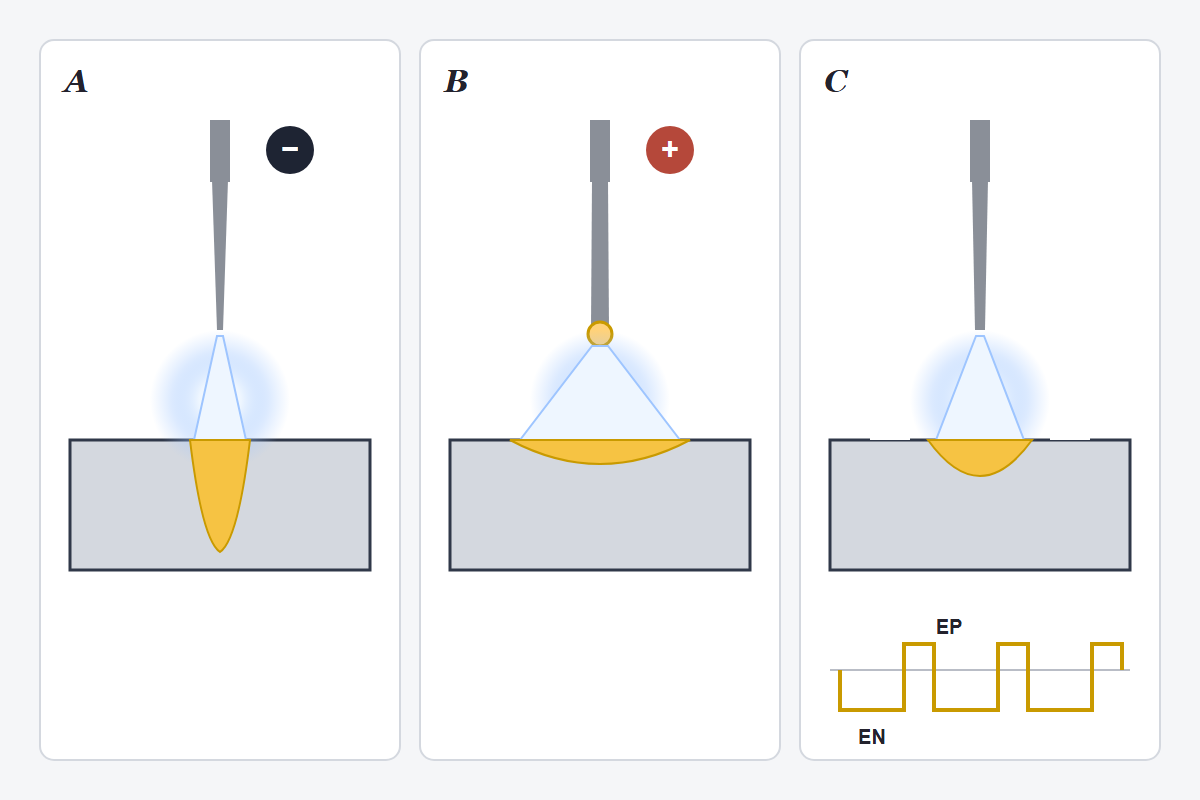
A electrode negative: most of the heat goes into the part, narrow and deep penetration. B electrode positive: the tungsten overheats and the pool is wide and shallow. C alternating current: below, a square wave with its cleaning part (EP) and its penetration part (EN).
“This won't work without AC.” So says the welder trying a first aluminum bead with the machine on DC, watching the metal wrinkle under a gray skin that refuses to melt. They are right, and the explanation fits in two paragraphs.
On DC with the electrode negative, the normal way to run TIG, electrons leave the tungsten and strike the work, and about two thirds of the heat, close to 70 %, stays in the plate: narrow, deep penetration and a cool, steady tungsten. That is how carbon steel, stainless, copper and titanium are welded. On AC, the current reverses direction many times a second; in the positive half, the stream of ions breaks up the oxide layer on aluminum, which melts above 2,000 °C while the aluminum itself melts at 660, and in the negative half the arc penetrates. That is why aluminum and magnesium are welded on AC.
What follows fine-tunes those two ideas.
With the tungsten connected to the positive side, the split reverses: the tungsten takes most of the heat and the work very little. The pool comes out wide and shallow, and the tungsten has to be much thicker for the same current or its tip melts. It is used little, and for special cases. It is the cleaning half of AC, which is why AC heats the tungsten more than DC does.
Inverter sources let you choose how much of each cycle is negative and how much positive. More time negative gives more penetration, a narrower arc and a cooler tungsten; more time positive, more cleaning and a wider white band along the bead, the trademark of cathodic cleaning. The typical setting for clean aluminum leaves most of the cycle negative, with just enough cleaning to break the oxide; on inverters that show balance as the percentage of negative time, something around 65 to 75 % is a common place to start. Turning cleaning up “just in case” heats the tungsten, widens the pool and cleans nothing a brush would not have cleaned first.
Transformer machines run AC at mains frequency, 50 or 60 cycles per second. Inverters can raise it to a hundred, two hundred or more, and the arc becomes narrower and stiffer: it aims better into a fillet or a corner. Lowering it widens the arc and the pool. On thin aluminum sheet, a high frequency helps avoid burning through. Some allow a square wave too, with near-instant reversals that keep the arc steadier than the sine wave of older machines.
Transformer machines deliver a sine wave, which crosses zero gradually: at every crossing the arc tends to go out, so high frequency works the whole time to keep it lit. Inverters deliver a square wave, which reverses almost instantly, and use high frequency only to start. That is why AC sounds smoother on an inverter, the arc aims better and balance and frequency can be set precisely. Both weld aluminum; the difference is control.
An arc on DC electrode negative is quiet and still, with the pool forming right under the tungsten. AC buzzes, and around the pool appears the white band of cleaning, wider the more positive time the balance has. If that band disappears and the pool looks dirty, cleaning is short or the part was not prepared; if it is very wide and the tungsten balls up, there is too much. Many welders end up setting balance by eye, watching that band.
Carbon steel, stainless, copper, titanium and nickel: DC, electrode negative. Aluminum and magnesium: AC, with balance and frequency set by thickness and cleanliness. Copper and its alloys stay on DC, with plenty of current or with helium, because they conduct heat even better than aluminum. A shop rule: if the metal grows an oxide skin that will not melt with the pool, it goes on AC.
There is one exception that proves the rule: mechanized welding of thick aluminum on DC electrode negative under helium, where a hot, deep arc does the job without a cleaning half, provided the joint has been scrupulously cleaned first. It is a specialist technique, not a shop habit.
A scene that repeats among beginners: welding aluminum on AC with the tungsten ground to a fine point and cleaning at maximum. The point melts, the little ball drops into the pool and leaves an inclusion. Tip shape and balance go together. That is all.
In summary: DC electrode negative for almost everything, AC for aluminum, and balance and frequency to fine-tune the AC. If you have aluminum or stainless parts to weld, Indumor quotes them from the welding services page. To keep going: lesson 5, on tungstens; lesson 10, on aluminum; the guide to 304 or 316 stainless; and the one on which steel to choose.
Think of the answer before you open it.
DC with the electrode negative: about two thirds of the heat goes into the work and the tungsten runs cool.
Because in the positive half of the cycle the arc breaks up the oxide layer, which melts above 2,000 °C, and in the negative half it penetrates.
The tungsten heats up, the pool widens and penetration drops, without cleaning more than a good brushing beforehand would.
It makes the arc narrower and stiffer, so it aims better in fillets and corners.
We TIG weld them on DC or AC, depending on the metal.
© Indumor 2010–2026 — Industrial steel fabrication, Córdoba, Argentina
