October 31, 2026 · Indumor
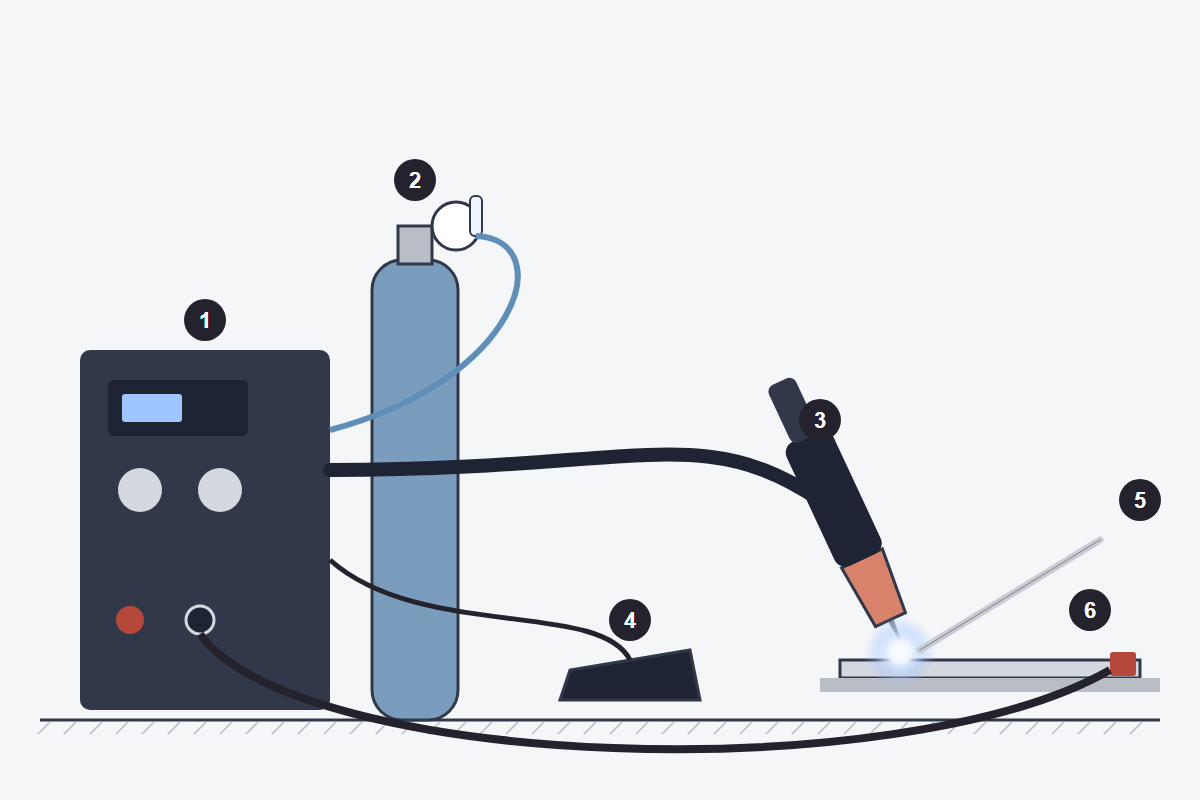
In the drawing: 1 constant current power source, 2 argon cylinder with regulator and flowmeter, 3 torch with ceramic cup, 4 current foot pedal, 5 filler rod, 6 work clamp on the table.
It happens in almost every shop on someone's first day with a TIG machine: they rest the tungsten on the plate to strike the arc, as if it were a stick electrode, and the tip ends up stuck, contaminated and wearing a little ball of metal. This lesson goes through the equipment the way it is used, from the moments before the arc to the seconds after it goes out, so that does not happen.
The power source holds the current you set and lets the voltage follow the arc length. For steel and stainless it runs on direct current; to weld aluminum, it has to be able to deliver alternating current. The torch holds the tungsten in a collet, inside a ceramic cup that directs the gas. Cups are numbered by their bore in sixteenths of an inch: a No. 6 is about 9.5 mm (3/8 in). Many torches carry a gas lens, a mesh that straightens the stream so it flows evenly, which lets the tungsten stick out further without losing shielding. Up to about 150 or 200 A, torches are usually cooled by the gas itself; above that, by water. A water-cooled torch is also slimmer and lighter for the same current, which helps in tight spots, at the cost of a cooling unit and two more hoses.
Argon arrives through a regulator with a flowmeter. And everything should be within reach before the helmet comes down: the rod, the clean part and the work clamp firmly placed, because with both hands busy there is no way to fix anything afterward.
The arc strikes without touching the work. High frequency fires a high-voltage spark that ionizes the air between tungsten and plate and opens the way for the arc. Sources without it, or places where it is unwelcome because it interferes with nearby electronics, use lift-arc starting: the tungsten touches down at very low current, lifts off, and only then does the source ramp up to welding current. Scratching the tungsten across the plate at full current is the mistake from the opening scene.
Current is controlled with a foot pedal or a torch-mounted control. With the pedal, the welder starts gently, comes up as the pool forms and backs off near an edge or at the end. Sources with a four-step function do the same with the trigger: upslope, welding current and downslope.
The downslope shrinks the pool gradually and fills the crater, which can crack if the arc is cut off abruptly. Then gas keeps flowing for a few seconds, the post-flow, to protect the tungsten and the bead while they cool. A tungsten that ends up blue or black is saying the post-flow was too short.
In short: a constant current source, non-contact starting, current at your foot and gas before, during and after. At Indumor we TIG weld whatever needs that control; tell us about the job from the welding services page. To keep going: lesson 4, on DC and AC; the MIG equipment lesson, for comparison; the guide to welding gases; and the one on welding tables.
Think of the answer before you open it.
To strike the arc without touching the work: a high-voltage spark ionizes the air and opens the way for the arc.
The tungsten touches down at very low current, lifts off, and only then does the source rise to welding current. It avoids high frequency.
Its bore in sixteenths of an inch: 8/16, about 12.7 mm (1/2 in).
To keep shielding the tungsten and the bead with gas while they cool after the arc is broken.
Stainless, aluminum and pipe roots, welded in our shop.
© Indumor 2010–2026 — Industrial steel fabrication, Córdoba, Argentina
