October 31, 2026 · Indumor
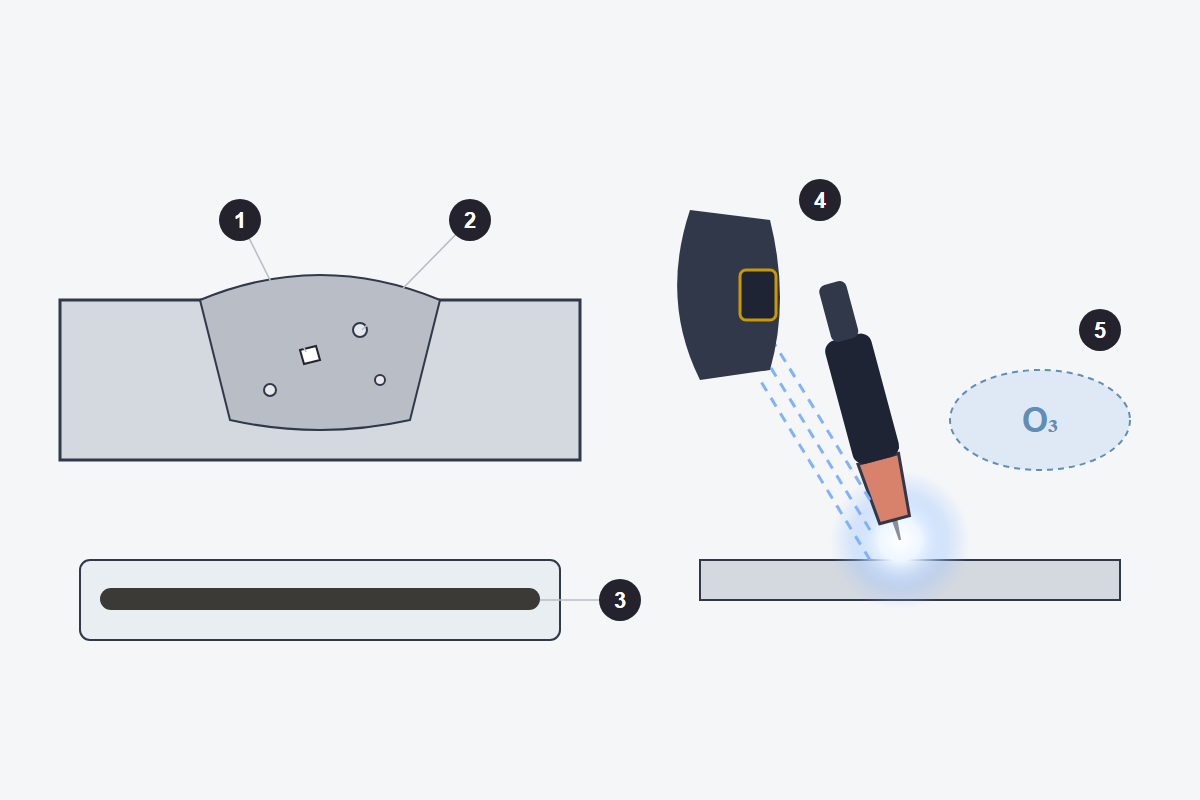
On the left: 1 tungsten inclusion, 2 porosity, 3 root sugared from lack of purging. On the right: 4 ultraviolet radiation from the arc toward the helmet, 5 ozone forming in the nearby air.
Because it makes almost no smoke, TIG looks like the healthiest process in the shop. On smoke, it is. On radiation it is the opposite: the argon arc gives off a great deal of ultraviolet, burns exposed skin in a short time and forms ozone in the surrounding air. This lesson puts the process's defects together with its hazards, because in both cases the source is the same: a clean, concentrated arc that does not forgive carelessness.
The tungsten inclusion is TIG's own defect. It appears when the tungsten touches the pool or the rod, when the current is too high for its diameter and the tip melts, or when the ball drops off on AC. On a radiograph it shows as a white spot, denser than the steel. Porosity comes from the gas: drafts, badly set flow, a cracked cup or a dirty rod; on aluminum, almost always from hydrogen. Oxidation of the bead, which leaves it gray or black, points to insufficient shielding or a short post-flow, and a sugared root to a lack of purging. Lack of fusion appears with too little current or too much speed, and the crater crack when the arc is cut off abruptly.
As for safety, the arc's ultraviolet radiation burns eyes and skin. The helmet filter is chosen by current: OSHA sets a minimum shade of 8 up to 150 A and 10 above that, and ANSI Z49.1 recommends 10, 12 and 14 as the amps go up. Ozone forms when the arc's light acts on the oxygen in the air, and it increases when welding aluminum, because of the higher currents, the pure argon and a metal that reflects the radiation. Dust from thoriated tungsten is mildly radioactive. And high frequency can interfere with electronic equipment and with pacemakers.
At the station, all of that turns into habits. A tungsten that touched the pool is cut back and reground, not left “to see if it cleans itself.” The rod and the part are cleaned before starting, the flow is checked and the post-flow is allowed to run. Stainless roots are purged. And before a run of parts, a test coupon confirms that everything is in place.
Protection is an everyday matter too. A helmet with the shade the current calls for, long sleeves and a covered neck, because a TIG burn on the neck and wrists shows up hours later, like sunburn. Thin goatskin gloves, which give feel but little protection from heat: the tip of the rod burns even when it is no longer red. Extraction close to the arc, without sweeping away the shielding gas, when welding aluminum or in enclosed spaces, because of the ozone. And safety glasses under the helmet for brushing or grinding. Radiation also bounces off light-colored walls and off aluminum or polished stainless sheet, so the screens around the station are chosen dark and non-reflective.
The first check is the eye, and in TIG it tells a lot: a silver, even bead with regular ripples is almost always well shielded; a gray, dull or dark-scaled one is not. Dye penetrant shows cracks and pores that reach the surface. Radiography shows what is inside, and there the tungsten inclusion appears as a white spot, the reverse of pores, which show dark. In sanitary tubing, the root is checked from inside with a borescope, a slim camera that travels through the pipe. Tungsten inclusions are not only a radiography problem: in a bend test they can start a crack, one more reason to stop and regrind.
High frequency deserves its own care. It travels through the cables and through the air, and it can affect computers, machine controls and communication equipment nearby. It is reduced with short torch and work cables run close together, a good earth connection on the power source and distance from sensitive equipment. People with pacemakers or other electronic implants should not be near a TIG machine with high frequency without first consulting their doctor.
There is one shop scene worth stamping out: grinding thoriated tungsten on the ordinary bench grinder, with no extraction, while the gray dust hangs in the air at face height. That dust is not to be breathed. Grind with extraction, on a dedicated wheel, or switch to a thorium-free tungsten.
And one hazard people forget: the argon that fills a pipe or tank for purging displaces the oxygen. Nobody puts their head into a purged pipe or climbs into a vessel without measuring the oxygen first.
Once you are back at a TIG machine, look at the tungsten after every bead: if the tip is still clean and silver, shielding and technique are in order. To keep going: lesson 12, on pipe roots; how health is protected in MIG-MAG; welding defects in general; how gases are separated from air; and TIG welding at Indumor.
Think of the answer before you open it.
The tungsten inclusion: it appears when the tungsten touches the pool or the rod, or when the current is too high for its diameter and the tip melts.
Because the arc's ultraviolet radiation acts on the oxygen in the air; it increases when welding aluminum, with its higher currents and a metal that reflects the radiation.
Breathing a mildly radioactive dust. Grind with extraction or switch to a thorium-free tungsten.
Because argon displaces oxygen and can asphyxiate without warning.
We TIG weld with a test coupon when the job calls for it.
© Indumor 2010–2026 — Industrial steel fabrication, Córdoba, Argentina
