October 31, 2026 · Indumor
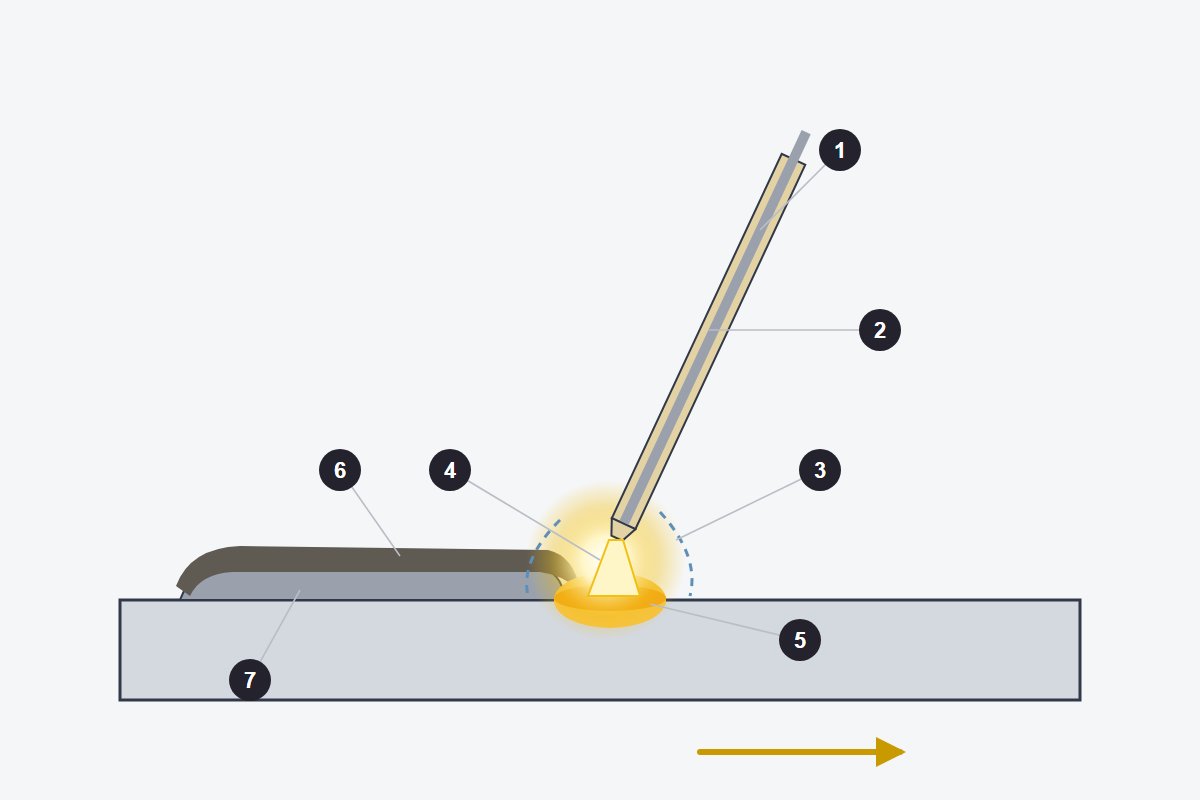
In the drawing: 1 steel core wire, 2 covering, 3 gas produced as the covering burns, 4 arc, 5 weld pool, 6 molten slag rising and solidifying on top, 7 bead under the slag. The arrow shows the direction of travel.
Why, with so many wire welders in shops, does an electrode holder still show up on almost every job site? The answer lies in how the oldest process still used every day actually works.
The electrode is a steel rod, the core, covered with a layer of flux called the covering. It is clamped in a holder connected to the power source, the arc is struck against the work and the core starts to melt and pass into the pool as filler metal. At the same time the covering burns. Part of it turns into gas, which displaces the air around the arc; part of it melts, floats on the pool and solidifies as slag, a crust that protects the bead while it cools and is chipped off afterward. The slag also slows the cooling a little, which helps the joint. ISO 4063 numbers it as process 111, and North American codes call it SMAW, shielded metal arc welding.
The power source is constant current, the opposite of a MIG machine, because here it is the hand that feeds the electrode in as it burns away. The most common electrodes are 2.5 to 4 mm (3/32 to 5/32 in) in diameter and 35 to 45 cm (14 to 18 in) long, and each one lasts a minute or two of arc. Then it gets changed, leaving a stub of about 5 cm (2 in) on the floor.
Against MIG-MAG, stick loses on almost everything you measure with a stopwatch. You stop to change rods every few minutes, chip slag between passes and throw away stubs, and the welder needs more practice hours to lay an even bead. On a production line, wire wins by a mile.
It wins on everything else. It needs no gas, so wind does not bother it. The set is a power source, two cables and a holder, and it can be an engine-driven welder out in a field, far from any outlet. It welds in every position and on parts that fit in no booth, and there are electrodes for almost any steel, including stainless, cast iron and hardfacing.
In the shop, the stick holder hangs next to the wire machines and comes out for welding outdoors, at height or on a structure that is already standing. On site the roles flip: it is the everyday tool.
For shop production, MIG-MAG. For field erection, pipelines, repairs, maintenance and anywhere with wind or no gas supply, stick. Many jobs use both: steel fitted up and wire-welded in the shop, field connections welded with stick on site. Neither process replaces the other.
Next time you watch a pipeline welder at work in the field, notice the rhythm: weld, break the arc, chip, brush and change the rod without looking. That rhythm is what this course takes apart piece by piece. To keep going: lesson 2, which runs from Petrov to the covered electrode, the comparison of MIG, TIG and stick, and Indumor's welding services, in the shop and in the field.
Think of the answer before you open it.
It produces gas, which pushes air away from the arc, and it forms slag, which floats on the pool and protects the bead as it cools.
Because the welder feeds the electrode in by hand as it burns: with constant current, heat stays the same even if the arc length changes a little.
It needs no gas, so it works in the wind, and the equipment is simple and portable: you can weld with an engine-driven machine far from everything.
In productivity: the rod has to be changed every minute or two, the slag chipped off and the stubs thrown away.
We weld with stick and MIG-MAG, in the plant and during erection.
© Indumor 2010–2026 — Industrial steel fabrication, Córdoba, Argentina
