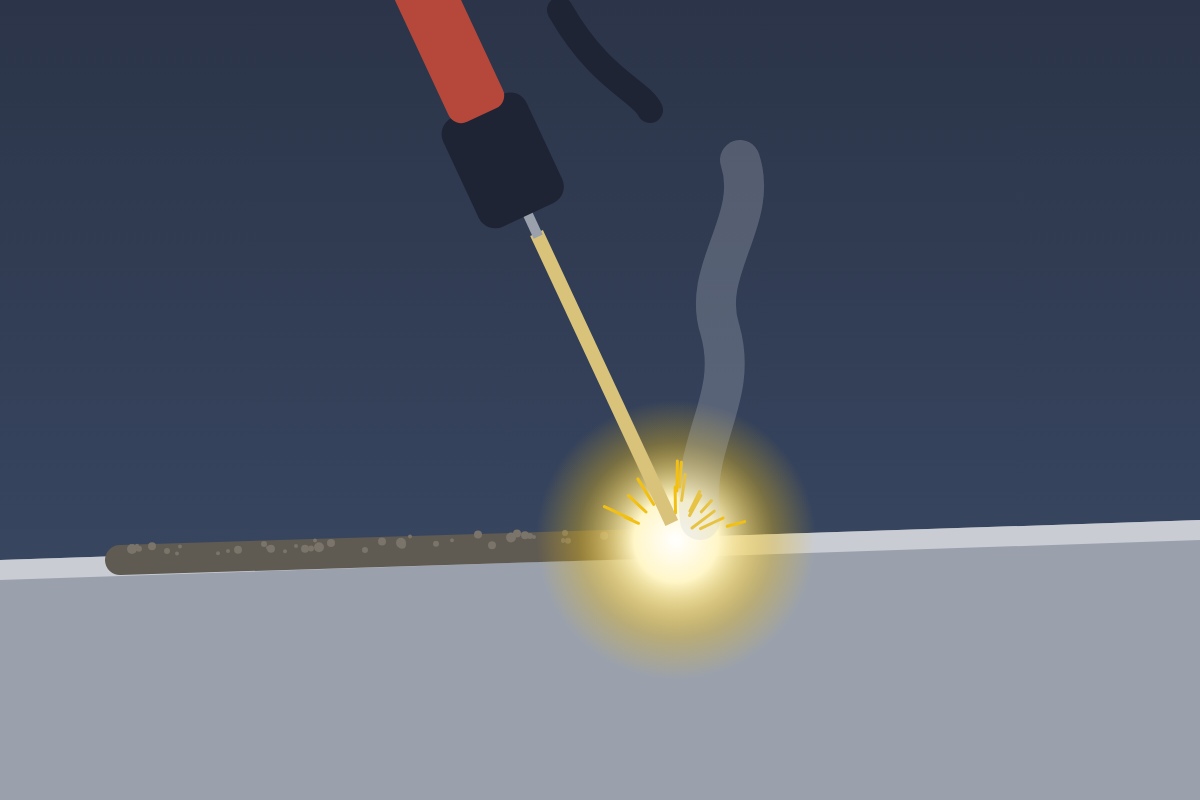
The easiest process to take to the field, explained from the covering to qualification.
The covered electrode still welds where the wind blows the gas away and no wire feeder can reach: construction sites, pipelines, repairs and erection. This course covers the power source, what the covering does, how to read a classification, storing low-hydrogen rods, settings, positions and the defects of the process.
A free theory course from the Steel Knowledge Hub of Indumor.
Welders, technical school students and site supervisors. You do not need to know how to weld to start.
The same as the MIG-MAG course: one principle per lesson, shop numbers and a self-test at the end.
The eleven new lessons and both appendices are published; lesson 2 is the history of electric welding. The TIG course comes next.
The arc, the power source and the covering.
1What stick welding isThe principle, the names of the process and why it is still around.Read 2History: from Petrov to the covered electrodeHow electric welding was born and why the covering changed everything.Read 3The power source: transformer, rectifier and inverterConstant current, AC and DC, and polarity.Read 4What the covering doesRutile, low-hydrogen, cellulosic and iron-powder types.ReadChoosing, storing and setting.
5How to read an E6013, E7018 or E6010The AWS A5.1 and ISO 2560 classifications.Read 6Which electrode for each jobBy steel, position and demand.Read 7Drying and storageHydrogen, ovens and why a damp low-hydrogen rod cracks.Read 8Current, arc length and travel speedHow to set it and how to read the bead.ReadTechnique, defects, safety and qualification.
9Striking, technique and positionsFrom flat to overhead, and pipe in 6G.Read 10Stick welding defectsSlag inclusions, arc blow, porosity and arc strikes.Read 11Stick welding safetyElectricity, fumes and burns.Read 12Procedures and qualificationWPS, test coupons and welder qualification.ReadStructures, tanks, piping and custom parts, with qualified procedures and welders when the job calls for them.
© Indumor 2010–2026 — Industrial steel fabrication, Córdoba, Argentina
