October 31, 2026 · Indumor
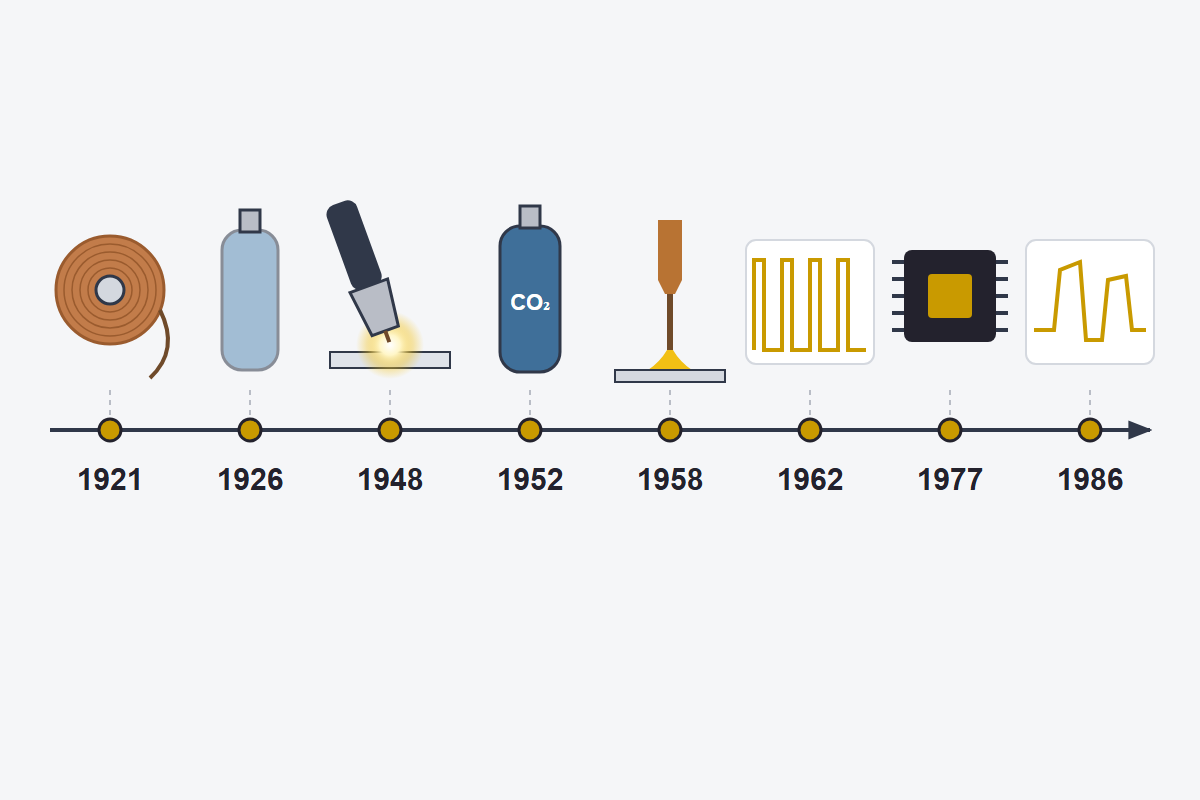
1921 continuous wire without gas · 1926 arc in helium and in argon · 1948 MIG, for aluminum · 1952 CO₂ · 1958 short-circuit · 1962 pulsed · 1977 synergic · 1986 controlled short-circuit.
The process that welds more steel today than any other was not born for steel. The first patent application for what would later be called MIG, filed in the United States on July 28, 1948, was for welding aluminum: that is how the patents it led to in Europe were titled. Steel came later, and it took quite a bit longer than the usual story says.
The underlying idea was old. In July 1921, Paul O. Noble of General Electric applied for a patent on an apparatus that pulled bare wire off a reel and fed it through a flexible tube to a hand gun or an automatic carriage. The motor that pushed it was governed by the arc voltage, so the arc length stayed the same. The patent was granted in 1924. Many histories call him “Nobel” and place him in 1920, but the patent says Noble. Something decisive was missing: the arc burned in open air.
In June 1926, two engineers at the same company filed nearly twin applications. Henry M. Hobart proposed wrapping the arc in helium to keep out the oxygen and nitrogen he blamed for brittle welds, and noted that helium, being lighter than air, helped with overhead welding. Philip K. Devers proposed argon and observed that about 20 volts were enough to strike and hold the arc. Another colleague, Peter P. Alexander, had filed in 1924 for an arc shrouded in hydrogen, and wrote in his patent that he had also tried CO₂ and that those joints came out brittle, worse than the ones made in air. All three patents were granted on the same day, February 4, 1930.
So why, with nearly everything already on paper, did twenty years pass before anyone welded this way in a factory? Because helium and argon were expensive, and because from the 1930s on covered electrodes gave better and better welds with much simpler equipment. In 1933, Porter H. Brace of Westinghouse applied for a patent on an automatic head that fed a consumable electrode under inert gas, and even suggested mixing the gas with oxygen or nitrogen to make it cheaper. It is the patented forerunner closest to MIG. Inert gas found its place only in the Second World War, with a tungsten electrode: the TIG process patented in 1942 to weld magnesium on aircraft.
The leap came in 1948 at the Battelle Memorial Institute in Columbus, Ohio, sponsored by the Air Reduction Company, an industrial gas firm. It was the TIG idea, an arc shielded by inert gas, but with a consumable wire that fed itself in place of the tungsten. The US patent regarded as the foundation of the process, No. 2,504,868, was filed in January 1949 in the names of Albert Muller, Glenn J. Gibson and Nelson E. Anderson, and granted in April 1950. It describes a bare wire under argon or helium, wire positive, fed at no less than 100 inches per minute and with a current so concentrated, around 80 amps per square millimeter, that the metal crossed the arc as a stream of fine droplets. It was spray, and it was expensive. That is why the process started with heavy aluminum and other nonferrous metals, where nothing else was as good. Air Reduction sold its version as Aircomatic, while a competitor called its own Sigma: they were rival names from the same years. The one that stuck in the shops was different, MIG, for metal inert gas.
Steel needed a cheap gas. One road was argon with a little oxygen, and in 1958 an Air Reduction patent already preferred argon with about 1 % oxygen for spray welding mild steel. The other road came from Moscow. K. V. Lyubavsky and N. M. Novozhilov, of the Central Research Institute of Machine Building Technology, showed that steel could be welded with wire under CO₂. Their Soviet author's certificate is dated February 2, 1952, and their paper came out in 1953, the date Western histories use; the West adopted the method only toward the end of that decade. They welded low-carbon steels with wires deoxidized with manganese and silicon, the same recipe MAG wires carry today, and failed on stainless, because the gas burned out the alloying elements. The gas that had spoiled Alexander's trials became the cheapest one in the shop, as long as the wire brought its deoxidizers along. The name MAG, metal active gas, comes from German nomenclature: the DIN 1910-4 standard separated MAG with CO₂ from MAG with blends.
Thin sheet was still missing. Spray needed high current and a large pool that only held in the flat. In late 1958 and early 1959, short-circuit variants appeared in the United States under names such as short arc and dip transfer: 0.035 in (0.9 mm) wire, low current and the metal passing into the pool at each contact, with a small pool that could be carried in any position. A patent filed in 1960 by the industrial gas division of a US chemical group covered a power source with adjustable slope and variable inductance for short-circuit transfer, the ancestor of the knob every machine has today. A Ukrainian review holds that thin-wire short-circuit welding was in use in the Soviet Union from 1956; the sources disagree. Cored wires were born almost at the same time. Arthur A. Bernard of National Cylinder Gas in Chicago applied in 1953 for a patent on a hollow wire filled with powder, and in 1956 two engineers at a US welding equipment maker applied for the self-shielding wire, granted in 1959. It is the one taken to windy job sites today.
On August 1, 1962, James C. Needham of the British Welding Research Association in Saffron Walden filed in the UK the idea of the pulsed arc: a background current that just keeps the arc alive and pulses above the spray threshold, to get fine droplets at a low average current. Soviet sources claim similar trials from 1953. The first commercial pulsed sources were hard to set up, and the answer came in 1977 in a report from the same institute, by then called TWI, by M. Amin and P. V. C. Watkins: tie the pulse frequency, duration and amplitude to the wire feed speed, so everything adjusted itself. They called it synergic. In 1981 Amin moved the control to a microprocessor, and by 1990 TWI was evaluating five commercial synergic sources. In 1986 a US manufacturer applied for a patent on a source that drops the current just before the metal bridge breaks on each short circuit, so it barely spatters, and around 2004 an Austrian manufacturer introduced a process in which the wire also pulls back.
Robots followed the same road. The first industrial robot, installed in 1961 at a General Motors plant, did not weld: it moved castings. Spot welding robots reached car body lines from 1969, and arc welding robots spread around the mid-1980s. Today, according to the International Agency for Research on Cancer, which studied the process because of its fumes, wire and gas welding is the most common welding process in industry.
Nearly everything in this story lives on in a shop machine. The wire pushed by a motor is Noble's; the argon-CO₂ blend is where Battelle and Moscow met; the inductance knob comes from the short-circuit of 1959; and the program that proposes a voltage once you pick a wire speed comes from the 1977 report. What in 1948 was an expensive process for heavy aluminum now welds the beams and tanks of any structural shop, Indumor's included. If you have something to weld, ask for a price in the strip below. To keep going: metal transfer modes, where argon and CO₂ come from and the history of electric welding.
Sources: US patents 1,508,711 (Noble), 1,746,207 (Alexander), 1,746,081 (Hobart), 1,746,191 (Devers), 2,053,417 (Brace), GB 659,015 and DE 977,411 (Air Reduction), US 2,504,868 (Muller, Gibson and Anderson), US 2,916,601 (Lesnewich), US 3,054,884, US 2,785,285 (Bernard), US 2,909,778, US 3,249,735 (Needham) and US 4,717,807; TWI reports 46/1977, 166/1981, 410/1990 and 418/1990, and its welding timeline; A. P. Litvinov, The Paton Welding Journal (2008 and 2009); A. Pocica, Biuletyn Instytutu Spawalnictwa (2019); H. B. Cary, Modern Welding Technology; IARC Monograph 118 (2018); DIN 1910-4.
Think of the answer before you open it.
Aluminum. Inert gas was expensive, and the process started with heavy aluminum and other nonferrous metals.
Shielding gas: the wire fed itself, governed by arc voltage, but the arc burned in open air.
K. V. Lyubavsky and N. M. Novozhilov in Moscow: an author's certificate dated 1952 and a paper in 1953.
The synergic idea: tying the pulse parameters to wire feed speed so the source adjusts itself, the origin of one-knob machines.
Some seventy-odd years after Battelle, we weld MIG-MAG in our shop in Córdoba, Argentina.
© Indumor 2010–2026 — Industrial steel fabrication, Córdoba, Argentina
