October 31, 2026 · Indumor
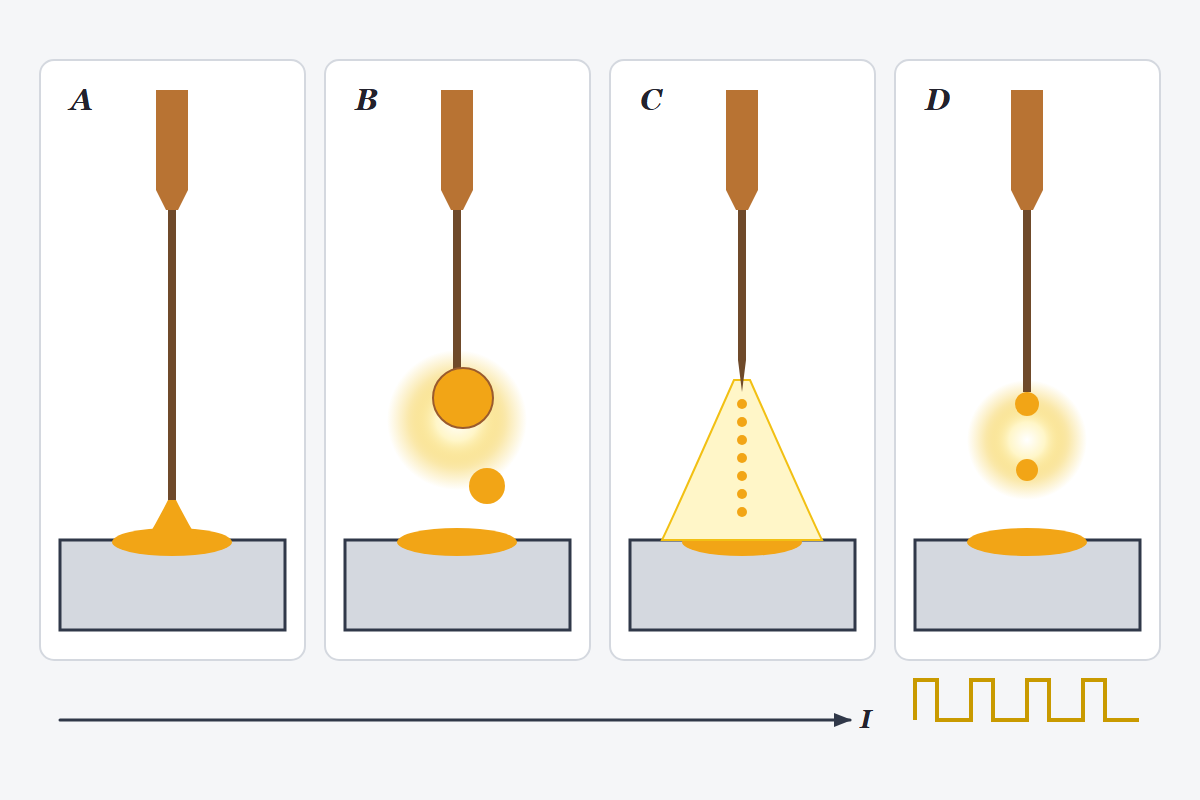
A short-circuit: the wire touches the pool and the metal crosses during the contact. B globular: a drop bigger than the wire falls by its own weight. C spray: a stream of fine droplets and a pointed wire tip. D pulsed: one drop per pulse, with the current waveform below. Current rises from A to C.
The first day someone moves from welding thin sheet to filling a thick joint, they turn up the wire speed and the voltage, and at some point the arc changes its sound. It stops crackling like bacon in a pan and starts to hiss evenly. That change of sound is a change of physics, because the metal has started to cross the arc in a different way. Let us walk through what happens as the machine goes up.
At low current and voltage, the wire tip forms a drop that cannot detach and touches the pool. At that instant the arc goes out, the current rises, the metal bridge necks down and the drop is drawn into the pool by surface tension. The arc reignites and the cycle repeats, somewhere in the order of 20 to 200 times a second. That is the crackle.
Since little heat goes in, it works on thin sheet, on root passes with a gap and in every position, because the pool is small and freezes fast. That same low heat is its weak point on thick plate: the metal sits on the edges without melting them and leaves lack of fusion. Modern sources that control each short circuit electronically drop the current just before the bridge breaks, and that cuts spatter a lot.
Keep going up and the drop grows larger than the wire diameter and falls by its own weight, irregularly and off-axis. With straight CO₂ this is the norm over much of the range, because arc forces push the drop upward before it lets go. There is spatter, the bead comes out uneven and you can only work flat and horizontal. It is a mode you pass through more than one you choose.
Above a certain current, called the transition current, and with a gas that is mostly argon, the wire tip tapers and releases a stream of droplets finer than the wire itself, hundreds per second, right along the axis. That is the even hiss. There are no short circuits and hardly any spatter, penetration is deep and deposition climbs a lot. The transition current depends on wire diameter and gas: the thicker the wire and the more CO₂ in the blend, the higher it is. With straight CO₂, true spray cannot be reached.
So why not weld everything in spray, if it is the cleanest? Because the pool is large and very fluid, and it falls out of anything but the flat position and horizontal fillets. And because it burns through thin sheet.
Pulsed transfer solves that dilemma. The source alternates a background current, which just keeps the arc alive, with pulses above the transition, and one drop detaches on each pulse. The average stays low, like short-circuit, but the drop travels as in spray. You get little spatter, a pool you can control vertically and less heat in the part. It needs an inverter source with synergic programs, which adjust the pulse automatically to the wire feed speed.
A structural shop uses all of them: short-circuit on thin plate and roots, spray to fill thick joints in the flat, and pulsed when the part cannot be turned. At Indumor we choose the mode joint by joint. If you have steel to weld, share the drawings: along with the welding quote, you get our view on which transfer suits each joint.
Think of the answer before you open it.
Because little heat goes in and the pool is small: it freezes fast and does not fall.
A current above the transition current, which depends on the wire diameter, and a gas that is mostly argon. Straight CO₂ gives no true spray.
Lack of fusion: with so little heat, the metal can sit on the edges without melting them.
Drops that travel as in spray, one per pulse, at a low average current. That allows out-of-position welding with little spatter and less heat.
We tell you which process and transfer suits each joint, and we give you the price.
© Indumor 2010–2026 — Industrial steel fabrication, Córdoba, Argentina
