October 31, 2026 · Indumor
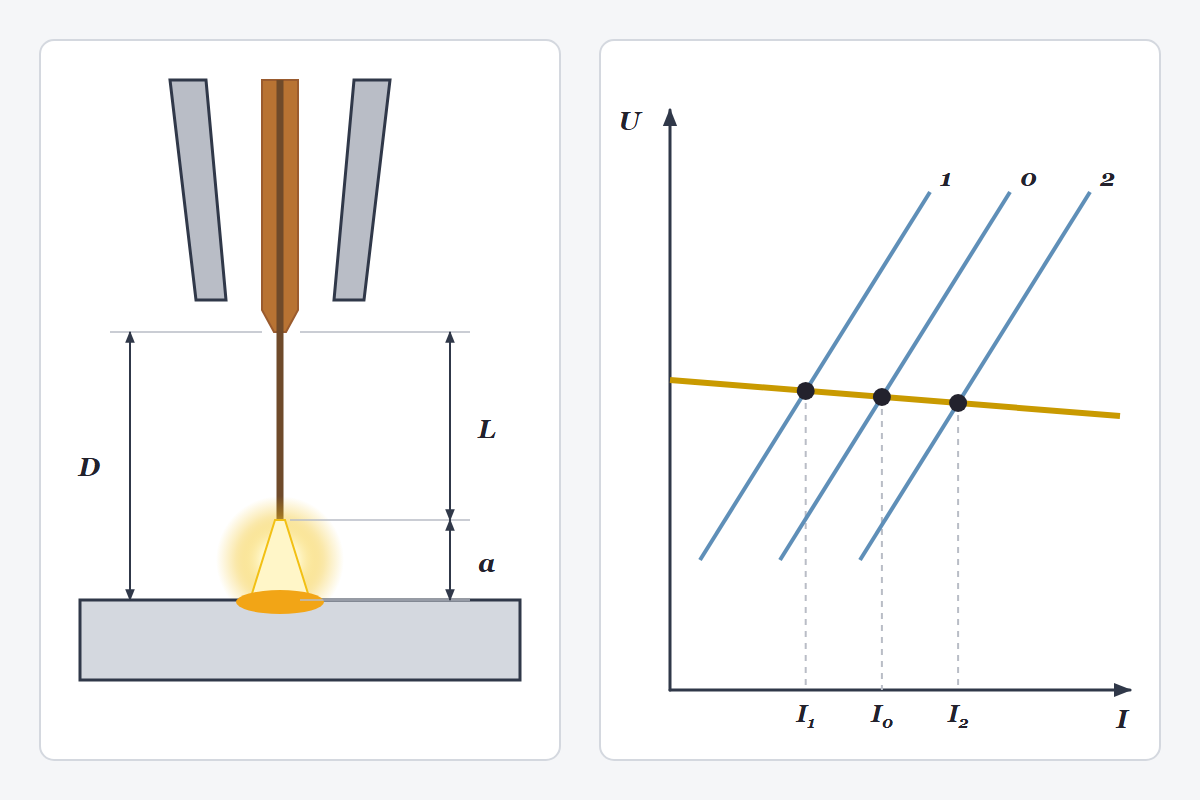
On the left, L is the stickout, a the arc length and D the contact tip to work distance. On the right, the gold line is the constant voltage source and the blue lines are three arc lengths: 1 long, 0 normal and 2 short. Each black dot is where they cross, and below it you read the resulting current.
On a MIG welder, the wire feed speed sets the current and the voltage sets the arc length. The rest of this lesson explains why, and why the distance at which you hold the gun changes the current even if you never touch a knob.
Because the source is constant voltage. It holds the volts you set and delivers whatever current it takes to melt the wire arriving, and the wire arrives at a fixed speed. If the feeder sends more meters per minute, the source has to deliver more current to melt them at the same rate. So for a given diameter, gas and stickout, each wire feed speed corresponds to a current. As a reference, about 6 meters per minute (roughly 240 inches per minute) of 1.2 mm wire runs close to 200 A.
It is the reason MIG is so easy to start with. If the welder lifts the gun and the arc gets longer, that longer arc needs more voltage for the same current. Since the source does not raise it, the operating point slides toward less current, from point 0 to point 1 on the graph. With less current the wire melts more slowly but keeps arriving at the same speed, so the tip moves down and the arc shortens again. Lower the gun and the opposite happens: the short arc draws more current, melts faster and lengthens. It all takes milliseconds, without the hand noticing.
Stickout is the free length of wire between the contact tip and the arc, the L in the drawing. All the current flows through it, and since steel conducts much worse than copper, it heats up by resistance before reaching the arc. The longer it is, the more it preheats. At the same wire feed speed, a longer stickout lowers the current and the penetration, and a shorter one raises them. Two welders with identical settings can turn out different beads just because one holds the gun farther away.
It depends on the transfer mode, the subject of lesson 5. In short-circuit, with 0.8 to 1 mm wire, it runs roughly from 6 to 12 mm (1/4 to 1/2 in). Spray uses more, in the order of 15 to 20 mm, because the nozzle has to stay clear of a large, very hot pool. Self-shielded cored wires want even more, and the maker prints it on the box. Too short, and spatter builds up in the nozzle and on the tip; too long, and the arc wanders and the gas shield thins out.
A written procedure usually specifies D, the contact tip to work distance, which adds the stickout and the arc. Eyeballing it is fine for practice. In production the welder should know the number and hold it, because every extra millimeter takes a little penetration with it.
Voltage sets the arc length, and the arc length sets the bead width. More volts open up the arc: the bead comes out wider and flatter and wets the edges better. Overdo it and you get spatter, undercut and porosity, because a long arc lets air in. Too few volts give a short arc and a narrow, tall bead, and the wire can stub into the work and push the gun back. Current, on the other hand, rules penetration and deposition rate.
It only matters in short-circuit. Every time the wire touches the pool, the current jumps to break the metal bridge, and inductance controls how fast it rises. More inductance means a softer rise, fewer short circuits per second, a hotter, more fluid pool and less spatter. Less makes the arc crisper and colder, which helps on very thin sheet. Synergic machines set it on their own according to the selected program.
In your next session with the gun, try this on a scrap plate: one bead with the contact tip 10 mm from the work and another at 25 mm, without touching the machine. Cut them in half, sand the face and compare how deep each one went.
Think of the answer before you open it.
It rises, because the source has to melt more wire per minute. Unless voltage goes up a little too, the arc gets shorter.
It drops. The free length preheats by resistance and needs less arc energy to melt. Penetration drops with it.
The contact tip to work distance, which adds the stickout and the arc length.
The current rises more slowly on each short circuit. There are fewer short circuits per second, less spatter and a hotter, more fluid pool.
We quote it with the right process for each joint, straight from your drawings.
© Indumor 2010–2026 — Industrial steel fabrication, Córdoba, Argentina
