October 31, 2026 · Indumor
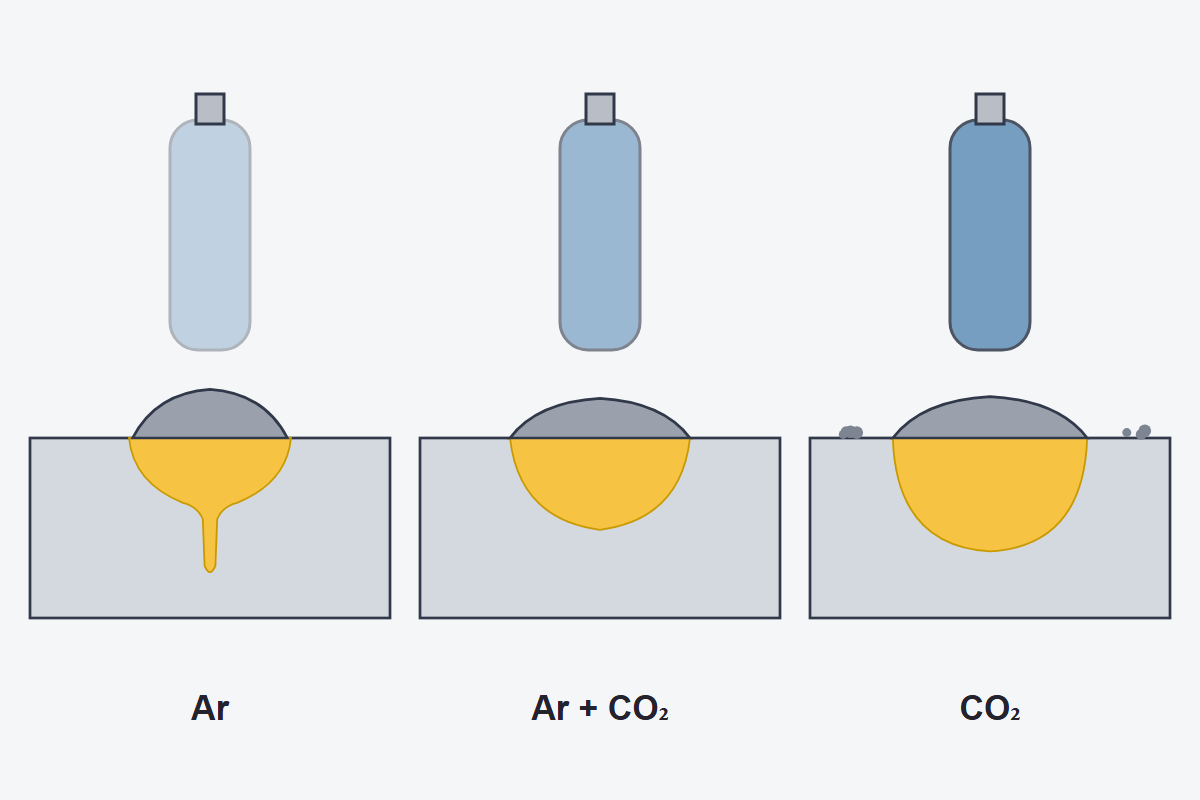
Penetration shape by gas, in weld cross-sections: with argon, a narrow finger in the center; with argon and CO₂, a rounded shape; with straight CO₂, broad and deep, with spatter around.
Almost one liter in every hundred of the air you breathe is argon: 0.93 %. That is where the gas shielding most MIG beads comes from, separated from air in plants that cool it until it turns liquid. Being plentiful does not mean any gas will do. Here are nine things worth knowing about the gas before you open the regulator.
Molten metal is a sponge. Oxygen in the air oxidizes it, nitrogen dissolves in it and on cooling forms pores and nitrides that make the joint brittle, and moisture brings in hydrogen. The nozzle blows a stream that keeps all that away from the pool and the wire tip while they are hot. If the stream fails, even because of a draft, the bead fills with porosity.
An inert gas, such as argon or helium, does not react with the metal. An active one does: CO₂ splits in the arc into carbon monoxide and oxygen, and that oxygen takes part. It sounds like a drawback, and on steel it is not, because a little active gas steadies the arc, helps the pool wet the edges and improves the bead shape. That is why carbon steel is welded MAG and aluminum, which tolerates no oxygen at all, MIG.
Argon ionizes easily, so the arc starts easily and runs stable. It conducts heat poorly, which leaves the arc with a very hot, narrow core: with pure argon, spray penetration is finger-shaped, deep in the center and weak at the sides. It is heavier than air, shields well in the flat position, and for the same reason collects in pits and tanks, a hazard covered in lesson 11. On its own it is used for aluminum and copper alloys; on steel it is almost always blended.
CO₂ is the cheapest gas and the one that penetrates most. As it dissociates in the arc it absorbs heat and gives it back when it recombines at the pool, which produces broad, deep penetration. The price is a harsher arc with more spatter, and no way to reach spray: with CO₂ you weld in short-circuit or globular. Its oxygen takes some silicon and manganese out of the wire, which show up as brown glassy islands on the bead, and that is why MAG wires carry extra amounts of both. It comes as a liquid in the cylinder, and at high flow rates the regulator freezes unless it has a heater.
They are the middle ground and the standard in structural shops. With more than 15 and up to 25 % CO₂, the blend welds well in short-circuit, wets better than pure argon and spatters much less than straight CO₂. With less CO₂, around 8 to 10 %, spray and pulsed come easier and with even less spatter, in exchange for slightly less penetration at the edges. Spray needs at least 80 to 85 % argon in the blend; sources differ on the exact figure.
A small amount of oxygen, 1 to 5 %, also steadies an argon arc and is used for spray on carbon and stainless steel. On stainless the active part is kept very small, because carbon from CO₂ can enter the metal and the low-carbon grades (the ones ending in L) would stop being low carbon. Helium is argon's opposite: it conducts a lot of heat, gives a hotter arc and a wider pool, and allows faster travel on thick aluminum and copper. It is expensive and scarce, so it is kept for when it is really needed.
ISO 14175 classifies gases with a letter and a number. I1 is pure argon; C1 is pure CO₂; argon-CO₂ blends fall in group M2: M20 carries more than 5 and up to 15 % CO₂, and M21, the most common in structural work, more than 15 and up to 25 %. A written procedure has to state the gas by its designation, because changing it changes the weld. AWS A5.18 and A5.20 use their own gas codes (C for CO₂, M for argon-rich blends). On the cylinder label a blend usually appears as 80/20 or 82/18, both M21; an 85/15, though often called the same, is already M20.
A shop rule of thumb says the flow rate in liters per minute is about ten times the wire diameter in millimeters: some 10 to 12 L/min (20 to 25 CFH) for 1 to 1.2 mm wire in short-circuit, and somewhat more with large nozzles and in spray. Cranking the flowmeter up to 30 liters a minute “just in case” is a rather expensive way of feeding air into the pool, because the stream turns turbulent and drags in what it was meant to push away. What really breaks the shield is wind. AWS D1.1 does not allow gas-shielded welding when the wind at the joint exceeds 8 km/h (5 mph), unless the area is protected.
Leaks count too. A cracked hose or a loose fitting lets gas escape all night if the cylinder is left open, and draws air into the line while welding.
On thin carbon steel, 1 to 4 mm, an M21 blend in short-circuit handles almost everything: it penetrates enough, spatters little and forgives a hand that is not steady yet. For structures from 8 mm (5/16 in) up that can be welded flat, a lower-CO₂ blend reaches spray at a lower current and leaves less cleanup; if there is vertical work too, the same blend serves for pulsed. Straight CO₂ makes sense when you want cheap penetration on parts that will be ground or painted anyway, as long as you accept the time spent removing spatter. Stainless takes argon with 2 % CO₂ or with 1 to 2 % oxygen. Aluminum takes pure argon, and argon-helium once the thickness goes past about 10 mm.
The cost math is misleading. A cubic meter of CO₂ costs much less than one of blend, but gas is a small share of the cost of each meter of weld: labor weighs far more, and an hour spent grinding spatter eats the difference. One last stockroom detail: cylinders are never run completely empty, because at zero pressure air and moisture can get in, and the next fill starts contaminated.
The guide to welding and cutting gases covers the rest of the shop's gases, and another of our guides tells how air separation began.
If you order a part from us and do not know which gas to specify in the procedure, we will settle it with you when we quote, at no cost. At Indumor we weld carbon steel with an argon-CO₂ blend and choose the ratio by thickness and transfer mode.
Think of the answer before you open it.
Because on steel a little oxygen or CO₂ steadies the arc and improves wetting; aluminum oxidizes immediately and tolerates no active gas at all.
Finger-shaped: deep and narrow in the center and weak at the sides, because an argon arc has a very hot, narrow core.
An argon blend with more than 15 and up to 25 % CO₂, such as 82/18, the most widely used for welding carbon steel structures.
Because the stream turns turbulent and drags air into the pool instead of pushing it away.
We settle it with you when we quote, by material, thickness and transfer mode.
© Indumor 2010–2026 — Industrial steel fabrication, Córdoba, Argentina
