October 31, 2026 · Indumor
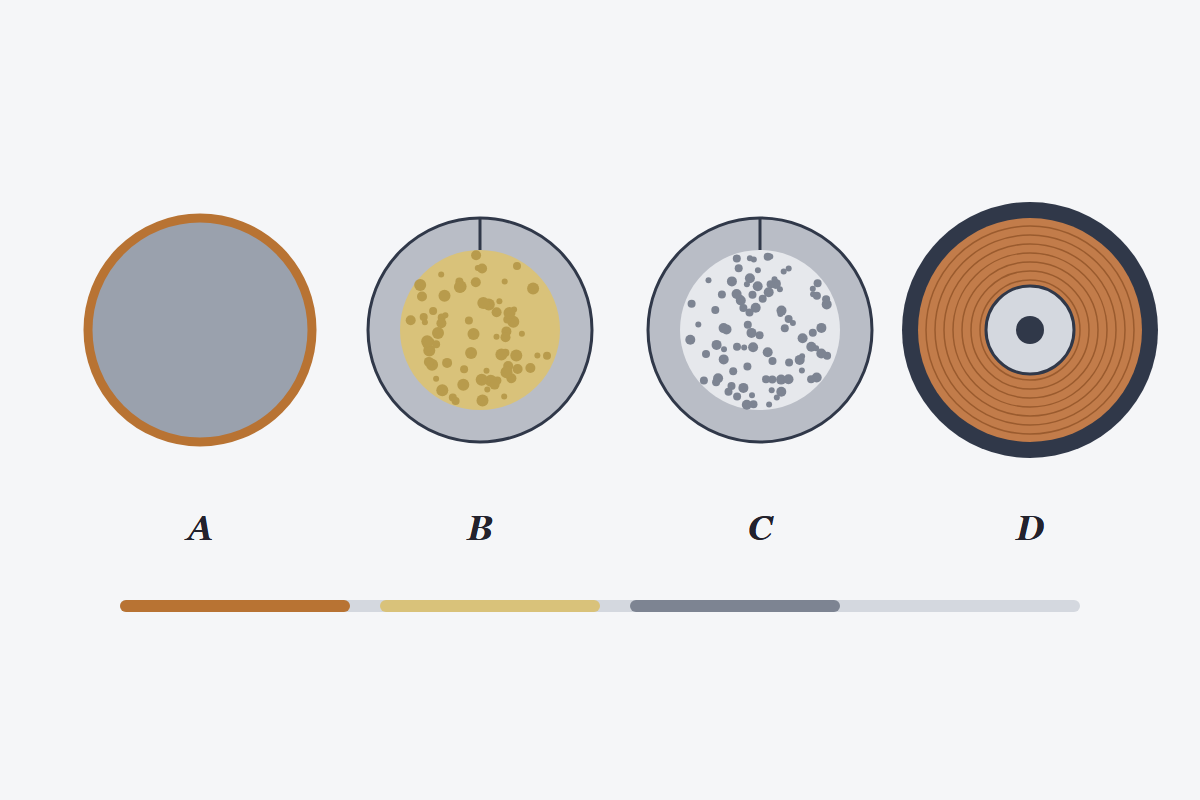
A solid wire with its copper coating. B flux-cored wire. C metal-cored wire. D spool.
Most of a MIG bead came off the spool.
That makes choosing the wire a design decision, not a purchasing one. For structural carbon steel, the everyday wire is solid ER70S-6, 1 or 1.2 mm (0.035 or 0.045 in), with an argon-CO₂ blend. For outdoor work without gas, a self-shielded flux-cored wire. To fill a lot in the flat, a gas-shielded flux-cored or a metal-cored wire. For stainless, ER308LSi or ER316LSi depending on the steel, and for aluminum, ER4043 or ER5356. If you keep only this paragraph, you have the core of the lesson.
What follows is how to read those codes and how to look after the wire so it reaches the arc in good shape.
In AWS A5.18, the E says it works as an electrode and the R as a rod too, the 70 is the minimum tensile strength of the weld metal in thousands of pounds per square inch (about 480 MPa), the S stands for solid wire and the 6 for the chemistry. The 6 carries the most manganese and silicon in the series, and those elements deoxidize the pool, so it copes better with mill scale and some rust. ISO 14341, in its European-style system A, describes this kind of wire differently, with designations such as G 42 4 M21 3Si1: wire for gas-shielded welding, 420 MPa yield, 47 J impact at −40 °C, M21 gas and the composition. The same standard also has a system B, closer to AWS, in which ER70S-6 corresponds exactly to the symbol S6. In system A there is no exact match: its chemistry overlaps types 3Si1 and 4Si1, and each wire certifies as one or the other according to its analysis.
A cored wire is a steel strip folded around a core. If the core is flux, it leaves slag like a stick electrode and the classification follows AWS A5.20: in an E71T-1C, the 7 is the strength, the 1 says it welds in all positions (a 0 would mean flat and horizontal only) and the C that it runs on CO₂. Self-shielded wires make their own gas from the flux and are the ones taken to site when it is windy; nearly all of them run with the wire negative. Metal-cored wires leave almost no slag and deposit fast, which is why they are common on robots.
Common diameters are 0.8, 0.9, 1, 1.2 and 1.6 mm. Thin wire suits thin sheet and short-circuit; 1.2 mm is the workhorse for structures. The copper coating on solid wire protects against rust and improves electrical contact at the tip.
In the shop, open spools of cored wire go back into their bag with the desiccant pack at the end of the day, and solid spools stay off the floor. There is one scene worth never repeating: the spool that spends the weekend on the feeder next to an open door in midwinter and welds porous on Monday. Moisture condenses on the cold wire when the shop warms up, and the hydrogen it brings can crack hardenable steels. Rusty wire also jams in the liner and burns contact tips.
Think of the answer before you open it.
The chemistry: it is the wire with the most manganese and silicon in the series, which deoxidize the pool and make it tolerant of mill scale and some rust.
That it welds in all positions. A 0 in that place would mean flat and horizontal only.
Outdoors and in the wind, where shielding gas would be blown away. It makes its own gas from the flux.
Because moisture from the air condenses on the cold wire and carries hydrogen and water into the pool.
Carbon steel, stainless and aluminum structures and parts, welded in our shop.
© Indumor 2010–2026 — Industrial steel fabrication, Córdoba, Argentina
