October 31, 2026 · Indumor
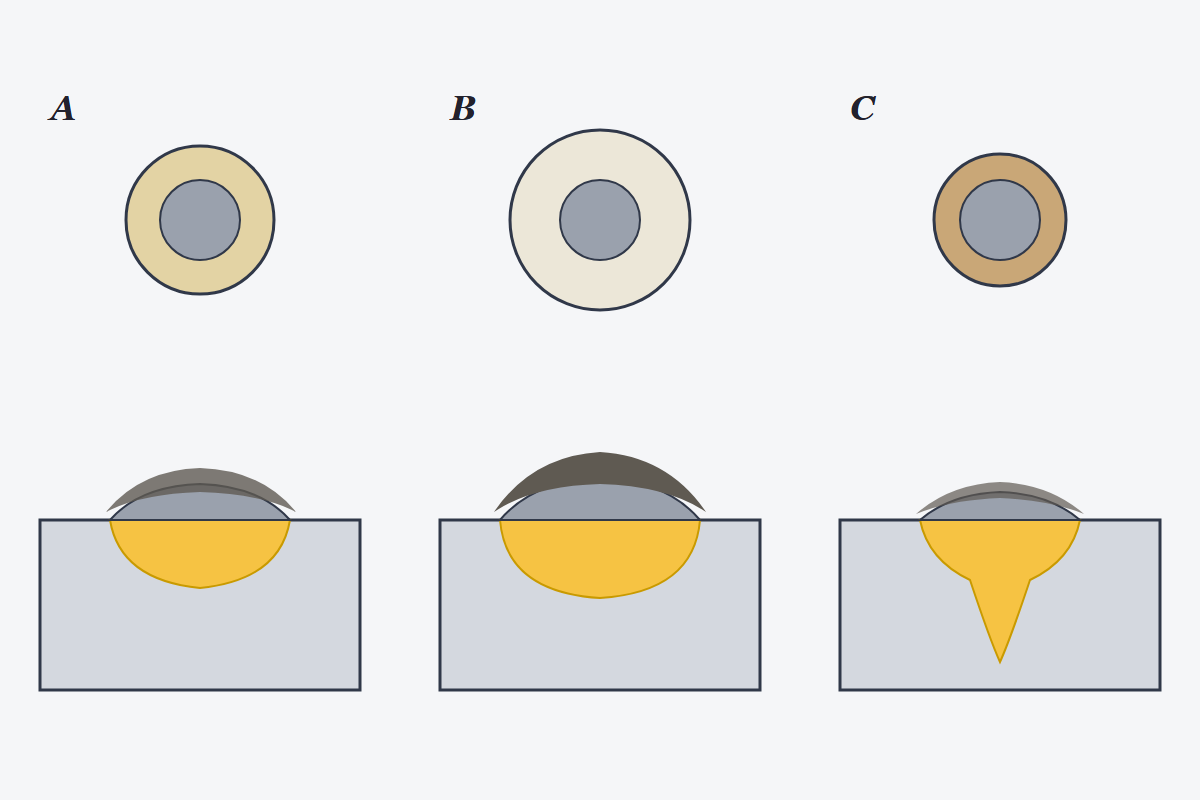
A rutile: soft arc, slag that peels off by itself, medium penetration. B low-hydrogen: thick covering, harder slag, tough weld metal. C cellulosic: thin covering, lots of gas, deep penetration.
The covering does nearly all the fine work in stick welding. The core wire supplies metal, and not much else. That is why two electrodes with the same steel core can weld in completely different ways, and why choosing the covering means choosing the behavior. It is the first thing to look at on the box.
As it burns, the covering produces the gas that shields the arc from the air. It melts into a slag that floats, protects the bead as it cools, shapes it and slows its cooling. It contains potassium or sodium compounds that stabilize the arc, and in AC electrodes keep it alive each time the current crosses zero. It carries ferroalloys that deoxidize the pool and adjust the weld metal chemistry. And in many electrodes, iron powder, which joins the bead and raises the weight deposited per rod. It does all five in a minute or two of arc.
The first coverings appeared early in the twentieth century, when it was found that covering the rod protected the metal from air and steadied the arc. For decades they were thin layers applied by dipping the rod; modern electrodes are made by extruding a paste of controlled composition around the core. The families below come out of that chemistry.
In structural steel, the real choice is almost always between two families. Rutile electrodes, based on titanium dioxide, such as the E6013, strike easily, have a soft arc, run on AC or DC, leave a neat bead and a slag that sometimes peels off on its own. They are the easiest to use. Their weak point is hydrogen: the covering holds moisture by its very nature, and that hydrogen can crack high-strength steels or thick, rigid joints.
Basic electrodes, based on calcium carbonate and fluoride, such as the E7018, are also called low-hydrogen. Kept dry, they leave a tough weld metal that withstands impact at low temperature and does not crack in demanding joints. They take more skill: a short arc, usually DC electrode positive, and a harder slag to remove. And they are jealous of moisture, so they are kept in ovens, as lesson 7 explains.
Cellulosic electrodes, such as the E6010 and E6011, play a different game. Their covering contains cellulose, which burns into an abundant, hydrogen-rich gas: the arc is forceful, penetration deep and the thin slag freezes fast. They are the ones used for pipelines welded downhill. The trade has a scene that keeps repeating: someone stores the cellulosic rods in the low-hydrogen oven “so they do not pick up moisture”, and the electrode, which needs a little water in its covering to work, starts to burn badly. Each family has its own rules.
The difference in hydrogen can be put into numbers. A well-kept low-hydrogen rod deposits metal with less than 4 or 8 milliliters of hydrogen per 100 grams, the H4 and H8 classes; a rutile rod leaves several times more, and a cellulosic one more still, because cellulose burns precisely into hydrogen. That is why procedures for high-strength steels call for low-hydrogen rods, and why no inspector accepts a rutile rod on a joint that works in fatigue.
You can tell the three families apart with your eyes closed. Rutile sounds even and calm, spatters little and fine, and its dense slag lifts off in one piece. Low-hydrogen transfers in larger drops, needs a short arc to stay free of porosity and leaves a more brittle slag that takes real chipping in fillet corners. Cellulosic roars: the arc is strong, digs into the joint, leaves very little slag and spatters more. Those differences explain why each one has its place, and why a welder used to one takes a few hours to adapt to another.
There are less common families too. Acid electrodes, with iron oxides, leave smooth beads in the flat and are rarely seen in structures. High-recovery electrodes carry so much iron powder that they deposit more metal than the core itself weighs. And electrodes for stainless, cast iron or hardfacing have coverings designed for their metal, with usage rules of their own.
For general work, thin sheet, railings, light brackets and touch-ups, rutile. For structures, heavy sections, higher-strength steels, parts that will work in the cold or under fluctuating loads, low-hydrogen. For pipe roots in the field, cellulosic. Rutile rods with lots of iron powder, such as the E7024, are for filling flat fillets at full speed.
One practical tip: if you are torn between an E6013 and an E7018 for a structural joint, pick the low-hydrogen rod and learn to run it. What you lose in comfort you gain in peace of mind. For a joint that carries a structure, a serious shop's rule is low-hydrogen or wire; that is how we approach structural welding at Indumor.
Think of the answer before you open it.
Because it contains potassium or sodium compounds that keep the arc ionized each time the current crosses zero.
Hydrogen: their covering holds moisture, and that hydrogen can crack high-strength steels or thick, rigid joints.
A tough weld metal that withstands impact at low temperature and does not crack in demanding joints.
Because they need some moisture in the covering to burn properly; dried out, the arc behaves badly.
We weld steel structures in the shop and in the field, to the procedure each joint needs.
© Indumor 2010–2026 — Industrial steel fabrication, Córdoba, Argentina
