October 31, 2026 · Indumor
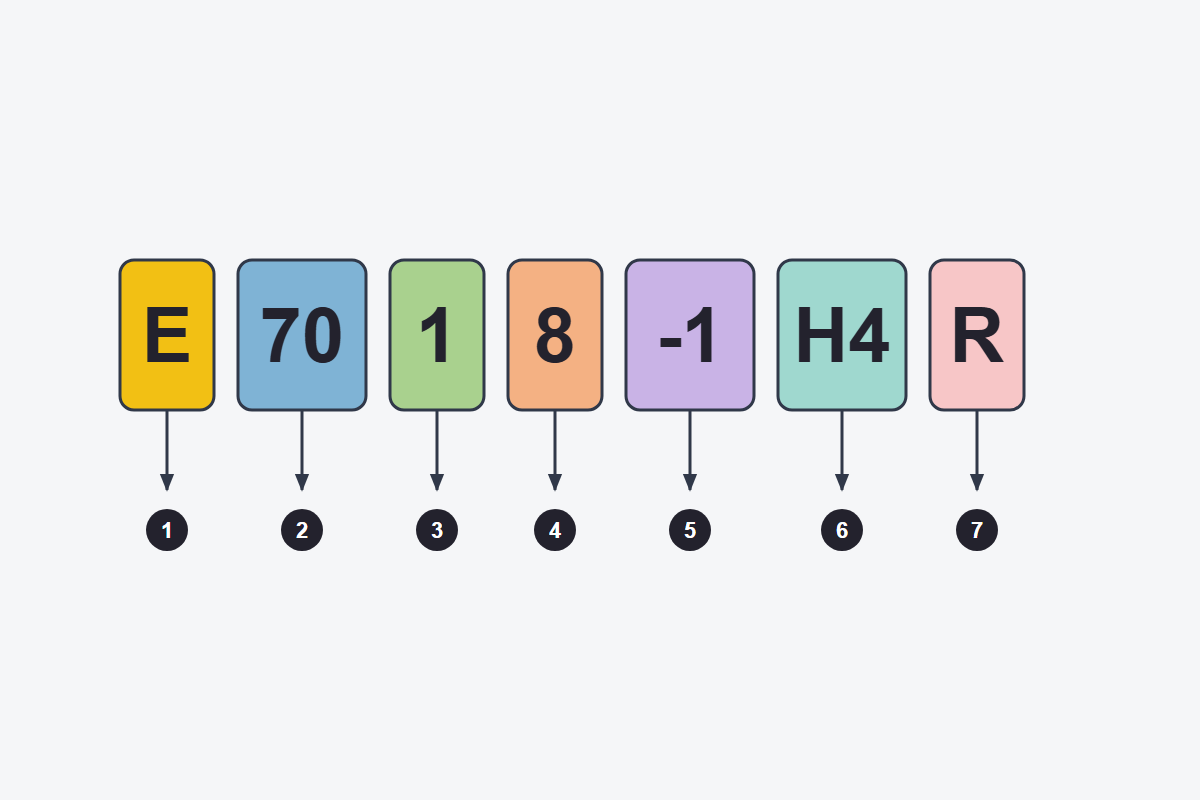
The designation E7018-1 H4R taken apart: E electrode, 70 minimum tensile strength in thousands of pounds per square inch, 1 position, 8 covering and current, -1 improved toughness, H4 maximum diffusible hydrogen, R moisture resistant.
The 70 in an E7018 means 70,000 pounds per square inch, about 480 megapascals of minimum tensile strength in the deposited metal. In other words, the bead usually ends up stronger than the ordinary structural steel it joins. All that information, and quite a bit more, fits into four digits and a couple of letters. This lesson walks through them question by question.
From AWS A5.1, the US specification for covered carbon steel electrodes, which appears on almost every box sold in Argentina and across the Americas. Low-alloy steels have their own, A5.5, and stainless steels A5.4. The international equivalent is ISO 2560, covered further down. Other countries have their own systems, but most of them map onto AWS or ISO, so learning one of the two goes a long way.
The E means it is an arc welding electrode. The next two digits are the minimum tensile strength of the weld metal, in thousands of pounds per square inch: 60 means about 415 MPa and 70 about 480 MPa. In the higher-strength electrodes of A5.5 that number grows to three digits, as in an E11018.
The position it can weld in. A 1 means all positions; a 2, flat and horizontal fillet only; a 4, flat, horizontal, overhead and vertical down. So an E7024 is a rod for filling in the flat, and there is no point taking it to a vertical joint.
The fourth digit, read together with the third, gives the covering type and the current it accepts. The ones you see most:
That makes the E6010 and the E6011 cousins that differ in current: the second runs on an AC transformer and the first does not. And why is the E7018 the structural electrode? Because it brings together what a demanding joint asks for: 70 ksi strength, all positions and a low-hydrogen covering.
The extras come after the dash. A -1 means improved toughness: a standard E7018 guarantees 27 J (20 ft·lbf) of impact at −29 °C (−20 °F) and an E7018-1 at −46 °C (−50 °F). The H with a number is the maximum diffusible hydrogen in the weld metal, in milliliters per 100 grams: H4, H8 or H16. The lower it is, the lower the risk of hydrogen cracking. The R means the covering resists moisture pick-up better, which is why those rods can stay out of the oven longer. Low-alloy rods carry composition suffixes, such as A1 (with molybdenum) or C1 (with nickel).
It has two systems. System B resembles AWS, with numbers like E4918, where 49 is the tensile strength in tens of megapascals. System A is organized differently. In an E 42 3 B 32 H5, the 42 is the minimum yield strength, 420 MPa; the 3 says the weld metal absorbs 47 J of impact at −30 °C; the B, that the covering is basic; the next 3, the recovery and current type; the 2, the positions, all but vertical down; and H5, the maximum hydrogen. An E7018 is roughly an ISO E 42, although the exact match depends on each electrode and has to be checked on its data sheet.
A G, as in an E8018-G, means a chemistry not tabulated in the standard: the electrode meets the strength and toughness it declares, but its composition is whatever its data sheet says. It is fine to use, as long as you read what it guarantees.
Because the standard sets minimums and ranges, not a recipe. Each maker has its own covering, and with it come differences in striking, arc and slag. That is why welders get used to one brand and find it hard to switch, and why a procedure calling for an E7018 accepts any rod that meets the classification, unless the specification says otherwise.
They follow AWS A5.4 and read differently. In an E308L-16, the 308 is the alloy of the weld metal, with about 19 % chromium and 9 % nickel for welding AISI 304; the L means low carbon, which prevents corrosion next to the weld; and the 16 is the covering: rutile, for AC or DC electrode positive. A -15 would be a basic covering, DC only, and a -17 a rutile variant with more silica that wets better and leaves flatter beads. The 316L, with molybdenum, follows the same logic for AISI 316.
AWS A5.5 adds a letter and a number at the end for the alloy. An E8018-B2 carries chromium and molybdenum and is used on piping that runs hot, such as steam lines; an E8018-C1 carries nickel for low-temperature service; an E7018-A1, half a percent of molybdenum; and those ending in M answer to high-strength military specifications, such as the E11018-M. If the specification calls for one of these, it does not get swapped for an E7018 just because the boxes look alike.
Diameters were born in inches: 3/32 is 2.4 mm, though it is sold as 2.5 in metric markets; 1/8 is 3.2 mm; 5/32, 4 mm; and 3/16, about 4.8 mm, sold as 5. The most common lengths are 350 and 450 mm, the original 14 and 18 inches. Boxes usually show both.
The full classification, with its suffixes; the recommended current and polarity; the amperage range per diameter, which the maker gives for each one; and, for low-hydrogen rods, the storage and rebaking conditions. That information overrides any general chart, including the one in this course's appendix.
Think of the answer before you open it.
The minimum tensile strength of the weld metal: 70,000 pounds per square inch, about 480 MPa.
Only flat and horizontal fillet: the 2 in the third digit says so.
Both are cellulosic, but the E6010 runs only on DC electrode positive and the E6011 also accepts AC.
That the weld metal has at most 4 ml of diffusible hydrogen per 100 g, which lowers the risk of hydrogen cracking.
We quote them with the electrode each joint calls for, in the shop or in the field.
© Indumor 2010–2026 — Industrial steel fabrication, Córdoba, Argentina
