October 31, 2026 · Indumor
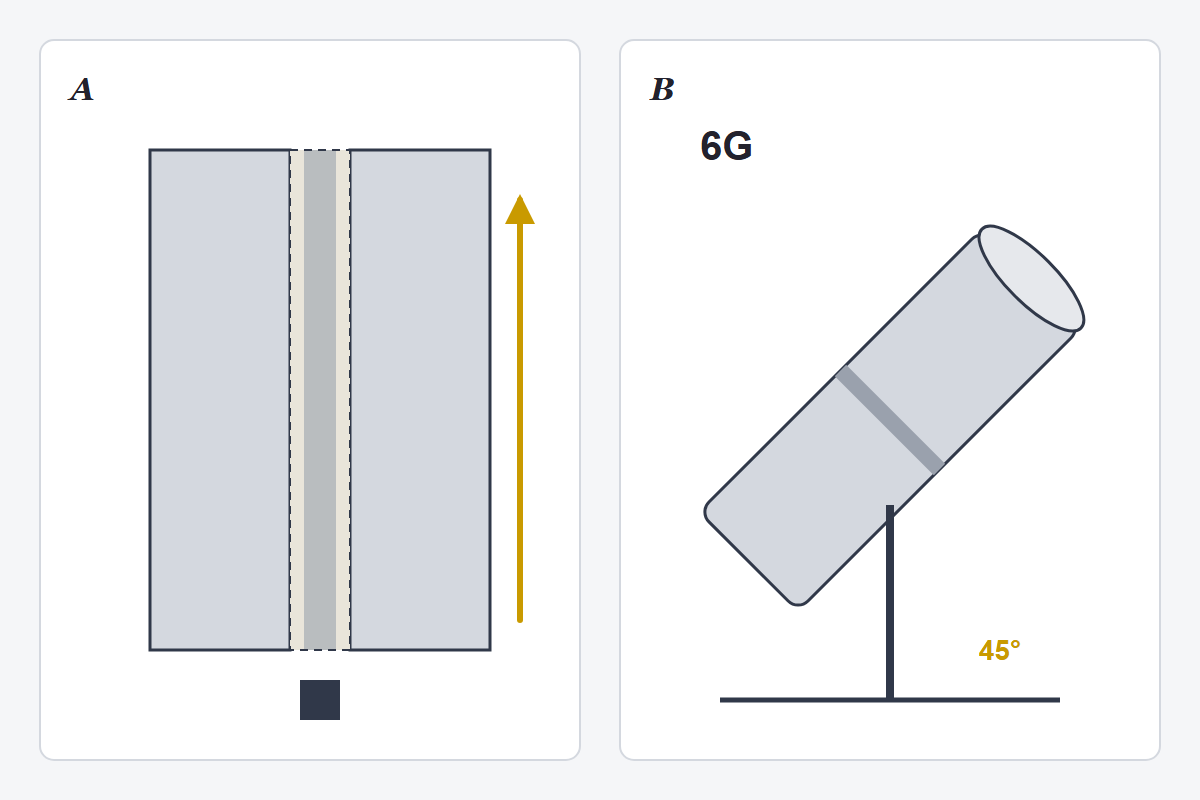
A plate coupon with a V groove and backing, welded vertical for structural qualification. B pipe coupon fixed at 45°, the 6G position.
Qualification: a test that authorizes a welder for a process, a position and a range of thicknesses. Put that way it sounds like paperwork. In practice it is what separates a welder who can sign off a structural joint from one who cannot yet, and with stick there are two worlds worth telling apart: structures and pipe.
The basics are the same as in the MIG-MAG course. The WPS says how to weld, the PQR proves with a tested coupon that this way of welding works, and the welder's qualification proves the person can do it. What changes is how each code treats the covered electrode.
In AWS D1.1, the structural steel code, shielded metal arc welding is a prequalified process: if the joint, the material and the electrode are within what the code has already proven, a prequalified WPS can be used without welding a PQR of your own. The welder, on the other hand, is always qualified with a coupon. The classic is a 9.5 mm (3/8 in) V-groove plate with backing, which qualifies thicknesses of about 3 to 19 mm (1/8 to 3/4 in); a 25.4 mm (1 in) plate qualifies unlimited thickness. A welder who passes one coupon in the vertical (3G) and another overhead (4G) is qualified for all plate positions. Coupons are bend-tested or radiographed.
ISO 9606-1 reaches the same place with a designation worth learning to read. “ISO 9606-1 111 P BW FM1 B t10 PF ss nb” means: process 111, covered electrode; P, plate; BW, butt weld; FM1, the filler group for unalloyed and fine-grain steels; B, basic electrode; t10, a 10 mm coupon; PF, vertical up; ss, welded from one side; nb, no backing. Each part defines a range the certificate covers.
For pressure vessels, boilers and plant piping, ASME IX rules. There electrodes are grouped into F-numbers by usability: F3 are the cellulosic rods and F4 the low-hydrogen ones, among others. Qualifying with one group authorizes, under conditions, the groups the code considers easier. The best-known test is the pipe fixed at 45°, the 6G, which forces every position on the same coupon and so qualifies nearly all of them. Cross-country oil and gas pipelines use API 1104, with root and hot pass run downhill with cellulosic rods and destructive tests of their own, such as the nick-break test. Speed rules there: one crew welds the root and hot pass right behind the crew lining up the pipe, and the other passes follow further back.
The answer comes from the specification, not from the welder. Structural steel: AWS D1.1 or, on Argentine projects, the CIRSOC 304 regulation, which follows its guidelines, and often ISO 9606-1 when the client works to European standards. Vessel or plant piping: ASME IX. Transmission pipeline: API 1104. A welder can hold several qualifications, and on a large job that is the norm. Shipbuilding follows the rules of the classification societies, and plant piping in Argentina often follows ASME as well. The specification for a job like that usually comes with a list of procedures and asks for the roster of welders with their certificates before work starts; putting that binder together takes time, and it is best settled along with the quote.
Continuity differs too. Under AWS D1.1, a qualification stays in effect as long as the welder does not go more than six months without using the process. Under ISO 9606-1, the employer confirms every six months that the welder kept welding within the scope, and the qualification is revalidated periodically. ASME IX uses a similar six-month rule.
The coupon is fitted up in front of the inspector, with the bevel, root face and root opening the procedure sets, and fixed in the position being qualified: it may not be turned or moved during the test. The welder cleans between passes as on the job. Visual inspection comes first: no cracks, no undercut or reinforcement out of tolerance, and a complete root. A coupon that fails visual inspection is not even cut. Then the strips are cut and tested. On the 9.5 mm (3/8 in) AWS D1.1 plate, face and root bends are made; on the 25.4 mm (1 in) plate, side bends, because the coupon is too thick to bend whole.
If the welder fails, the code allows another chance. Under AWS D1.1, an immediate retest means welding two coupons for each one that failed, and both must pass; or a single retest after a period of further practice. What passes goes into a qualification record signed by the inspector, with every variable of the test, which the company keeps and presents when the job asks for it.
One detail that gets forgotten: the qualification belongs to the welder, but the records belong to the company. If the welder moves to another shop, the new employer has to keep its own continuity records. And each certificate covers what it says, not what the welder can do: someone with a flawless 6G on low-hydrogen rods is not qualified to weld downhill with cellulosic rods unless they passed that test.
The test is supervised by a certified welding inspector. The best-known US credential is the AWS CWI, and Argentina has inspector certification schemes as well. Qualifying a welder takes a few hours of welding and some days of testing, so it is worth planning before the job starts, not when the client's inspector is already on site. Nor does everything need qualifying: a structural welder who will never touch pipe qualifies on plate, and the 6G is for whoever needs it. Some clients also check a production weld in the first days of work, to confirm that the certificate matches what happens on site, and on many jobs each welder has an ID stamp marked next to their welds, so any defect can be traced.
One last clarification: a welder's qualification does not replace the procedure. A welder qualified under one WPS can only weld within the ranges on the certificate and with the procedures the code allows, even if in practice they can do much more. The certificate sets a floor for the job, not a ceiling for the welder.
That is how it works in practice: with the right WPS, a welder qualified for that position and the planned test, the joint reaches inspection without surprises. To keep going: WPS, PQR and qualification in MIG-MAG, how welds are tested and the defects those tests look for.
Think of the answer before you open it.
Not always: it is a prequalified process, and if the joint, material and electrode are within what the code provides, a prequalified WPS can be used. The welder is always qualified, though.
Vertical up (PF), welded from one side (ss) and no backing (nb).
Electrode groups by usability: for example, F3 for cellulosic and F4 for low-hydrogen rods.
API 1104.
We quote with the procedure and qualification the specification requires.
© Indumor 2010–2026 — Industrial steel fabrication, Córdoba, Argentina
