October 31, 2026 · Indumor
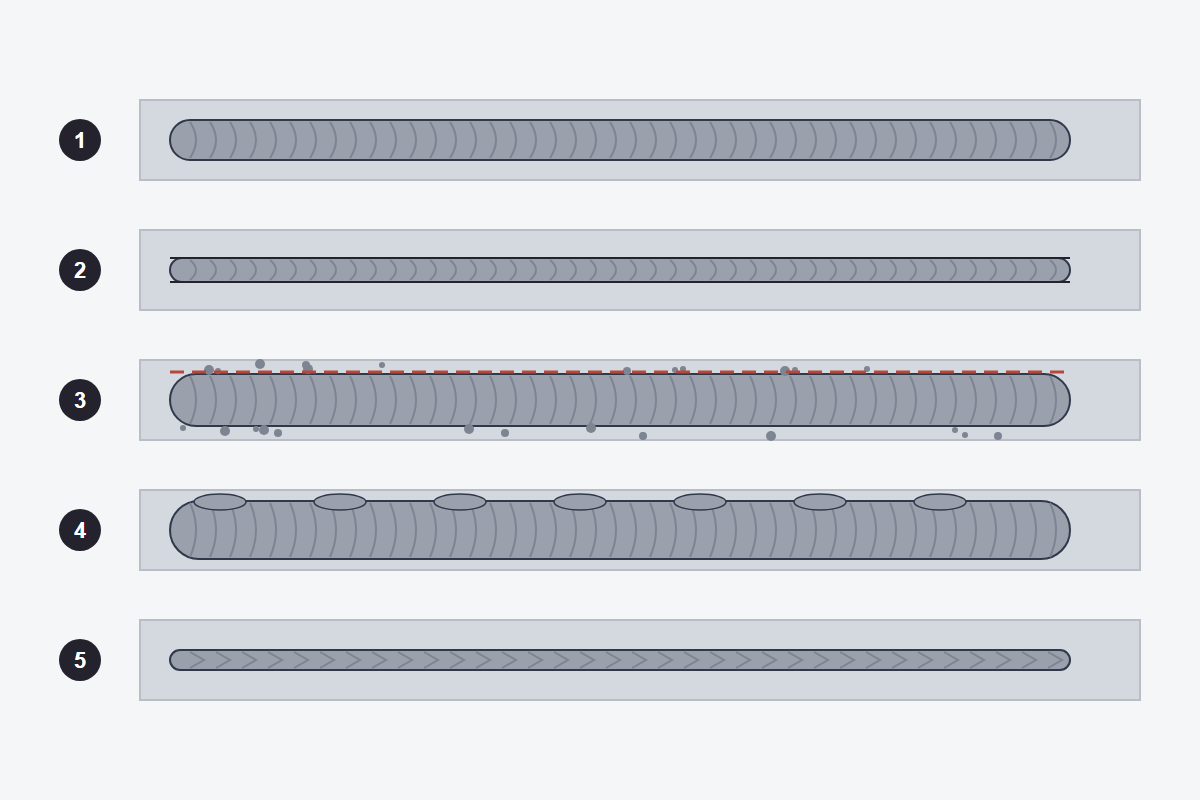
Starting values for the most common electrodes, in the flat position. For vertical and overhead, lower them by 10 to 15 %. The range the maker prints on the box overrides this chart, and when there is a procedure, the WPS rules.
| Electrode | Covering | Current | Positions | Ø 2.5 mm, 3/32 in (A) | Ø 3.2 mm, 1/8 in (A) | Ø 4.0 mm, 5/32 in (A) | Ø 5.0 mm, 3/16 in (A) | Typical use |
|---|---|---|---|---|---|---|---|---|
| E6010 | Cellulosic (sodium) | DC, electrode + | All | 50 to 80 | 75 to 125 | 110 to 160 | 140 to 200 | Pipe roots, vertical down |
| E6011 | Cellulosic (potassium) | AC or DC + | All | 50 to 85 | 75 to 120 | 90 to 160 | 120 to 200 | Maintenance, dirty surfaces, AC transformers |
| E6013 | Rutile (potassium) | AC or DC ± | All | 50 to 90 | 80 to 130 | 105 to 180 | 150 to 230 | Light fabrication, thin sheet, general work |
| E7018 | Low-hydrogen with iron powder | AC or DC + | All | 70 to 110 | 100 to 150 | 140 to 200 | 180 to 260 | Structures, heavy sections, demanding joints |
| E7024 | Rutile, heavy iron powder | AC or DC ± | Flat and horizontal fillet | – | 120 to 170 | 170 to 230 | 210 to 300 | Long fillets in the flat |
| E308L-16 | Stainless, rutile | AC or DC + | All | 50 to 80 | 75 to 110 | 100 to 140 | – | AISI 304 and 304L stainless |
Each column is explained in lesson 5, lesson 6 and lesson 8 of the course. The chart belongs to the Steel Knowledge Hub of Indumor.
In the shop or in the field, with the electrode each joint calls for.
© Indumor 2010–2026 — Industrial steel fabrication, Córdoba, Argentina
