Updated November 20, 2026 · Indumor
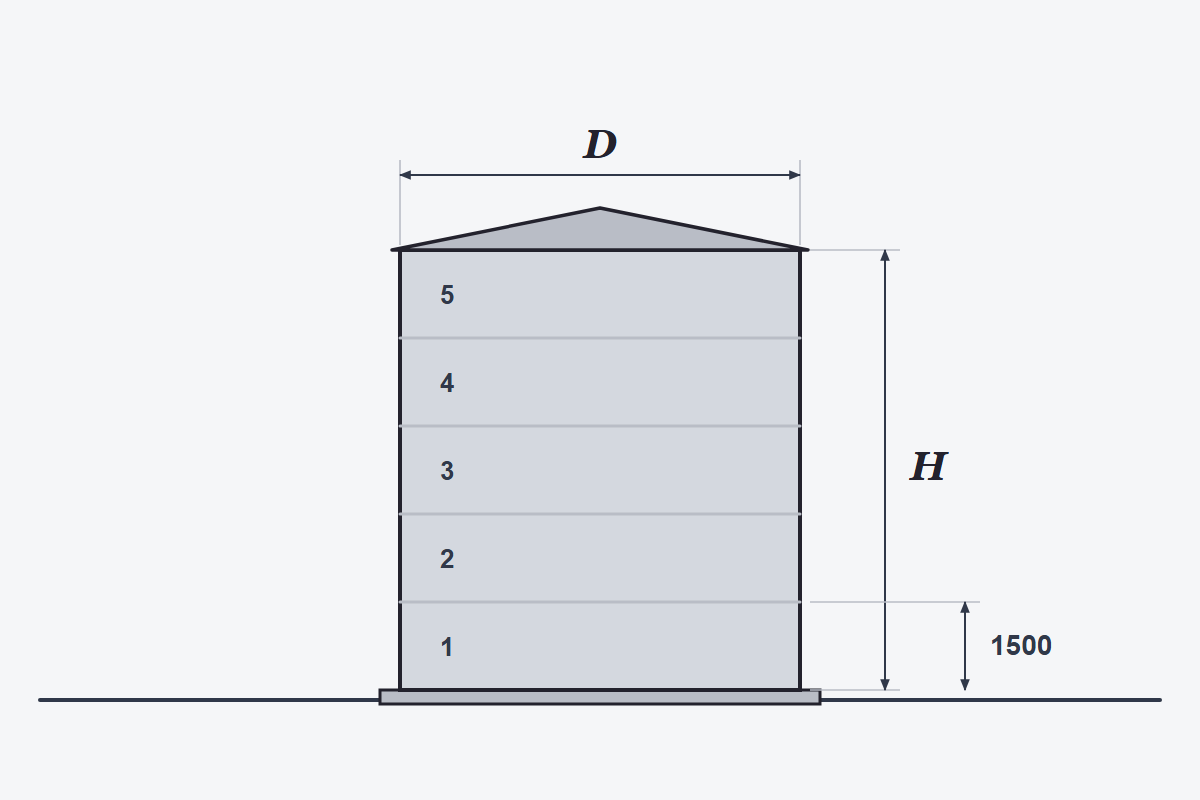
What diameter and height does a 100 m³ vertical tank need? Either 4.65 m across and 6 m tall or 4.15 m across and 7.5 m tall will do, and both hold the same. The chart gives two options like that for every capacity from 10 to 150 m³ (about 2,640 to 39,600 gallons).
| Capacity m³ | Diameter m | Shell height m | Geometric capacity m³ | 1.5 m courses | H/D | Shell m² | Bottom m² | Plate, sample weight kg |
|---|---|---|---|---|---|---|---|---|
| 10 | 2.10 | 3.0 | 10.4 | 2 | 1.43 | 19.8 | 3.5 | 1290 |
| 10 | 1.70 | 4.5 | 10.2 | 3 | 2.65 | 24.0 | 2.3 | 1400 |
| 20 | 2.95 | 3.0 | 20.5 | 2 | 1.02 | 27.8 | 6.8 | 1990 |
| 20 | 2.40 | 4.5 | 20.4 | 3 | 1.88 | 33.9 | 4.5 | 2090 |
| 30 | 2.95 | 4.5 | 30.8 | 3 | 1.53 | 41.7 | 6.8 | 2680 |
| 30 | 2.55 | 6.0 | 30.6 | 4 | 2.35 | 48.1 | 5.1 | 2850 |
| 50 | 3.80 | 4.5 | 51.0 | 3 | 1.18 | 53.7 | 11.3 | 3680 |
| 50 | 3.30 | 6.0 | 51.3 | 4 | 1.82 | 62.2 | 8.6 | 3850 |
| 75 | 4.00 | 6.0 | 75.4 | 4 | 1.50 | 75.4 | 12.6 | 4860 |
| 75 | 3.60 | 7.5 | 76.3 | 5 | 2.08 | 84.8 | 10.2 | 5120 |
| 100 | 4.65 | 6.0 | 101.9 | 4 | 1.29 | 87.7 | 17.0 | 5860 |
| 100 | 4.15 | 7.5 | 101.4 | 5 | 1.81 | 97.8 | 13.5 | 6060 |
| 125 | 4.65 | 7.5 | 127.4 | 5 | 1.61 | 109.6 | 17.0 | 6960 |
| 125 | 4.25 | 9.0 | 127.7 | 6 | 2.12 | 120.2 | 14.2 | 7240 |
| 150 | 5.05 | 7.5 | 150.2 | 5 | 1.49 | 119.0 | 20.0 | 7690 |
| 150 | 4.65 | 9.0 | 152.8 | 6 | 1.94 | 131.5 | 17.0 | 8050 |
Height goes up in 1.5 m steps, the width of the plate in each course. The diameter is solved from the capacity and rounded up to the next 5 cm, which is why the geometric capacity comes out a little higher. The H/D column runs from 1.02, a tank about as tall as it is wide, to 2.65 for the skinny 10 m³ option.
So which one? The site usually decides, more than the tank. The short option takes more ground and more foundation. The tall one frees up room next to it, but adds shell plate, and that is where most of the work goes.
If the order comes in tonnes, use the second chart. Vinasse measured at distilleries has a density of 1.015 to 1.018 (Revista Cubana de Química, 2019), and at 1.017, 150 tonnes come to about 148 m³. That fits the 150 m³ rows, and the 9 m tall one leaves more room on top.
| Capacity m³ | Water t (1.000 t/m³) | Diesel t (0.845 t/m³) | Vinasse t (1.017 t/m³) |
|---|---|---|---|
| 10 | 10.0 | 8.5 | 10.2 |
| 20 | 20.0 | 16.9 | 20.3 |
| 30 | 30.0 | 25.4 | 30.5 |
| 50 | 50.0 | 42.3 | 50.9 |
| 75 | 75.0 | 63.4 | 76.3 |
| 100 | 100.0 | 84.5 | 101.7 |
| 125 | 125.0 | 105.6 | 127.1 |
| 150 | 150.0 | 126.8 | 152.6 |
At Indumor we roll each course separately and set it on the one below. A 5.05 m tank is 15.87 m around, so with 6 m plates it takes three per course, and we stagger the vertical seams away from the ones in the course underneath. At 7.5 m tall that means five courses and fifteen rolled plates before the bottom and roof.
The chart weight is a sample, with a 6.35 mm (1/4 in) shell and bottom and a 4.76 mm (3/16 in) cone roof. Real thickness comes from the design calculation for the standard and the product. Liquid pressure rises with depth, so the lower courses usually end up thicker. At equal thickness the tall option weighs a bit more, 8,050 kg against 7,690 kg for the 150 m³ pair.
Vinasse leaves the still at 80 to 100 °C (ANA, Brazil, 2016). The usual basis is API 650 (14th edition, 2025), with Annex S for austenitic stainless and Annex M when the design temperature goes over 93 °C in carbon steel or 40 °C in stainless, as long as the buyer calls for them.
Full of water, the 150 m³ tank at 7.5 m tall weighs about 158 tonnes. That is the figure for the foundation, because during a hydrostatic test the tank is full of water and the flat bottom bears on its whole area.
Laid on a truck, the diameter becomes the width of the load, and past roughly 2.60 m it no longer travels assembled without a special permit in Argentina. Both 10 m³ options fit, plus the 20 m³ at 4.5 m and the 30 m³ at 6 m. From 50 m³ up, none do. We erect those at our plant or on your site, and ship them in sections when needed.
Picture your yard a few years out, with the plant bigger and a second tank next to the first. Picking the short or the tall option today decides whether that spot will be there. Once you have your numbers, we will get you a same-day quote, at factory-direct prices.
Sources: vinasse density, Revista Cubana de Química 32(2), 2019; outlet temperature, ANA (Brazil), 2016; API 650, Annexes S and M; steel, 7.85 kg/dm³; our own calculation.
Send us capacity, product and site: same-day quote, at factory-direct prices.
© Indumor 2010–2026 — Industrial steel fabrication, Córdoba, Argentina
