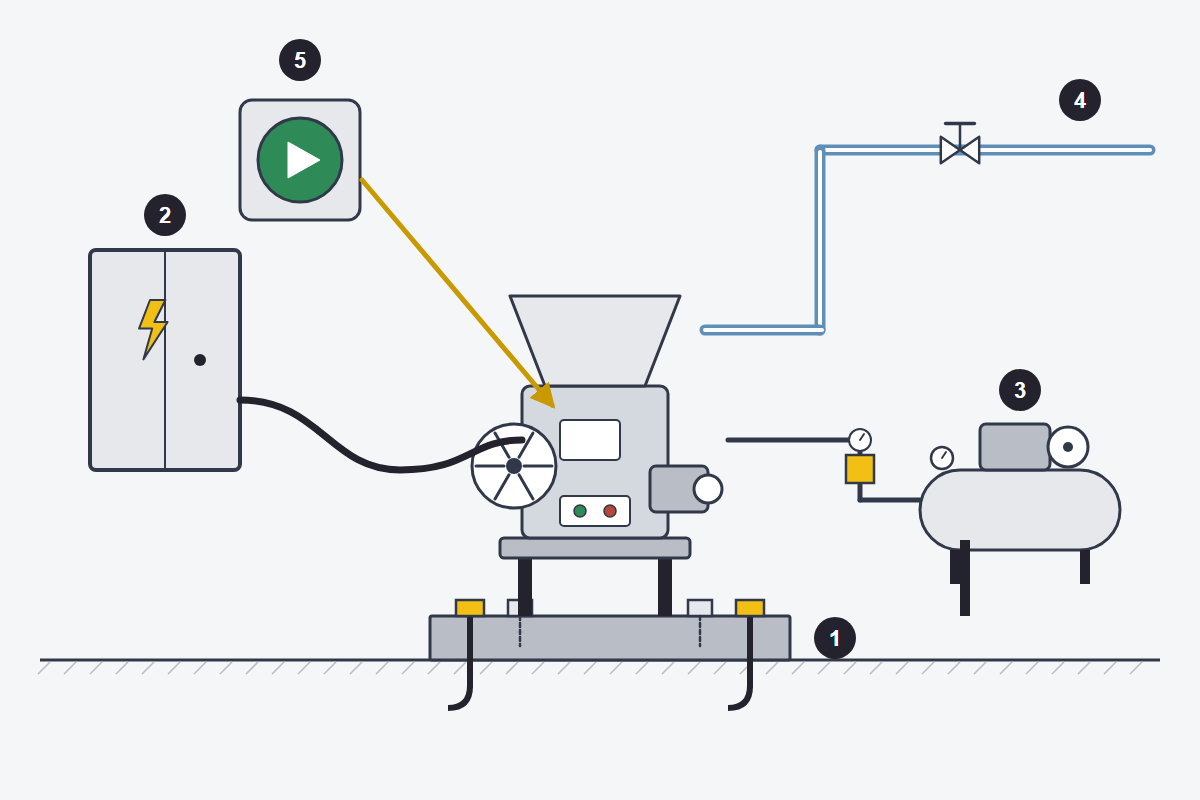
1 Base and leveling · 2 Power · 3 Compressed air · 4 Water or gas · 5 First start.
There is a widespread idea that a new machine arrives, gets plugged in and produces. On the plant floor something else happens. It arrives in crates, with a half-translated manual, no hydraulic oil, a control panel in another language and a technician who was supposed to come and never did. We see it all the time with Chinese machinery, with used equipment bought from another company and with whole lines that have been waiting in a warehouse for months.
At Indumor we make it run: inventory of what arrived, foundations and leveling, power, compressed air, water and gas hook-ups, whatever is missing gets fabricated in our plant in Córdoba, Argentina, and the start-up goes from cold checks to no-load to full load until it produces what it was bought to produce.
Request a quoteThe supplier got paid, the machine arrived and the technician never showed up. Step by step to start it anyway.
Read more →What the manual leaves out and what the supplier does not send: voltage, air, oil, PLC and contract.
Read more →Receiving, staged assembly, hook-ups and section-by-section start-up of a line that arrived in several containers.
Read more →Erection of imported pre-engineered buildings, with the local wind check and the parts the kit leaves out.
Read more →Bought from another company or at auction: dismantling, transport, a new foundation and start-up.
Read more →Bearings, oil, panels, the PLC battery and the drives: what to check before applying power.
Read more →Adapting the electrical and control side of an imported machine to the local grid and the plant.
Read more →Platforms, stairs, walkways, intermediate hoppers, ductwork and barriers that never come in the container.
Read more →What arrived, what is missing and in what condition, checked against the packing list. Which utilities the plant has and which it lacks: contracted power, compressed air, water, gas. That produces a staged plan and a list of what must be fabricated, bought or requested from the supplier.
Foundations, leveling and anchoring, mechanical assembly, and the structures, platforms and ductwork that get fabricated in our plant. Electrical work is done by a licensed electrician under Argentina's AEA rules, and automation by specialized partners. We coordinate the whole thing.
Cold checks, rotation with the coupling open, no-load running and then load, up to real production. Training for the people who will run it and as-built documentation, so the next shutdown is not a mystery.
Who starts a machine when the company that sold it no longer answers the phone? In our shop the first day of an installation always starts the same way: open the crates, count against the list, and remove the red-painted shipping brackets that, if nobody removes them, end up breaking something on the first start. Then comes what the supplier should have sent and did not: the wiring diagram, the parameters, the program backup.
What is missing gets rebuilt. Drawings, by survey; the PLC program, rewritten; the parts that never arrived, fabricated. And for the next purchase, the clauses that keep the story from repeating are in the guide the supplier got paid and vanished.
Read what to check before powering it up, then write to us with photos: we will get it running.
© Indumor 2010–2026 — Industrial steel fabrication, Córdoba, Argentina
