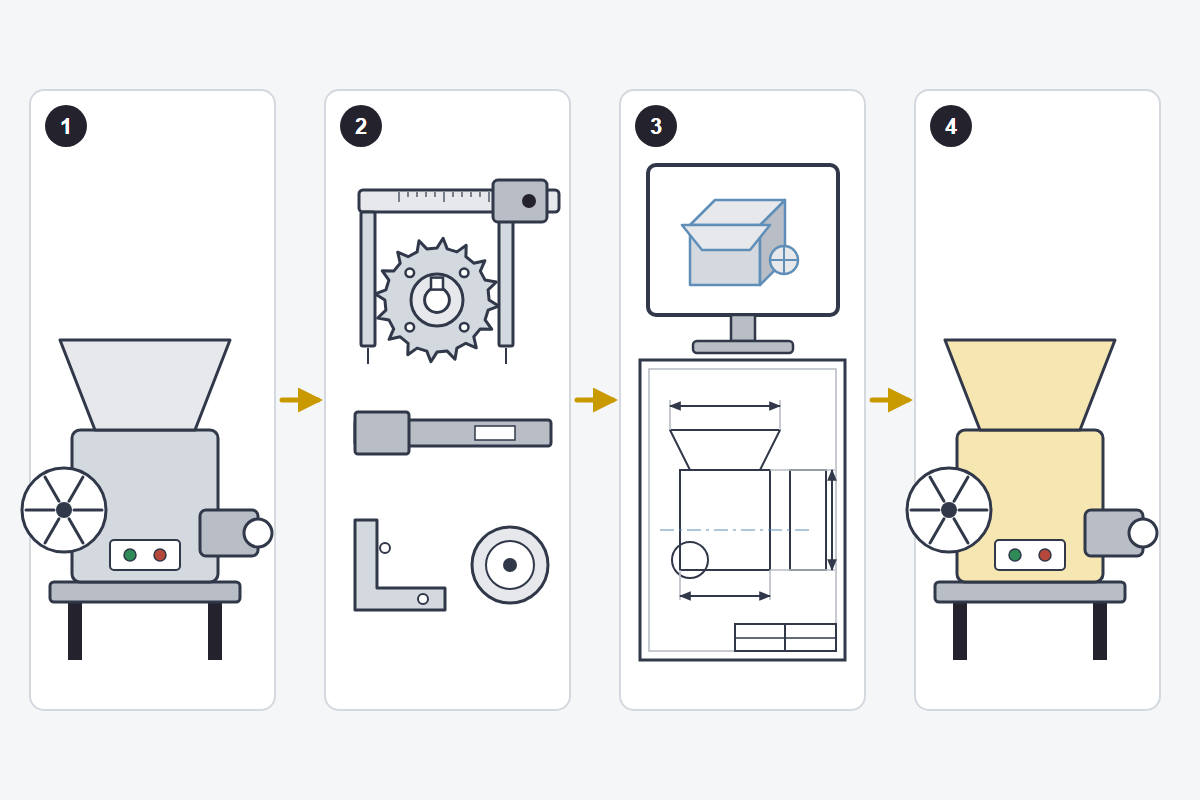
1 Original machine · 2 Measurement and teardown · 3 3D model and drawings · 4 Fabricated copy.
Or one nobody builds anymore, with a spare part you cannot find anywhere? That is reverse engineering: start from the part, the machine or the plant that already exists, measure it, understand it and build it again. No drawings needed, because we make the drawings.
At Indumor we run the whole process in our plant in Córdoba, Argentina: measurement with calipers, micrometers or a 3D scanner, 3D model and shop drawings, fabrication with laser cutting, press-brake bending, machining and welding, and assembly. Catalog items (motors, gearboxes, bearings, drives, PLCs) are bought as standard parts. Whatever cannot be sourced gets made.
Request a quoteTeardown, measurement, 3D model and fabrication of a machine identical to the one you already run.
How it is done →Shafts, gears, sprockets, bushings, blades and wear plates made from the original part.
Read more →When the maker is gone or the part takes six months by sea: copy, improve or redesign.
Read more →The machines plus everything between them: conveyors, hoppers, chutes, dust collection and structures.
Read more →Known steel grades, thicker wear parts, a variable-speed drive, guards, and none of the old patches.
Read more →Hoppers, conveyors, chutes, cyclones, drums, frames and buildings matching those of another plant.
See products →Surveys and as-built drawings of machines and equipment that never had documentation.
How we measure →We go where the machine is, or you bring it to our plant. Photos of every assembly, nameplates of motors and gearboxes, an orderly teardown with tags, and measurement with calipers, micrometers or a 3D scanner depending on the part. A machine with 180 different parts takes several days to strip; a hopper with its support frame, one morning.
3D model, shop drawings, a list of purchased components and a list of fabricated parts. This is where we decide what gets copied as is, what gets improved and what gets replaced by an off-the-shelf component. The control panel and the PLC program are designed from scratch.
Laser cutting, bending, machining, welding and painting in our plant in Ferreyra, Córdoba. Assembly, no-load and load testing, adjustments, and the drawings stay with you: the second unit comes out faster and cheaper than the first.
There is a habit we see often: taking pictures of the neighbor's machine on the sly and sending them over WhatsApp asking for "one just like it". Don't do it that way. Before we start we check whether the machine has a patent or a utility model in force in Argentina (patents run 20 years and utility models 10, counted from filing), and whether the owner gave you permission to survey it. What is already in the public domain, which is the vast majority of industrial machinery, can be built. Brands, logos and PLC programs are not copied: they are redesigned.
If you are unsure about your case, start with the guide on what you can legally copy. And if the machine is yours, bought legitimately and with no contract forbidding it, taking it apart to build another one is your right.
Read the cost guide, then send us photos and dimensions: we will tell you whether it pays to copy it, improve it or buy another.
© Indumor 2010–2026 — Industrial steel fabrication, Córdoba, Argentina
