Cloning a factory: what to survey to build an identical plant somewhere else

November 2, 2026  ·  Indumor
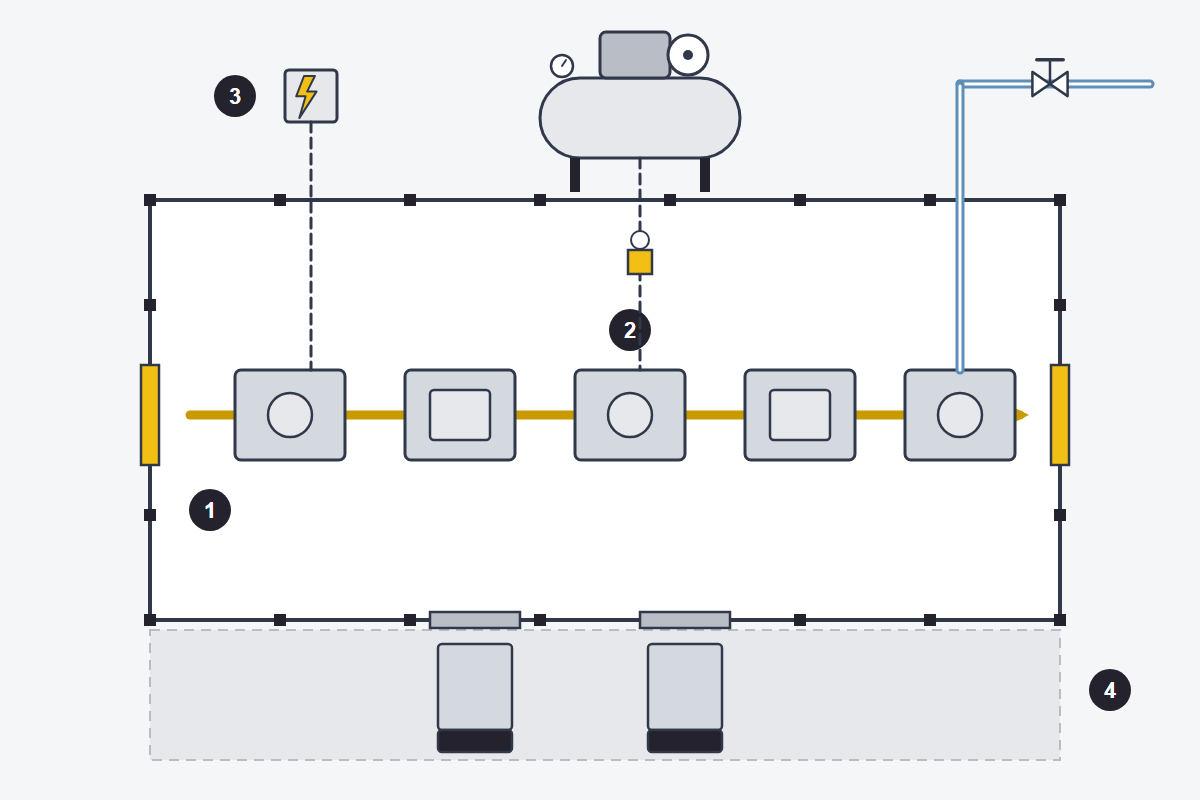
Diagram of a plant survey: material flow between machines, their capacities, the power, air, water and gas utilities, and the building with its access points

1 Material flow · 2 Machines and capacities · 3 Utilities: power, air, water, gas · 4 Building and access.

Survey (n.): the act of measuring, counting and recording what exists in a place so that it can be reproduced or changed. In a factory, the document that says which machines there are, where they stand, what they consume and what building holds them.

That is the trade dictionary. Our view is that the survey is the whole project, compressed onto paper. A running plant was cloned well when the person building it in another province never has to call back with a question, and cloned badly when two months in a machine turns up with nowhere to plug in. The difference between the two is the list below. It is long. Worth every line.

The list

  • Dimensioned layout. A plan of the plant with the position of every machine, the aisles, the stockpiles and the direction the material moves. If there is no drawing, it gets sketched by hand with a 50 m tape and cleaned up afterwards.
  • Material flow. Where it comes in, how many times it gets moved, where it waits and where it leaves. The waiting spots are where the square meters you will later be missing are hiding.
  • Machine list, one per line. A photo of every nameplate, with make, model, year, power, voltage, frequency and capacity. Whatever the plate does not say gets asked.
  • Consumption per machine. Real kilowatts, cubic meters of air per hour and at what pressure, liters of water, gas flow. That is what sizes the transformer, the compressor and the piping of the new plant.
  • Dust and fume extraction. Which hoods exist, what diameter the ducts are, which fan and which filter, and whether they work or are just decoration.
  • Material handling. Overhead crane and its capacity, height under hook, forklifts, pallet jacks. And the floors, what load they take and where they are broken, which is where the load was bigger than the floor.
  • The building. Bay width, clear height, doors and their sizes, loading docks, daylight, ventilation. If there is an overhead crane, the new building has to be designed for it from day one.
  • Yard and logistics. Where trucks park, where they turn, how much is stored outside and under what roof.
  • People per shift. How many run it, how many maintain it, and what they know how to do that is written down nowhere.
  • Bottlenecks. The machine that always has a queue in front of it. Write it down, because in the new plant that is the one worth upgrading or doubling.
  • What you cannot see. Recipes and process settings, suppliers of consumables and spares, the maintenance plan and the repeat breakdowns. None of this is measured with a tape, and without it the new plant runs at half speed.

One warning worth more than any drawing: survey the consumption with the plant producing, not on a Saturday with everything switched off. A compressor that copes at idle runs short on Monday at ten.

Four deliverables come out of that list. A dimensioned layout drawing. A machine list with nameplates and consumption. A utilities table per machine, which is what the electrician and the compressed-air contractor need. And a building specification, with bay width, height, doors and loads, which is what we need to quote the structure. With those four documents, building the second plant stops being a mystery and becomes a job with a bill of materials.

If you have already surveyed your plant, send it over and we will review it at no charge before you start asking for quotes. At Indumor we use it to quote the building, the structures and the custom equipment with an open takeoff, kilo by kilo. And if you have not done it yet, industrial reverse engineering explains how we go about it.

← Back to the Knowledge Hub

Keep reading

Copying a complete production line

What you buy and what gets fabricated between the machines.

Read guide →

Industrial reverse engineering

Survey, engineering and fabrication under one roof.

View service →

Already surveyed your plant?

Send it over and we review it at no charge before quoting.