November 24, 2026 · Indumor
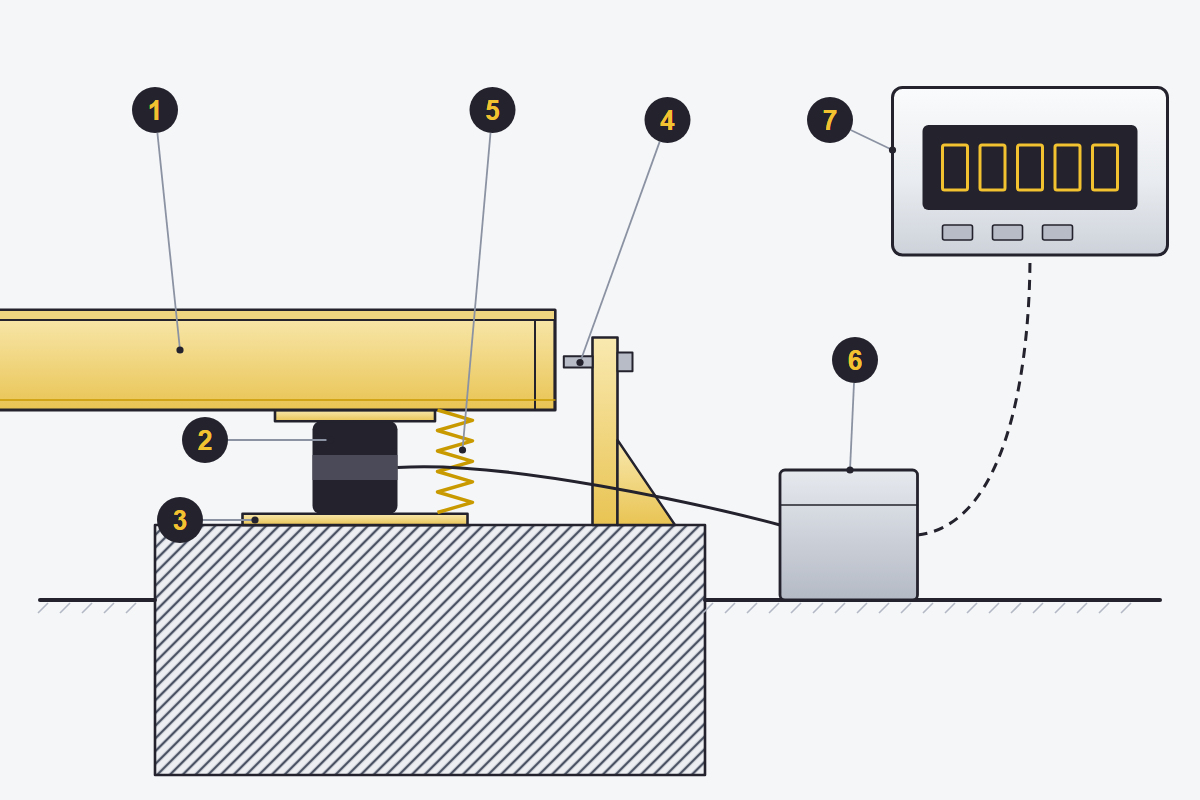
1, deck; 2, load cell; 3, mount and base plate; 4, check stop; 5, ground strap; 6, junction box; 7, indicator.
How does a weighbridge know what a 45 tonne truck weighs when nobody lifts it? The truck rests on the deck, the deck rests on a handful of load cells, and each cell bends a tiny bit and reports it as an electrical signal. The rest is the questions that come next, answered from the shop at Indumor, where we make the steel underneath all of that.
A steel body with strain gauges bonded to it. When the load bends the steel, the gauges change their electrical resistance and the cell sends out a small signal that rises with the weight.
The spec sheets name four families of strain gauge cells, besides hydraulic cells, which read oil pressure:
The hydraulic cell and the first three come from a US maker's load cell technical note, the last from an Indian buyer's guide. Per the spec sheets, each cell carries 23 to 50 t. And the C3 on a load cell data sheet doesn't mean 3 tonnes, however much the number invites it. It's accuracy class C under OIML R 60 with 3,000 divisions, and a C4 has 4,000. Our truck scale sizes guide lists how many cells each length takes.
Every cell's cable runs to the junction box, which combines the signals into one and sends it to the indicator in the scale house, where the ticket number shows up. A European spec sheet puts a surge protection circuit in the box. A US one prefers fiber-reinforced polyester with a membrane vent, because the stainless box, the one that looks more serious, builds up more condensation inside.
The deck, the load cell mounts with their base plates, the check stops and the embedded plates in the foundation. The deck has to be free to move just slightly, so all the weight goes through the cells and none goes anywhere else; NIST Handbook 44 requires clearance around the live parts so they don't touch under any load (Section 2.20, UR.2.4).
That's why the mount lets the cell work as a rocker pin, with no bolts tying it to the structure (a US maker), or sets it on swinging supports that cancel side forces (a European one, which also keeps its cells 35 cm, about 14 in, off the wall so they don't collect dirt).
Stiffness counts too. OIML R 76 calls for testing vehicle scales with the heaviest, most concentrated rolling load in normal use, placed at different points (clause 3.6.2.4). The Handbook calls the most a pair of axles 4 ft (1.22 m) apart can carry the CLC (Appendix D), and one US spec requires that, with that load at the center of a module, deflection mustn't push the scale out of tolerance.
They limit how far the deck can shift sideways and endways, say when a truck brakes on it. They have to be snug but keep a gap, empty and loaded, because in afternoon heat steel and concrete expand and a stop with no gap binds the deck (maintenance note from a US maker). Some designs self-center by gravity and use no stops or rods at all.
It's a braided copper strap from the structure to each cell's support, to carry a surge around the cell, with the whole scale grounded at a single point (a US maker's specification). Lightning worries the industry enough that another US maker tests its protection at 29,000 A. To a thunderstorm, a scale out in open country is the most interesting thing in the landscape.
It's counted in divisions, not percent. A 60 t scale with a 20 kg division has 3,000 divisions, which puts it in OIML R 76 class III, the range from 500 to 10,000 (Table 3). For that class the standard allows a new scale an error of ±10 kg up to 10 t, ±20 kg up to 40 t and ±30 kg up to 60 t, and twice that in service (clause 3.5). Minimum load is 20 divisions, 400 kg.
Why not a 10 kg division, which sounds finer? At 120 t that's 12,000 divisions, over the class limit. Big scales use 20 kg or two ranges; a European maker offers 10 kg up to 40 t and 20 kg from 40 to 80 t.
The scale company. We build the structure; load cells, indicator and setup are their side of the job, and we coordinate with them. If they bring their own deck drawings, we build from those.
The most cited cause is a stone or mud jammed between the deck and the foundation, holding back part of the weight that should reach the cells (US maintenance note). The rest is in our truck scale maintenance guide.
Would you send us the scale company's drawings, or the length and capacity you're after, so we can work out the structure together?
Sources: OIML R 76-1:2006, Table 3 and clauses 3.5 and 3.6.2.4; OIML R 60, load cell class designation; NIST Handbook 44, 2026 edition, Section 2.20, UR.2.4, and Appendix D, CLC definition; technical notes, specifications and buyer's guides from makers in the US, Europe and India, cited without brand names.
We build the deck, the load cell mounts and the check stops to their drawings or your dimensions, with a same-day quote.
© Indumor 2010–2026 — Industrial steel fabrication, Córdoba, Argentina
